
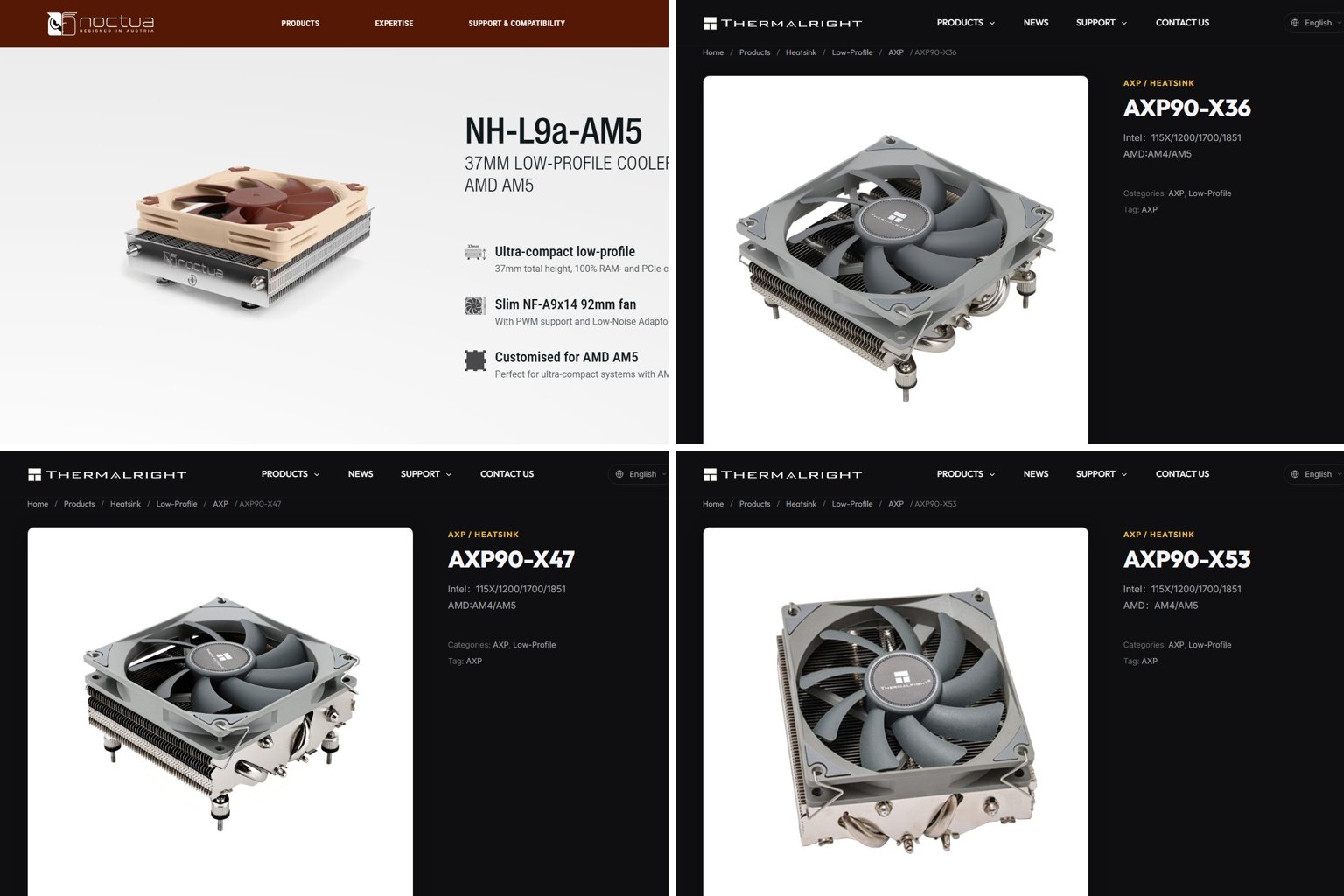
In a small case, a 2mm difference decides whether a low profile CPU cooler fits. This guide sorts the best options by height (37, 47, 53, 65 and 67-77mm) and checks each one for AM5 and LGA1851 support and for how much CPU power it can really handle. Last checked November 16, 2026.
Key takeaways
- Choose by your case’s measured CPU cooler limit in mm first. Brand comes second.
- Check whether a listed height includes the fan. Retailers often quote the heatsink alone.
- Confirm AM5 or LGA1851 support on the exact SKU and mounting kit, not just the listing title.
- A Ryzen 7 9800X3D says 120W TDP but draws up to 162W at stock, so coolers under 53mm need a power limit.
- Coolers that sit flat over the CPU blow air down onto the VRMs and M.2 drive, which helps in cramped ITX boards.
Fact-checked
We checked these key facts against the sources named, on November 16, 2026:
- ID-Cooling’s official page lists LGA1851/1700/1200/115x and AM5/AM4 (source: idcooling.com)
- The ID-Cooling IS-40X V3 (45mm) is a cheap backup that officially lists LGA1851 and AM5 (source: idcooling.com)
- The Noctua NH-L9i-17xx (37mm, LGA1700/1851/1954) for 65W chips, and the NH-L12Sx77 for higher-power Core Ultra 200S chips (source: noctua.at)
- It’s the best-documented LGA1851 option at this height. – IS-55: 57mm on most listings (one spec table says 55mm), five heat pipes and a 120x120x15mm fan (source: ypc.co.uk)
Quick answer: the best low profile CPU cooler for your height limit
Find your case’s maximum CPU cooler height and buy the strongest cooler that fits with 1-2mm to spare. One pick per height tier covers almost every small build:
| Height limit | Pick | Why |
|---|---|---|
| 37-40mm | Noctua NH-L9a-AM5 (AMD) or NH-L9i-17xx (Intel) | 37mm with fan, quiet NF-A9x14 fan, correct mounting out of the box |
| 45-48mm | Thermalright AXP90-X47 (X47 Full if you can stretch the budget) | 47mm, four 6mm heat pipes, very cheap |
| 53-57mm | Thermalright AXP90-X53 or X53 Full | 38mm heatsink plus a 15mm fan, the strongest 92mm option at this height |
| 65-69mm | Noctua NH-L9x65 (quietest) or Thermalright AXP120-X67 (cheaper, stronger) | The jump to a bigger heatsink or a 120mm fan |
| 70-77mm+ | Noctua NH-L12S (70mm) or NH-L12Sx77 (77mm heatsink) | NSPR 88 and 100, the best low-profile air coolers for 105-120W chips |
The picks are based on official maker specs (total height, heat pipes, fan size, RAM clearance and socket lists), Noctua’s NSPR ratings, published vendor TDP figures, current US pricing and known compatibility problems reported by retailers and the small form factor community. Fitting your case and handling your CPU’s power count most. Noise comes next, then price.
Best overall for most small cases
The Thermalright AXP90-X53 suits the most popular SFF cases. At 53mm it fits the FormD/Ncase T1 in its 3-slot setup, the Lian Li Dan A4-H2O (55mm limit) and the Fractal Terra at its 53mm spine position. Its four 6mm heat pipes and 38mm heatsink give you real headroom over 37mm coolers. If your case allows 53mm, start here.
Best budget low profile cooler
The Thermalright AXP90-X47 sells for about $22-30 at US retailers. It handles any 65W chip comfortably, and Thermalright rates it at 135W. Expect the slim fan to be loud at full speed, so it needs a fan curve (covered below).
Best for 47mm-limit cases
Choose the AXP90-X47, or the AXP90-X47 Full all-copper version if you run a Ryzen X3D chip. The be quiet! Pure Rock Low Profile (45mm) is the quieter, more expensive option. The ID-Cooling IS-40X V3 (45mm) is a cheap backup that officially lists LGA1851 and AM5.
Best for a Ryzen 7 9800X3D in SFF
If your case takes 77mm or more, get the Noctua NH-L12Sx77 (NSPR 100). At 70mm, the NH-L12S (NSPR 88) or the AXP120-X67 at 67mm are next best. Under 55mm, the AXP90-X53 Full plus a lower power limit or a negative Curve Optimizer works well for gaming. AMD itself recommends liquid cooling for this chip, so a 240mm AIO is worth a look if your case has the radiator space.
Low profile CPU coolers compared (official specs)
Total height includes the stock fan in its standard position. Where a maker doesn’t publish a figure, the cell shows a dash, never a guess.
| Cooler | Total height (mm) | Heatsink-only height | Heat pipes | Fan | RAM clearance | Sockets (maker/listing) | Rating (NSPR / vendor TDP) | Best for |
|---|---|---|---|---|---|---|---|---|
| Thermalright AXP90-X36 | 36 | – | – | 92mm slim | No overhang class | AM4, AM5, LGA1150/1151/1200/1700/1851 | – | Ultra-slim cases, 65W chips |
| Noctua NH-L9a-AM5 | 37 | 23 | – | NF-A9x14 (92x14mm) | Low-profile design, 114mm wide | AM5 (AM4 version sold separately) | NSPR 61 | Quiet AMD HTPC |
| Noctua NH-L9i-17xx | 37 | 23 | – | NF-A9x14 (92x14mm) | Inside Intel keep-out zone (95x95mm) | LGA1700, LGA1851, LGA1954 | NSPR 59 | Quiet Intel HTPC |
| be quiet! Pure Rock Low Profile | 45 | 30 | 3 x 6mm | 92x15mm, 2,500 RPM | Compact 92mm footprint | AM4, AM5, LGA1700/1200/115x | 100W | Quieter 47mm-class pick |
| ID-Cooling IS-40X V3 | 45 | – | 4 | 92mm, 15mm slim | Compact 92mm footprint | AM4, AM5, LGA1700/1851/1200/115x | – | Budget 47mm cases |
| Thermalright AXP90-X47 / X47 Full | 47 | about 32 (47 minus the 15mm fan) | 4 x 6mm | TL-9015 92x15mm | Compact 92mm footprint | AM4, AM5 (check kit), LGA1700/1200/115x | 135W (X47) | 47-48mm limits, budget |
| Thermalright AXP90-X53 / X53 Full | 53 | 38 | 4 x 6mm | 92x15mm | Compact 92mm footprint | AM4, AM5, LGA1700/1200/115x | 150W (X53 Full) | Best overall at 53mm |
| ID-Cooling IS-55 | 57 (some listings say 55) | – | 5 | 120x120x15mm | Overhangs DIMMs | AM4, AM5, LGA1700/1200/115x (LGA1851 on some listings) | – | 57mm+ cases on a budget |
| Noctua NH-L9x65 | 65 | about 51 | – | NF-A9x14 (92x14mm) | No overhang class | AM4, AM5, LGA1700/1851 (by kit) | NSPR 67 | Quiet 65mm slim cases |
| Thermalright AXP120-X67 | 67 | – | 6 | TL-C12015 120x15mm (ARGB versions) | Overhangs DIMMs | AM4, AM5, LGA1700/1200/115x | – | Cheap and strong at 67mm |
| ID-Cooling IS-67-XT | 67 | – | – | 120mm | Overhangs DIMMs | AM4, AM5, LGA1700/1200/115x | – | Alternative to AXP120-X67 |
| Noctua NH-L12S | 70 (fan under fins) | – | 4 | NF-A12x15 (120x15mm) | 35mm (fan under) / 51mm (fan on top) | AM4, AM5, LGA1700/1851 (by kit) | NSPR 88 | 70mm cases, 105W chips |
| Noctua NH-L12Sx77 | 77 heatsink with fan under, 93 with fan on top | 77 | 6 | NF-A12x15 (120x15mm) | 44mm (low-profile mode) / 56mm (high-clearance mode) | AM4, AM5, LGA1700/1851 | NSPR 100 | 9800X3D in roomier SFF cases |
Noctua’s NSPR (Noctua Standardised Performance Rating) is a relative score that compares Noctua coolers with each other. Thermalright’s and be quiet!’s watt figures are the makers’ own claims, not independent tests. You can compare an NSPR with another NSPR, and you can loosely compare vendor TDP claims with each other. Don’t treat 135W from one brand and NSPR 67 from another as the same kind of number.
Step 1: Measure what fits (height, RAM, VRM)
The figure that matters is your case’s maximum CPU cooler height, measured from the top of the CPU’s heat spreader to the side panel or GPU backplate. Pick a cooler at least 1-2mm under that limit. Then check two side conflicts: tall RAM under an overhanging cooler, and motherboard VRM or M.2 heatsinks under the fins.
Total height vs heatsink-only height
Total height is heatsink plus fan, and that’s the number to compare with your case limit. The two can differ a lot. The Thermalright AXP90-X53’s heatsink is only 38mm. The 15mm slim fan brings it to 53mm.
Noctua’s NH-L12Sx77 is the classic trap. Retailers often list 77mm. That is the heatsink with the fan mounted underneath the fins. With the fan on top, Noctua’s spec page says 93mm. With a 25mm-thick 120mm fan on top, it reaches about 102mm. Same cooler, three heights.
Measure your real clearance
Hold a steel ruler on the CPU’s heat spreader (or on the motherboard socket if the CPU isn’t fitted yet) and measure up to the inside of the side panel. Subtract 1-2mm for thermal paste, mounting tolerance and panel flex before you choose a tier.
RAM clearance and low-profile DIMMs
Coolers with a 92mm footprint (all the AXP90 models, the NH-L9 series, the Pure Rock Low Profile) usually stay clear of the memory slots. The 120mm coolers overhang the DIMMs, so RAM height becomes a real limit.
Noctua publishes exact figures. The NH-L12S leaves 35mm under the fins with the fan underneath, or 51mm with the fan on top. The NH-L12Sx77 leaves 44mm in low-profile mode and 56mm in high-clearance mode.
Did you know?
According to Noctua’s RAM clearance FAQ, moving the fan on the NH-L12Sx77 changes RAM clearance from 44mm to 56mm. The same cooler can fit or block tall RAM depending on how you mount it.
So do you need low-profile RAM with the NH-L12S? In low-profile mode with only 35mm of clearance, yes. Corsair Vengeance LPX-class modules at around 31mm fit, but most RGB kits with tall heat spreaders don’t. Mount the fan on top and you get 51mm, which fits most memory, at the cost of total height.
The AXP120-X67, ID-Cooling IS-55 and IS-67-XT also overhang the RAM. If you want those, plan on low-profile DIMMs.
VRM heatsinks and M.2 heatsinks
ITX boards pack big VRM heatsinks and M.2 shrouds right next to the socket. A wide cooler base or a low fin stack can hit them. This is the problem the NH-L12Sx77 was designed to fix: Tom’s Hardware’s launch coverage notes it was built for better clearance over RAM and VRM heatsinks than the NH-L12S.
These coolers also help that area. A low-profile cooler blows its fan down at the board, so air washes over the VRMs, the M.2 drive and the chipset heatsink. In a small case without a motherboard fan, that’s a real bonus over a tower cooler or an AIO.
Case clearance lookup table
Here are the published CPU cooler limits for popular SFF and slim cases, with the tiers from this guide that fit.
| Case / configuration | Max cooler height | Tiers that fit |
|---|---|---|
| FormD (Ncase) T1, 3.25-slot GPU setup | 48mm | 37mm, 45-47mm |
| FormD (Ncase) T1, 3-slot GPU setup | 53mm | 37mm, 47mm, 53mm (no margin) |
| Lian Li Dan A4-H2O | 55mm | 37mm, 47mm, 53mm |
| Fractal Terra, spine position 6 | 53mm | 37mm, 47mm, 53mm (no margin) |
| Fractal Terra, spine position 7 | 48mm | 37mm, 45-47mm |
| Fractal Ridge | 70mm | Everything up to NH-L12S (70mm, zero margin); AXP120-X67 and NH-L9x65 with room to spare |
The Fractal Ridge row matters for anyone eyeing the NH-L12Sx77. Its 77mm heatsink is over the Ridge’s 70mm limit, and Tom’s Hardware flagged the Ridge as a case where the Sx77 could run into clearance trouble. In a Ridge, the AXP120-X67 (67mm) or NH-L9x65 (65mm) is the safer buy. The NH-L12S at exactly 70mm leaves no margin for error.
Step 2: Check your socket (AM4, AM5, LGA1700, LGA1851)
Socket support depends on the exact SKU and the mounting kit in the box, and listing titles for the same cooler often disagree. Confirm AM5 or LGA1851 on the maker’s own spec page before buying, and check whether older stock needs a separate kit.
AMD AM5 and AM4
AM5 and AM4 use the same cooler hole spacing, but the stock backplates and retention parts differ, so a cooler needs the right standoffs and screws.
- Noctua NH-L9a: Noctua sells separate versions. The NH-L9a-AM5 is the one for Ryzen 7000/8000/9000 boards. The older NH-L9a-AM4 is for AM4. Don’t buy the AM4 version for an AM5 build because it’s cheaper on clearance.
- Thermalright AXP90 series: Early AXP90-X47 stock was AM4 and Intel only. Thermalright released an AM5 upgrade kit (a fixing frame, plastic posts and longer screws) that buyers had to request by email. Current listings include AM5, but old stock still turns up.
- Alpenföhn Black Ridge: This 47mm cooler used to be the community favourite. A PSA on the smallformfactor.net forum warns that the Black Ridge seems to be dead for AM5, with compatibility disputed. Don’t plan an AM5 build around it.
So will the AXP90-X47 fit AM5, or do you need the newer version with longer screws? Check the box contents or listing for AM5 hardware. If your unit came without AM5 parts, you need Thermalright’s AM5 kit. If the 47mm Black Ridge is out, the AXP90-X47 (with AM5 hardware), the be quiet! Pure Rock Low Profile and the ID-Cooling IS-40X V3 are the alternatives at 45-47mm.
Intel LGA1700 and LGA1851
Intel’s LGA1851 (Core Ultra 200S, such as the Core Ultra 5 225 or Core Ultra 9 285K) uses the same cooler mounting layout as LGA1700. In practice, a cooler with an LGA1700 kit generally fits LGA1851 too. Makers list LGA1851 explicitly as they update their pages.
Noctua’s NH-L9i-17xx spec page lists LGA1700, LGA1851 and LGA1954. ID-Cooling officially lists LGA1851 for the IS-40X V3. LGA1851 shows up on some IS-55 listings but not all, and none of the IS-67-XT listings in current results mention it. For any Thermalright model on LGA1851, the LGA1700 kit is what you’re relying on. Check that it’s in the box.
Older LGA1200/115x coolers without a 1700-class kit won’t mount on these boards. That rules out a lot of cheap old stock.
Reading Amazon listings without getting burned
Amazon titles for the same cooler disagree. Some AXP90-X53 listings omit AM5. Some AXP120-X67 titles list AM4 and AM5 while others don’t. Height filters in inches are too coarse to separate a 47mm cooler from a 53mm one.
Buy from a listing that names your socket
Buy from the maker’s official store or a listing that names your socket explicitly (AM5 or LGA1851). Then check the box for that socket’s standoffs before you take the motherboard out of the case.
Step 3: Match the cooler to your CPU’s real power draw
TDP labels understate what modern CPUs draw at stock settings. A 65W chip is easy for any cooler here. A 120W Ryzen X3D draws more than its label says and needs either a 53mm-or-taller cooler or a power limit. Noctua’s NSPR and vendors’ wattage claims are rough guides, not guarantees.
Did you know?
AMD’s spec page lists the Ryzen 7 9800X3D at 120W TDP and 95°C max temperature, but a LANOC launch review measured its default socket power limit (PPT) at 162W. A cooler rated for 120W can still struggle at stock.
AMD sells the 9800X3D without a cooler and recommends liquid cooling. That doesn’t mean air can’t work. It means a 37mm or 47mm cooler at stock settings will let the chip hit its temperature limit and boost lower.
Noctua is unusually blunt about limits. It says the 65mm NH-L9x65 isn’t suited to overclocking and should be used with care on CPUs above 100W TDP, even though some retailer listings claim far more. It warns that the NH-L9i-17xx isn’t suitable for CPUs with high heat loads. Thermalright’s 135W (X47) and 150W (X53 Full) ratings are vendor claims. Treat them as best-case numbers.
Which cooler tier for which CPU
| CPU type / example | Rated power | Minimum sensible tier | Tuning needed? |
|---|---|---|---|
| Ryzen 5/7 non-X (e.g. Ryzen 5 9600, Ryzen 7 7700) | 65W TDP | 37mm (NH-L9a-AM5) | No |
| Intel Core i5 non-K / Core Ultra 5 225 | 65W base power | 37mm (NH-L9i-17xx) | No; set long-duration turbo limits if temps climb |
| Ryzen 7 7800X3D | 120W TDP | 47mm with tuning; 53mm+ preferred | At 47-53mm, a negative Curve Optimizer helps |
| Ryzen 7 9800X3D | 120W TDP, 162W default PPT | 53mm (X53 Full) with tuning; 70mm+ (NH-L12S/Sx77) for stock | Yes below 67mm |
| Intel K-series (e.g. Core Ultra 9 285K) | 125W base, up to 250W turbo | 70mm+ and a power limit, or an AIO | Yes, always in SFF |
65W CPUs (Ryzen 5/7 non-X, Core i5 non-K)
Any cooler in this guide handles a 65W chip. Pick on height and noise. The Noctua NH-L9a-AM5 and NH-L9i-17xx are built for this job: quiet HTPCs, slim office PCs and ITX boxes in an entertainment unit. The AXP90-X36 is the cheaper Thermalright route at 36mm, with a louder fan.
X3D and K-series chips in small cases
These chips are where low-profile cooler choice gets serious. The 7800X3D and 9800X3D game well on small coolers because games rarely load all eight cores fully. Rendering, compiling or a stress test will push them to their limit.
Competitor tests show how far tuning goes. One widely cited ultra-low-profile shootout ran a 7800X3D at a 76.7W limit with Curve Optimizer -20 to keep 37-53mm coolers in range. With that tuning, gaming performance barely changes. Intel K-series chips running at full turbo in an SFF case are better served by the NH-L12Sx77 with a power limit or by an AIO.
Simple power-limit settings that make small coolers work
Two BIOS settings do most of the work on Ryzen. Menu names vary by board maker, but on ASUS, MSI and Gigabyte AM5 boards both sit under the AMD Overclocking or Precision Boost Overdrive section.
- Curve Optimizer (negative, all-core): Start at -10 and test for stability with your usual games. Many chips run -15 to -20. It lowers voltage, which cuts heat without cutting clocks much.
- PPT limit (PBO Limits set to Manual): Set PPT to around 88W for 37-47mm coolers, or around 110W for 53mm coolers. AMD’s Eco Mode presets are the easy version of this.
- Intel: Set the long-duration power limit (PL1) and short-duration power limit (PL2) in the board’s CPU power management menu. Something like 95W/125W suits a 70mm cooler in a small case.
Tune an X3D chip for a small cooler
On a Ryzen 9800X3D or 7800X3D with a 47-53mm cooler, set a lower PPT or a negative Curve Optimizer in the BIOS. You’ll lose a sliver of all-core performance and keep nearly all your gaming FPS.
The best low profile CPU coolers in 2026, reviewed
Each mini-review covers the official specs, who the cooler suits, who should skip it and how it compares with the closest alternative. Prices are current US street prices or official MSRPs where published.
Noctua NH-L9a-AM5 / NH-L9i-17xx (37mm)
These are the quiet 37mm option for AMD and Intel. Each stands 37mm with its fan and 23mm without, uses Noctua’s NF-A9x14 PWM fan (600-2,500 RPM) and accepts 92x92x14 or 92x92x25mm fans. The NH-L9a-AM5 is rated NSPR 61 and is 114mm wide. The NH-L9i-17xx is rated NSPR 59 and stays inside Intel’s 95x95mm socket keep-out zone, which means no RAM or VRM conflicts.
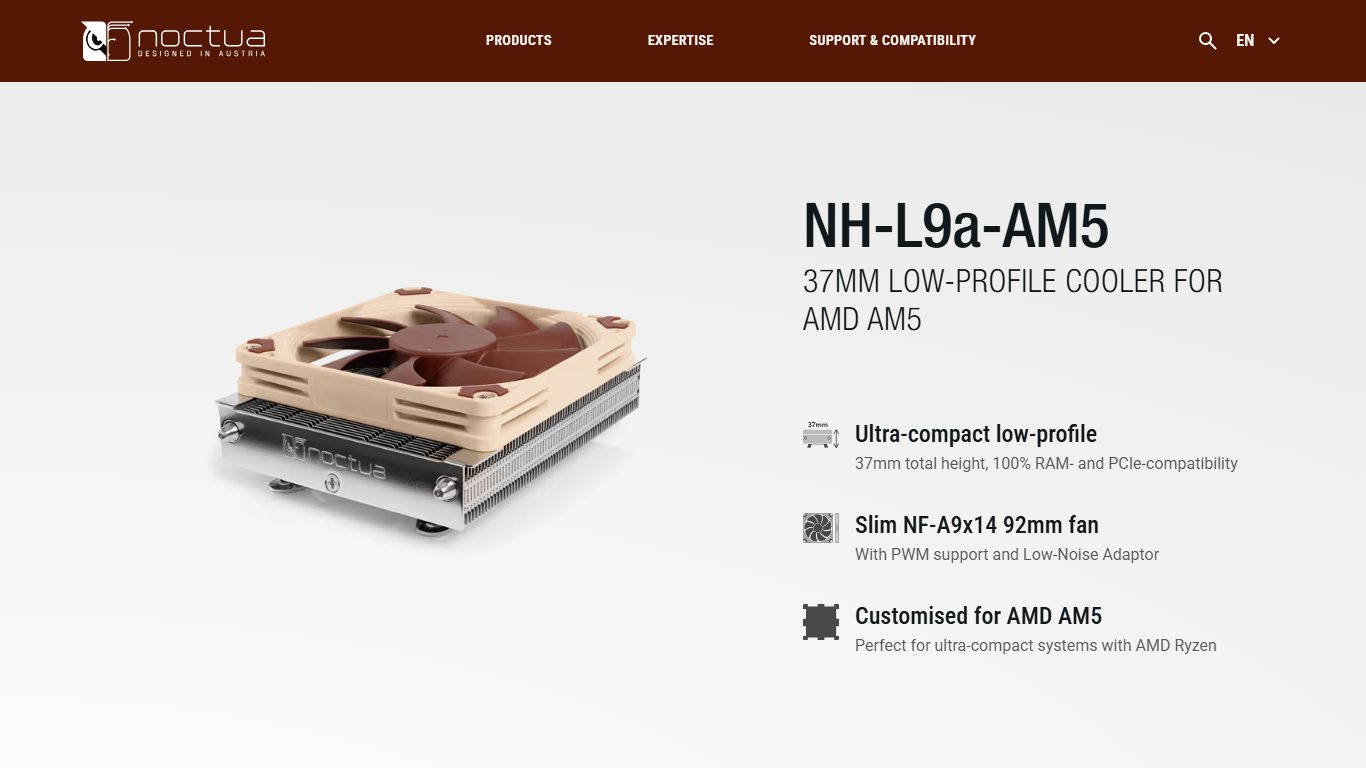
Price tier: Noctua’s entry low-profile tier, priced well below the NH-L12S family. chromax.black versions cost a little more.
Who it suits: 65W CPUs in HTPCs, slim office PCs and very tight ITX cases. The NF-A9x14 is noticeably quieter than Thermalright’s slim fans at the same speed, and Noctua’s six-year warranty and mounting quality are the best in this group.
Skip it if: You run a 9800X3D or a K-series chip at stock. Noctua itself says these aren’t for high heat loads.
vs AXP90-X36: The Thermalright is 1mm shorter and cheaper. The Noctua is quieter and, on AMD and Intel, comes as dedicated socket versions with correct hardware.
Upgrade path: Swap in a 25mm NF-A9 and the 23mm heatsink plus the thicker fan comes to just under 50mm. You get lower noise at the same cooling, but the cooler moves into the 47-53mm tier.
Thermalright AXP90-X36 (36mm)
This is the budget ultra-slim option. At 36mm it’s the shortest cooler here, and current listings name AM4, AM5 and LGA1150/1151/1200/1700/1851. It suits 65W chips in cases where even 37mm is tight.
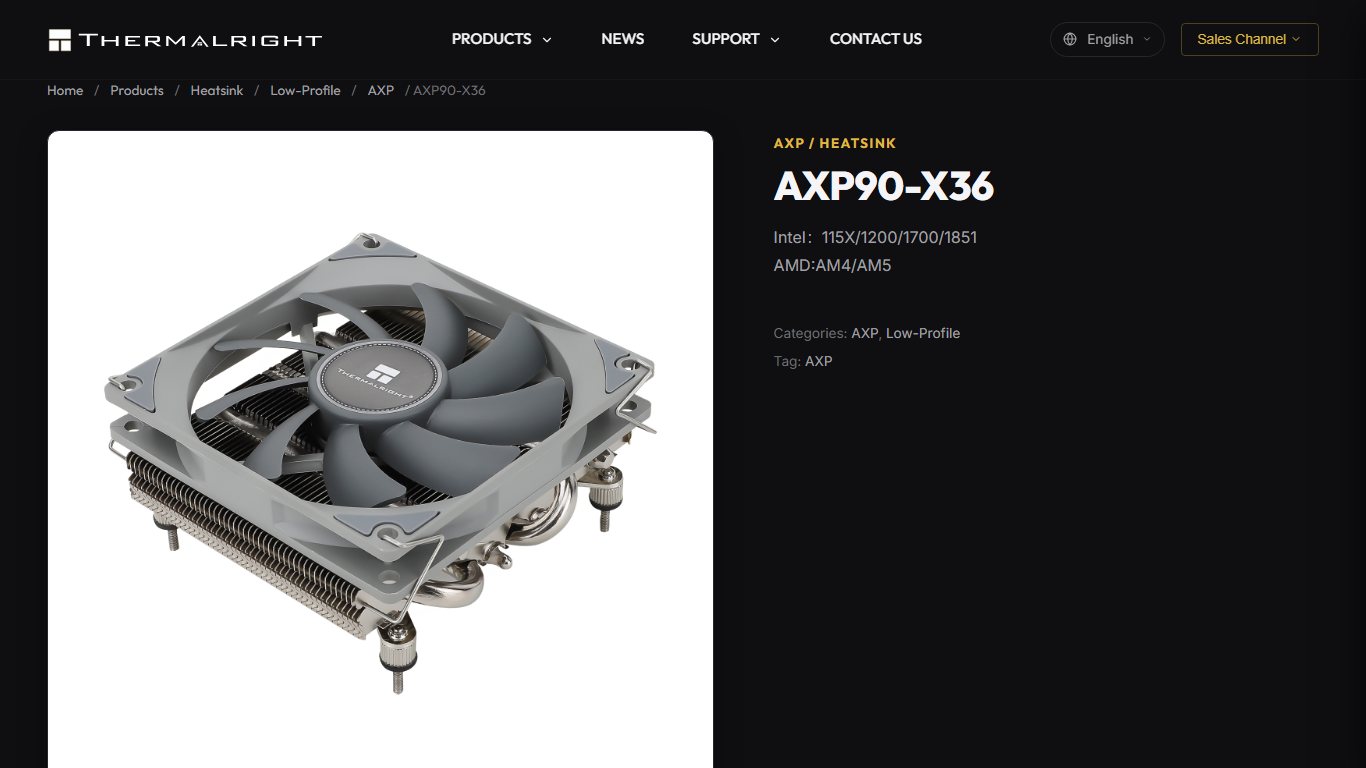
Who it suits: Budget slim builds and DeskMini-style systems running 35-65W chips.
Limitations: The slim fan gets loud under load, and a thin heatsink has little thermal mass for bursty boost loads. Thermalright doesn’t publish a meaningful TDP figure for it in the listings checked.
vs NH-L9a-AM5: Cheaper and 1mm shorter. The Noctua is quieter and better documented.
Thermalright AXP90-X47 and X47 Full (47mm)
This is the budget pick for 45-48mm limits. It stands 47mm tall with four 6mm heat pipes and a TL-9015 92x15mm PWM fan. Thermalright rates it at 135W (a vendor claim). It’s one of the more affordable coolers here.
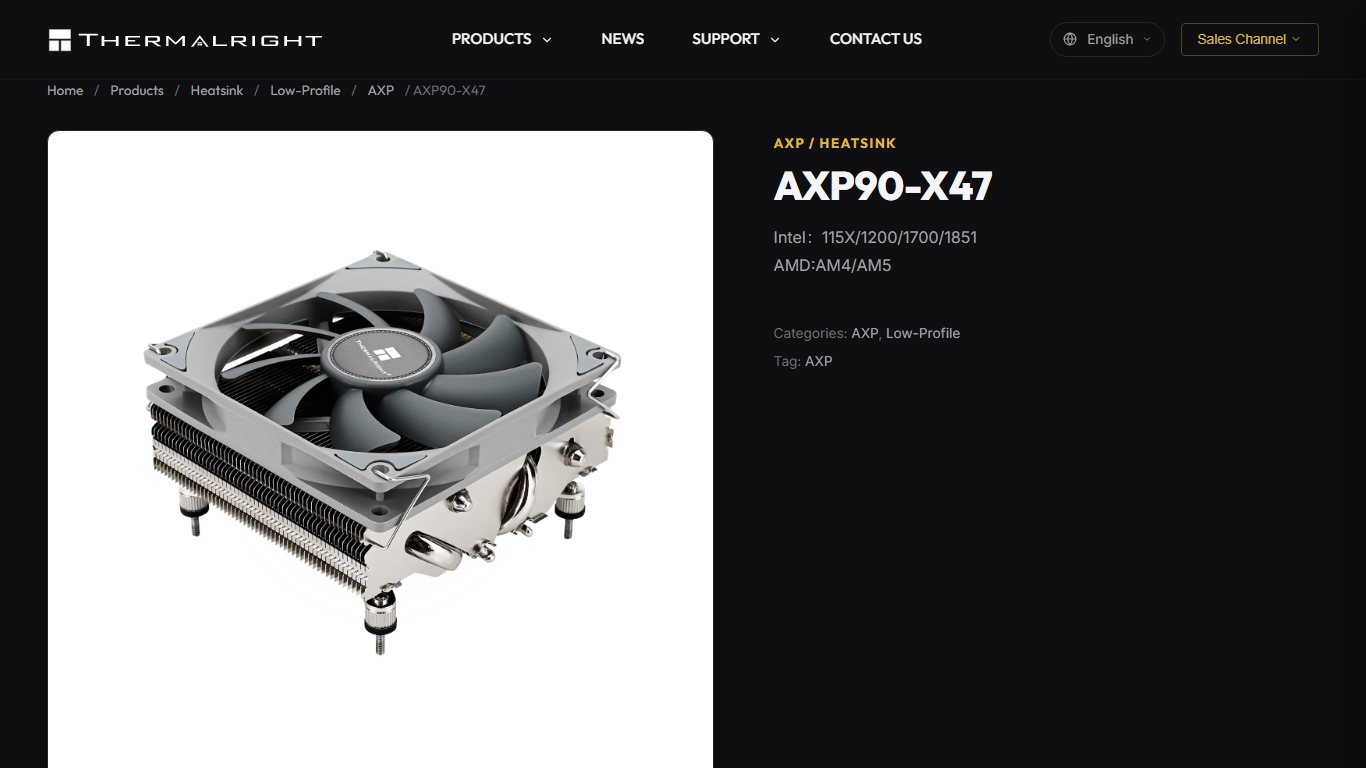
Who it suits: Cases with a 47-48mm limit, such as the Terra at its 48mm position.
Full copper vs aluminium: The X47 Full uses a full-copper heatsink. Copper holds and spreads heat better, so it soaks up short boost spikes and runs a little cooler under sustained load, at a higher price and weight. For a 65W chip, the aluminium version is enough. For an X3D chip at 47mm, the Full is worth paying for.
Limitations: The fan is loud at full speed. Old stock may lack AM5 hardware (see Step 2).
vs be quiet! Pure Rock Low Profile: The X47 has one more heat pipe, a higher vendor rating and a much lower price. The be quiet! is 2mm shorter and quieter at full speed.
X47 vs X53, is 6mm of extra height worth it? Yes, if your case allows it. The X53’s heatsink is 38mm against roughly 32mm on the X47, with the same fan. That extra fin area matters most on 105-120W chips.
be quiet! Pure Rock Low Profile (45mm)
This is the quieter 47mm-class option. be quiet! lists it at 45mm total, made up of a 30mm heatsink and a 15mm 92mm PWM fan with a 2,500 RPM maximum. It has three 6mm heat pipes and a 100W TDP rating. be quiet! quotes 13.3, 23.8 and 30.6 dB(A) at 50, 75 and 100% fan speed. A UK retailer listing names AM4, AM5 and LGA1700/1200/115x.
Price: Recommended retail price of €49.90 in Europe. In the US it typically sits above the AXP90-X47.
Who it suits: A 65W build in a 45-48mm case where noise matters more than headroom.
Skip it if: You run an X3D chip. Three heat pipes and a 100W rating leave little margin.
Thermalright AXP90-X53 and X53 Full (53mm)
This is the best overall pick for small cases. Thermalright’s product page lists a 38mm heatsink, four 6mm heat pipes and 53mm total height with its 15mm 92mm fan. The X53 Full (all copper) carries a 150W vendor rating, the highest claim for any 92mm cooler here.
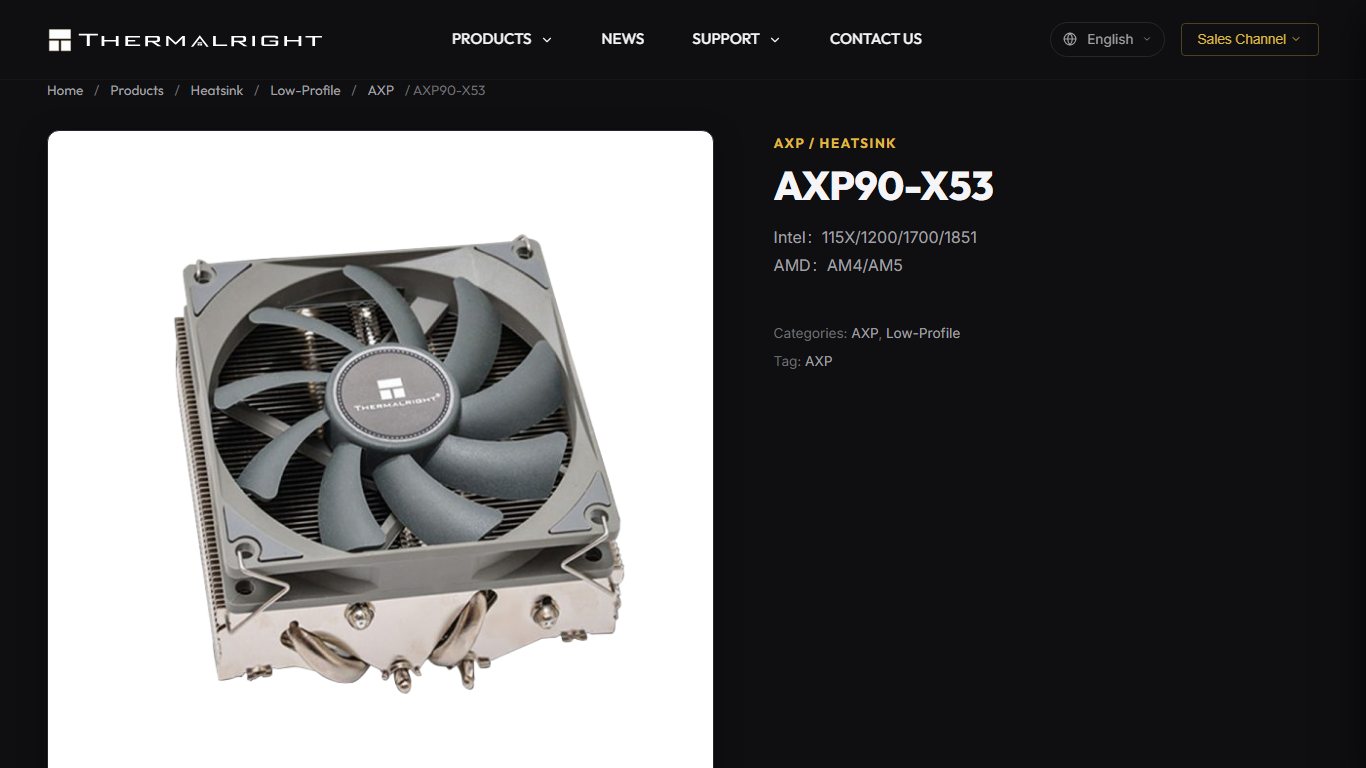
Who it suits: The Dan A4-H2O (55mm), FormD T1 in the 3-slot setup and the Terra at position 6. It’s the strongest cooler you can realistically fit in those cases, and with a Curve Optimizer it handles a 9800X3D well while gaming.
Limitations: A 53mm cooler leaves zero margin in a 53mm case. Paste thickness and panel flex can make the side panel bow. As with every AXP90, the slim fan needs a fan curve.
vs NH-L9x65: The Noctua is 12mm taller and quieter, with a lower rating for high-power chips. If your limit is 53-57mm, the X53 is the answer. If you have 65mm, compare it with the AXP120-X67 instead.
ID-Cooling IS-series (IS-40X V3, IS-55, IS-67-XT)
ID-Cooling’s IS line competes directly with Thermalright on price, height for height.
- IS-40X V3: 45mm (94x101x45mm), four heat pipes, 15mm slim fan. ID-Cooling’s official page lists LGA1851/1700/1200/115x and AM5/AM4. It’s the best-documented LGA1851 option at this height.
- IS-55: 57mm on most listings (one spec table says 55mm), five heat pipes and a 120x120x15mm fan. The 120mm fan overhangs RAM. AM5 is listed, and LGA1851 appears on some listings.
- IS-67-XT: 67mm with fan (120x120mm footprint). Listings show LGA1700/1200/115x and AM5/AM4. None of the listings checked confirm LGA1851, so confirm it with ID-Cooling first for a Core Ultra 200S build.
vs Thermalright: Roughly equivalent at each height. Thermalright’s wider retail availability and clearer heat-pipe specs give it the edge, but an IS-40X V3 is a fine pick if it’s the one in stock with LGA1851 hardware.
Noctua NH-L9x65 (65mm)
This is the quietest cooler in the 65mm tier. It’s 65mm tall with its NF-A9x14 PWM fan and rated NSPR 67. Its 92mm footprint keeps it off the RAM and most VRM heatsinks.
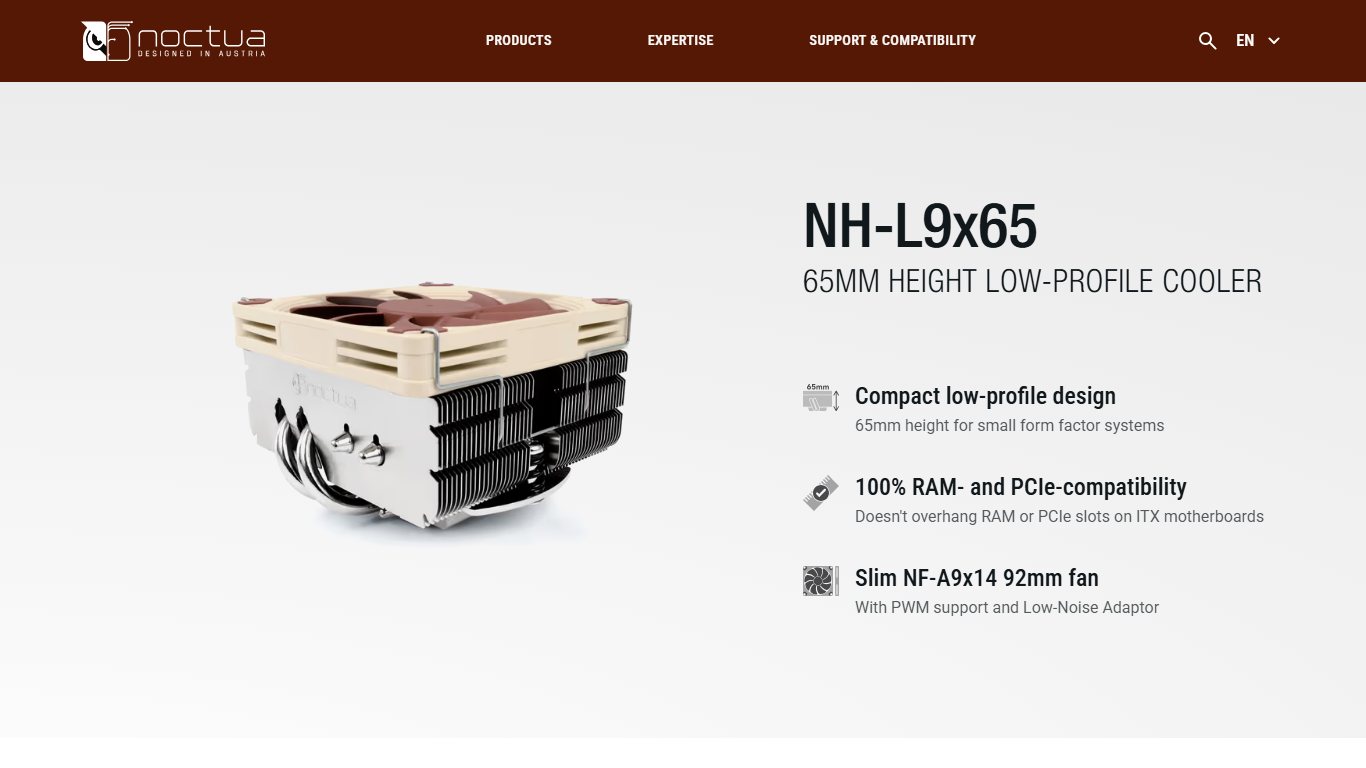
Who it suits: 65-105W CPUs in slim cases with a 65-70mm limit where quiet matters most, such as living-room HTPCs.
Is the full-speed fan loud? At 2,500 RPM, a 92mm fan is clearly audible. Most of the time it doesn’t need to run that fast on a 65W chip. With Noctua’s low-noise adapter or a sensible BIOS curve, it stays quiet at desktop and light loads.
Limitations: Noctua’s own datasheet says it isn’t suited to overclocking and needs care on CPUs above 100W TDP. On a 9800X3D, plan on a power limit.
Upgrade path: A 25mm NF-A9 adds about 11mm (around 76mm total). That’s more quiet airflow if your case has the room, but at that height an NH-L12S fits instead.
vs AXP120-X67: The Thermalright is 2mm taller, cheaper and has six heat pipes and a 120mm fan, so it has more raw capacity. The Noctua is quieter and keeps clear of RAM.
Thermalright AXP120-X67 (67mm)
This is the value pick for 67-70mm cases. It stands 67mm with six heat pipes and a 120mm TL-C12015 slim PWM fan. Black, white and ARGB variants exist. US pricing sits around $38 (Altex lists it at $37.99), and UK price trackers show about £29.
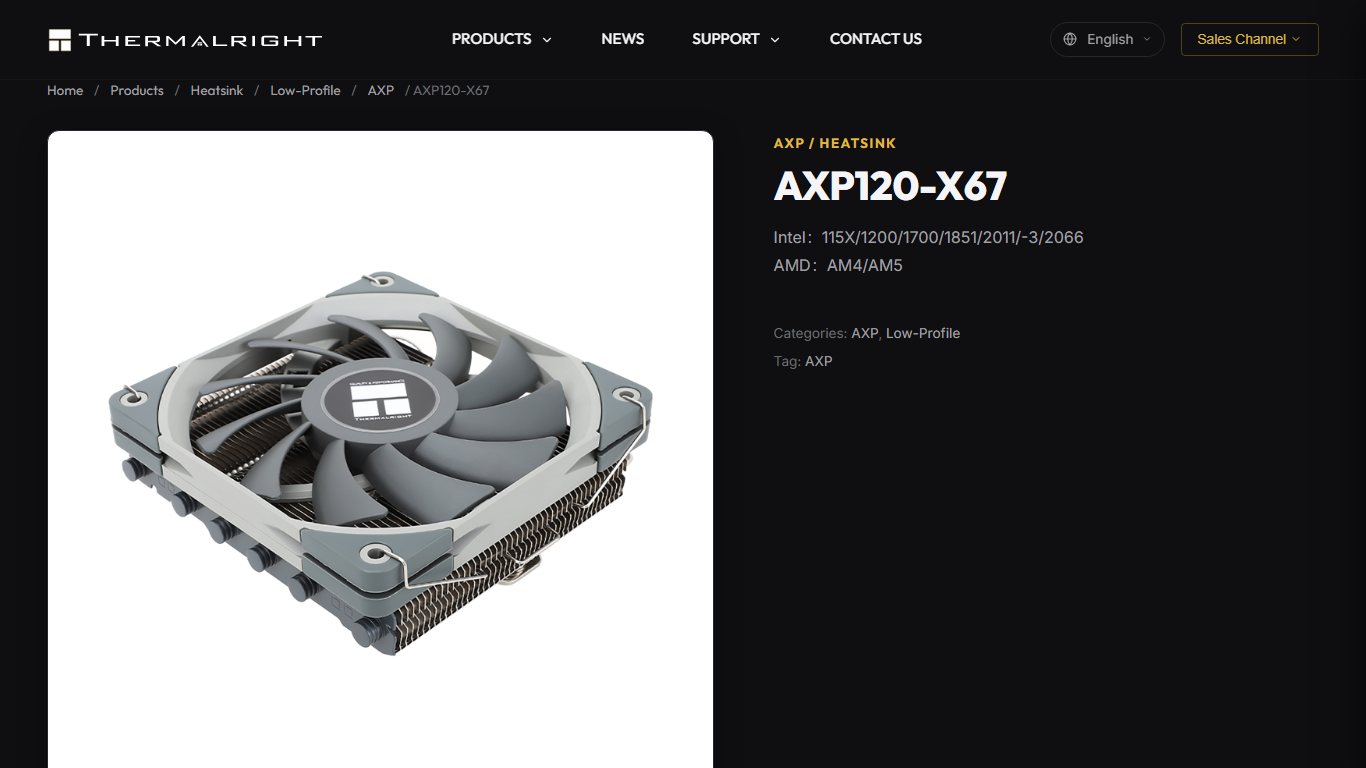
Who it suits: Fractal Ridge owners and anyone with 67-70mm of clearance who wants near-NH-L12S cooling for about half the price.
Limitations: It overhangs the DIMMs, so tall RAM can block it. The 15mm 120mm fan is louder than Noctua’s NF-A12x15 at the same cooling level. Socket lists vary across listings, so confirm AM5 hardware.
Noctua NH-L12S and NH-L12Sx77 (70-77mm)
These are Noctua’s 120mm low-profile coolers, and they carry the highest NSPR ratings in this guide.
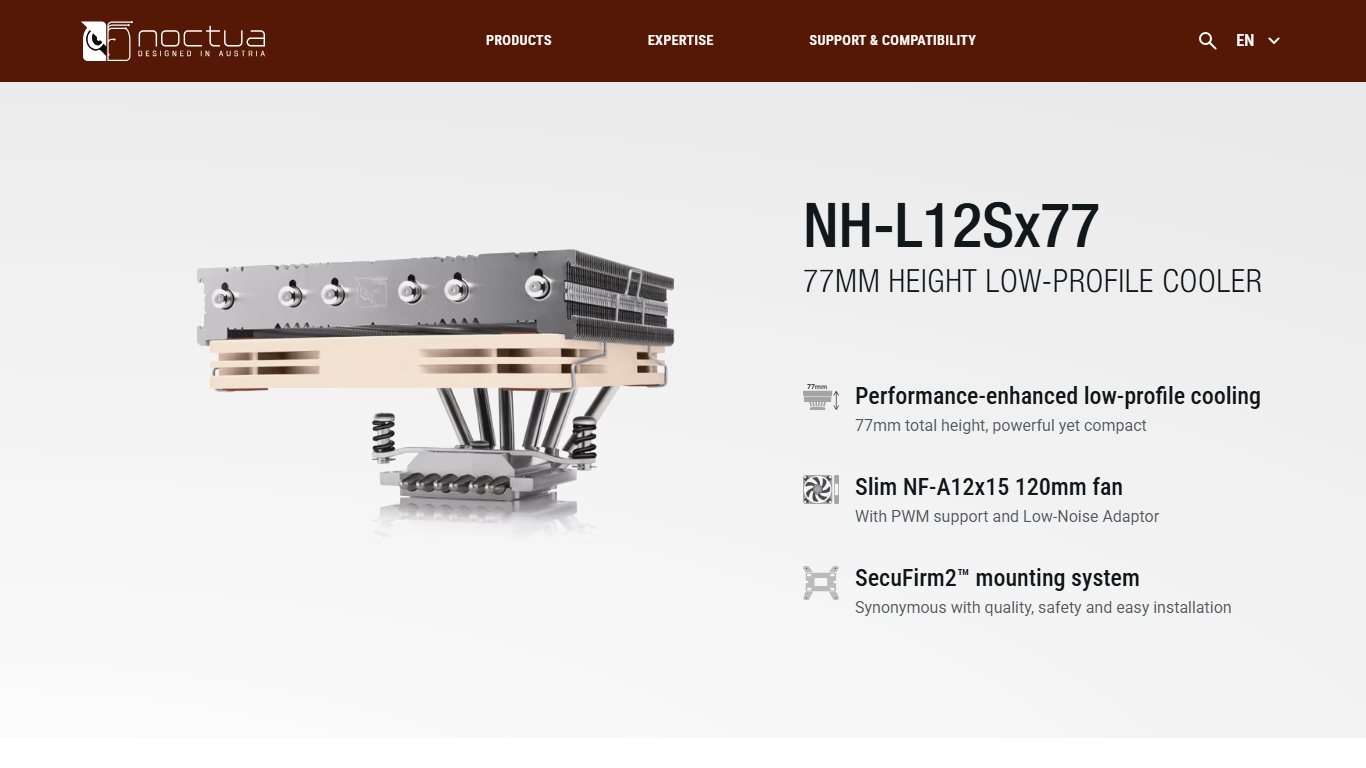
- NH-L12S: 70mm with the fan under the fins, four heat pipes, NF-A12x15 fan, NSPR 88. RAM clearance is 35mm (fan under) or 51mm (fan on top). It sold for $64.90 on Amazon when the Sx77 launched.
- NH-L12Sx77: Launched May 2024 at a $74.90 MSRP (EUR 84.90) as the NH-L12S successor. It has a 77mm heatsink, six heat pipes (two more than the NH-L12S), 93mm total height with the fan on top, and NSPR 100. RAM clearance is 44mm or 56mm depending on fan position.
NH-L12Sx77 vs NH-L12S, is the extra 7mm worth it? If your case takes 77mm or more, yes. You get two more heat pipes, a 12-point NSPR jump and more RAM and VRM clearance in either fan position. If your limit is 70mm (the Fractal Ridge, for example), the Sx77 won’t fit and the NH-L12S is the right Noctua.
Who should skip them: Anyone under 70mm. Anyone at exactly 70mm should also weigh the AXP120-X67, which leaves 3mm of margin.
A note on older names: Scythe’s Shuriken line and the Alpenföhn Black Ridge show up in many older roundups. The Black Ridge is a poor bet for AM5 given the reported compatibility problems. For new builds, the coolers above have the better current socket support.
Low profile server coolers
Rackmount servers are a different market. A 1U chassis is only 44.45mm tall overall, so 1U CPUs normally use passive heatsinks supplied by the server vendor and rely on the chassis fans. The desktop coolers here suit tower-style workstations and some 2U-or-taller chassis. Measure clearance the same way and check the vendor’s socket support.
Is my CPU too hot? Temperatures explained
Most likely not. Modern Ryzen and Intel chips boost until they reach a temperature or power limit, so high readings under load are normal. Worry only if the chip sits at its maximum (95°C on the 9800X3D) during ordinary gaming or throttles badly in benchmarks.
Normal load temps for small coolers
Is 84°C hot for a CPU? On a Ryzen 9800X3D with a 95°C maximum, 84°C while gaming is safe and normal for a 47-53mm cooler. AMD’s boost algorithm uses whatever thermal headroom it has, so a small cooler gives you higher temperatures and slightly lower clocks, not damage.
Expect higher numbers in stress tests such as Cinebench or Prime95 than in games. A small cooler reaching 95°C in an all-core render on a 9800X3D is the chip protecting itself, but it’s also a sign to set a Curve Optimizer or PPT limit if you render often.
Signs your cooler is the problem
Temperatures jumping to 90°C+ within seconds of a load, with the fan already at full speed, point to a mounting problem. That usually means uneven pressure, a missing paste spread or protective film left on the base. Idle temperatures far above room temperature plus 15-20°C point the same way.
If temperatures crept up over months, dust in the slim fan and fins is the usual cause. Clean them with compressed air while holding the fan still. If a stable, correctly mounted cooler can’t keep up with your workload even after a power limit, move up a height tier or consider an AIO.
Making a small cooler quieter
Slim 15mm fans have to spin fast to move enough air, which is why an AXP90 at full speed sounds like a hairdryer. Three changes fix most of it.
- Set a fan curve in the BIOS. On most boards it’s under Hardware Monitor, Q-Fan Control (ASUS), Smart Fan (Gigabyte) or Fan Control (MSI). Keep the fan around 40-50% up to 60°C, then ramp it. A gentler curve with a slower response (fan step-up time) stops the fan revving on every short boost spike.
- Use the low-noise adapter. Noctua includes a low-noise adapter (L.N.A.) with its slim fans. It caps maximum speed. Use it on 65W builds, not on X3D chips.
- Fit a 25mm fan where height allows. The NH-L9a and NH-L9i take 92x92x25mm fans, which brings them to just under 50mm. The NH-L12Sx77 takes a 25mm 120mm fan on top at about 102mm. Thicker fans move the same air at lower RPM, and lower RPM means less noise.
So how do you quiet an AXP90 fan that’s very loud at full speed? Start with the BIOS curve, because the fan rarely needs 100% on a gaming load. If it still whines, a Curve Optimizer or PPT limit cuts the heat the fan has to deal with.
Case airflow matters too. A low-profile cooler that blows down onto the board needs fresh air above it. A side-panel intake in the T1, A4-H2O or Terra feeds it cool air. Exhausting hot GPU air over the cooler does the opposite.
Install tips: avoid the 5 classic mistakes
Most poor results from small coolers come from installation, not the cooler. Five mistakes cover nearly every bad thread on r/sffpc.
Before you start
Remove the motherboard from a tiny case if the cooler needs a backplate change. Working blind through a 2cm gap is how pins, M.2 drives and fan headers get damaged.
- Wrong backplate or retention. On AM5, most low-profile coolers reuse AMD’s stock backplate after you remove the plastic retention arms. Keep the backplate in place. Intel coolers on LGA1700/1851 may use the motherboard’s backplate or their own mounting system depending on the model, so follow the cooler maker’s instructions. Some models need a separate LGA1700/1851 mounting kit.
- Too much or too little paste. A pea-sized dot (or a thin X on larger heat spreaders) is enough. Thick paste raises temperatures and can add a fraction of a millimetre in tight cases.
- Tightening one screw fully first. Tighten in a cross pattern, a few turns at a time, until each screw stops. Uneven pressure is the most common cause of one-core-hot readings.
- Fan cable pointing the wrong way. Before final tightening, rotate the cooler so the fan cable reaches the CPU fan header without crossing the fins or touching the fan blades.
- Forgetting the protective film. Many coolers ship with a plastic film on the base. Peel it off. Leaving it on gives temperatures in the 90s within seconds.
Also check RAM and VRM clearance before the final tightening, while you can still turn the cooler 90° if a fin edge touches a DIMM.
Low profile air vs small AIO in SFF
A low-profile air cooler is simpler, cheaper and more reliable. A 240mm AIO cools better if your case has a proper radiator mount and you run a 9800X3D or a K-series chip at stock. For 65W chips and tuned X3D chips, air is the better choice.
How risky is AIO cooling? The main failure is the pump wearing out over years, which shows up as a slow rise in temperatures or a pump that stops. Coolant also permeates slowly through the tubes over time. Leaks are rare with reputable brands, but when one happens it can damage the GPU or motherboard, while a dead air cooler fan only means throttling.
Radiator space is the other limit. The Lian Li Dan A4-H2O was built around a 240mm radiator mount, and that’s the case where an AIO makes most sense. In the T1 or Terra, a radiator competes with GPU and power supply space. The trade-off favours low-profile air there unless you plan the build around the radiator.
Low-profile air also cools the VRMs and M.2 drive as a side effect, something an AIO’s pump block doesn’t do. Some AIO-cooled ITX builds need a small fan aimed at the board for that reason.
Measure, check, install: the desk-side checklist
Here’s the order to work in if you’re helping a friend at the desk with the case open.
Measure, check, install
- Find the case’s max CPU cooler height for your GPU or spine setup, then measure it with a ruler and subtract 1-2mm.
- Pick the tallest tier that fits: 37, 47, 53, 65, 67-70 or 77mm.
- Match the tier to your CPU: 65W suits any tier, while X3D and K chips need 53mm+ with tuning or 70mm+ at stock.
- Confirm the exact SKU lists your socket (AM5 or LGA1851) and that the box includes the matching hardware.
- Check RAM height against the cooler’s overhang and decide the fan position (NH-L12S family).
- Install with the film removed, a pea of paste, cross-pattern tightening and the fan cable aimed at the header.
- Set a BIOS fan curve, then a Curve Optimizer or PPT limit if load temperatures sit at the CPU’s maximum.
Measure first: the right cooler is always the one that fits your exact millimetres, and in SFF that settles more than the brand does.
FAQ
What is the best low profile CPU cooler?
For most small cases, the Thermalright AXP90-X53 is the best balance of 53mm height, four heat pipes and price. With 77mm or more of room, the Noctua NH-L12Sx77 (NSPR 100) is the strongest low-profile option.
What is the best low-budget CPU cooler?
The Thermalright AXP90-X47 at about $22-30 is the best entry-level low profile cooler. It handles any 65W chip and, with a fan curve, stays tolerable on noise.
What is the best small CPU cooler?
At 36-37mm, the Thermalright AXP90-X36 is the cheapest compact CPU cooler and the Noctua NH-L9a-AM5 or NH-L9i-17xx is the quietest. Both suit 65W chips.
Is 84°C hot for a CPU?
No, not for a modern desktop chip under load. The Ryzen 7 9800X3D’s maximum is 95°C, and boost algorithms deliberately run close to their limits. Watch for sustained readings at the maximum during gaming.
How risky is AIO cooling?
Low risk with reputable brands, but higher than air. Pumps wear out over years, coolant slowly permeates, and a rare leak can damage hardware. Air coolers have one moving part: the fan.
What is the best low profile CPU cooler for AM5?
The NH-L12Sx77 if you have 77mm or more. The AXP90-X53 at 53mm and the NH-L9a-AM5 at 37mm are the other picks. Make sure the box includes AM5 hardware, especially with older Thermalright stock.
What is the best low profile CPU cooler for LGA 1700 / LGA 1851?
The Noctua NH-L9i-17xx (37mm, LGA1700/1851/1954) for 65W chips, and the NH-L12Sx77 for higher-power Core Ultra 200S chips. The ID-Cooling IS-40X V3 officially lists LGA1851 at 45mm.
Can a low profile cooler handle a Ryzen 7 9800X3D?
Yes. The NH-L12Sx77 or NH-L12S handles it at stock. A 53mm AXP90-X53 Full handles it well while gaming with a negative Curve Optimizer or a PPT limit, since the chip draws up to 162W by default.
What cooler for a 9800X3D in a Fractal Terra with a 4090?
A thick GPU usually pushes the Terra’s spine to the 48mm setting, so the AXP90-X47 Full plus a Curve Optimizer and a PPT limit around 88W is the practical choice. If your GPU allows the 53mm position, use the AXP90-X53 Full.
Is Thermalright as good as Noctua for low profile coolers?
On cooling per dollar, Thermalright usually wins. Noctua wins on fan noise, mounting quality, documentation (NSPR, RAM clearance figures) and warranty. Pick Thermalright for value and Noctua for quiet HTPCs.
What height counts as low profile for a CPU cooler?
Anything up to about 77mm is generally sold as low profile. The ultra-low-profile class is 47mm and under. Mainstream tower coolers start around 150mm.












