
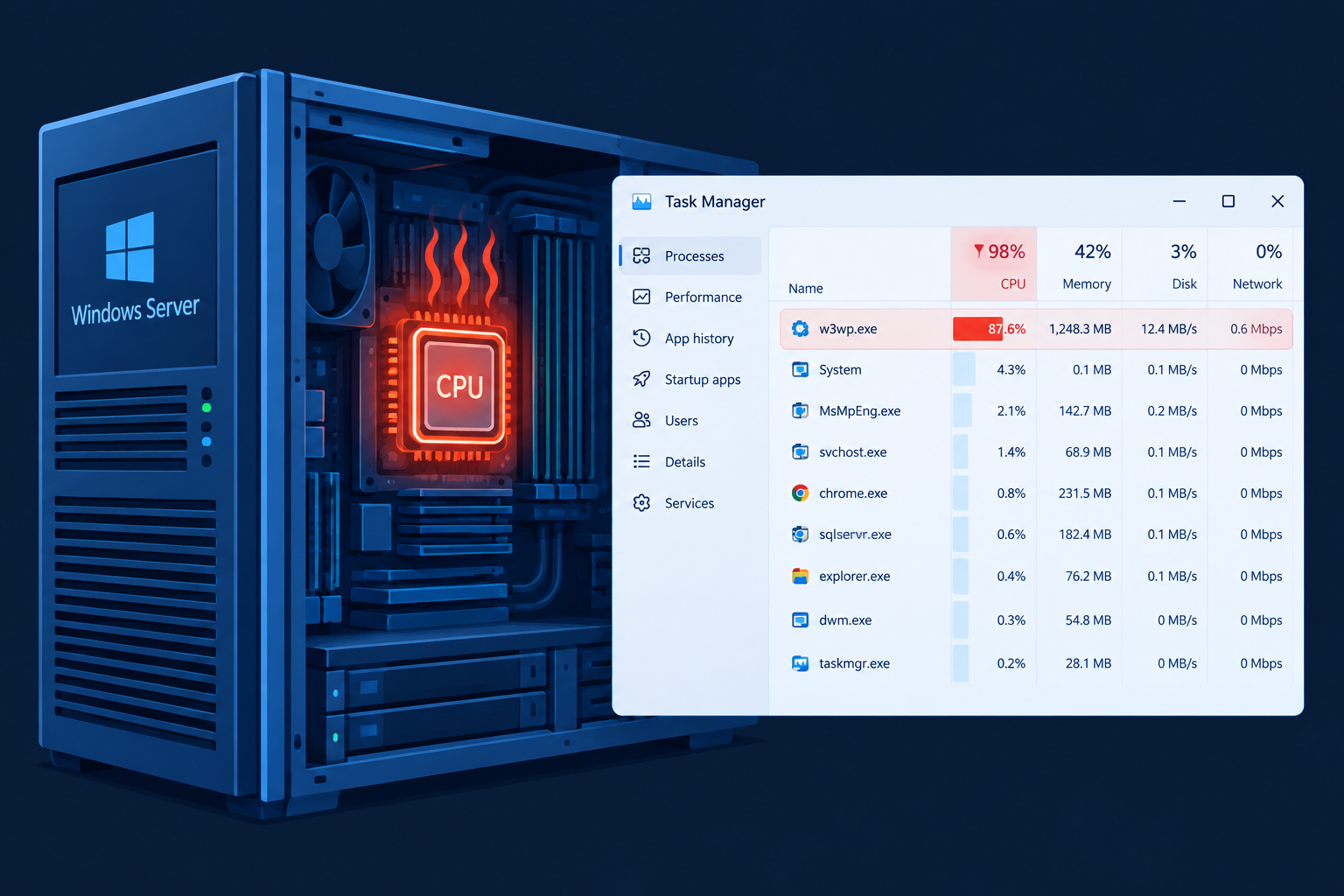
w3wp.exe is the Internet Information Services (IIS) worker process. It is a genuine Microsoft file that runs the code of the websites and web apps hosted on a Windows PC or server. If it uses a lot of CPU, find out which application pool and which requests are causing the load, recycle that pool for quick relief, and then fix the slow code or traffic behind it. Only treat it as malware if the file sits outside the C:\Windows\System32\inetsrv or C:\Windows\SysWOW64\inetsrv folders, or if it starts unexpected programs.
What w3wp.exe does
w3wp.exe is the program that IIS starts to handle web requests for an application pool. If you see it in Task Manager, IIS is turned on and at least one site or app on the machine has received a request.
A web server has to take each incoming request and pass it to the right application quickly and safely. IIS does this with worker processes. A kernel driver called HTTP.sys receives the request, the Windows Process Activation Service (WAS) starts a w3wp.exe process for the right application pool, and a thread from that process’s thread pool runs the request. This setup lets you host static websites and.NET web applications on a Windows desktop for development, or on Windows Server for production.
What is IIS
Internet Information Services (IIS) is Microsoft’s web server for Windows. It hosts web applications and serves client requests over HTTP and HTTPS, and it has an optional FTP server. Every supported version of Windows Server, from Windows Server 2016 to Windows Server 2025, ships IIS 10.0. You can also turn it on in Windows 10 and Windows 11 for local testing.
An application pool in IIS Manager is a group of one or more sites or apps that share the same worker process settings. One pool can host several web apps on a single PC or laptop, and each pool normally gets its own w3wp.exe. That is why a busy server often shows several copies of w3wp.exe at once. You can manage IIS through the graphical IIS Manager or from the command line with appcmd.exe and PowerShell.
How w3wp.exe works
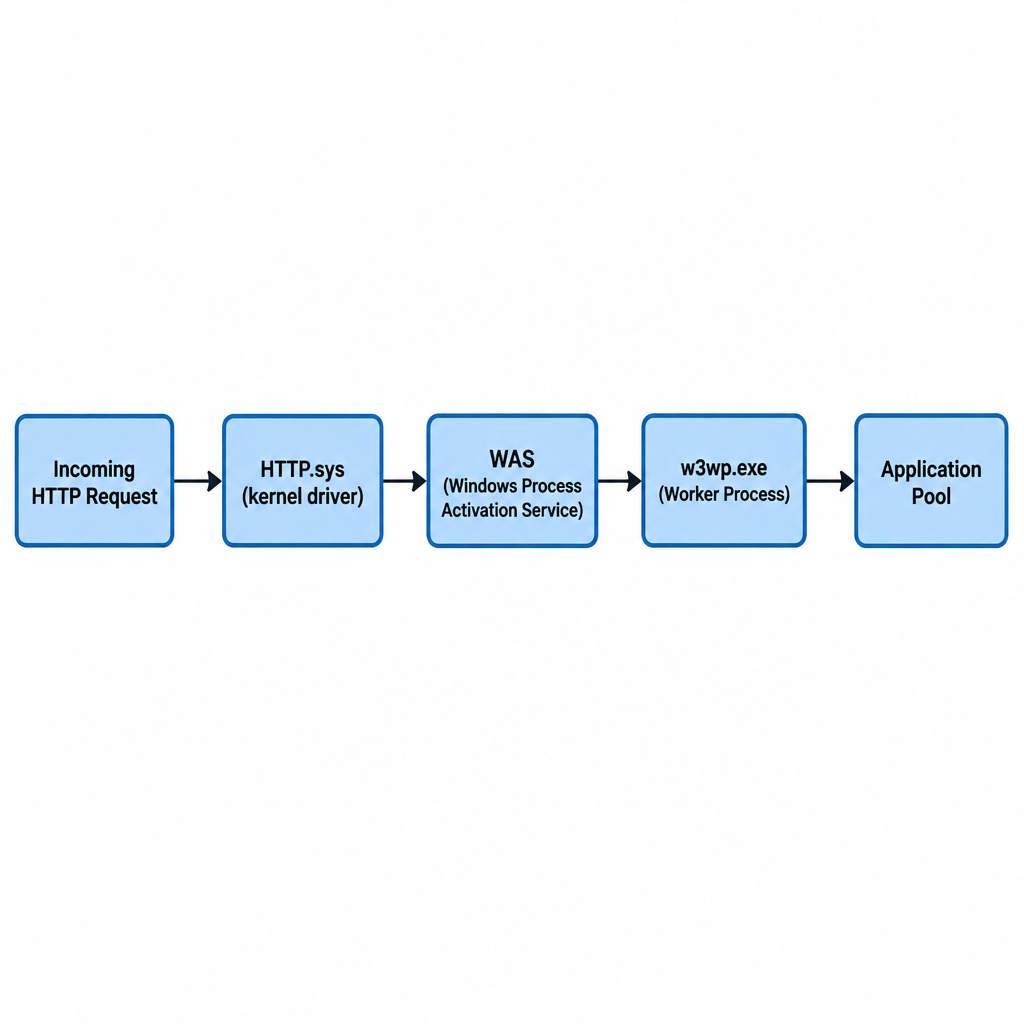
IIS runs web applications through worker processes like w3wp.exe. Say you are building a site with ASP.NET. The pages will not open until IIS is installed and running on your PC. When the first request for your app comes in, IIS starts the app’s application pool as a worker process, and that pool shows up as a w3wp.exe process. From then on, IIS handles each request by taking a thread from that process’s thread pool.
Any machine running IIS needs w3wp.exe to process web requests for its application pools. You can change how each pool behaves in IIS Manager under Application Pools, then right-click a pool and choose Advanced Settings. Useful settings include:
- Identity: the Windows account the app runs under. Since Windows 7 and Windows Server 2008 R2, the default is ApplicationPoolIdentity, a virtual account named after the pool.
- Recycling: restarts the worker process automatically on a schedule or after a set number of requests or amount of memory.
- Idle Time-out and Idle Time-out Action: shuts down an idle worker process (Terminate, the default) or pages it out to disk (Suspend, added in IIS 8.5).
- CPU Limit and Limit Action: caps how much CPU the pool can use, with the actions NoAction, KillW3wp, Throttle or ThrottleUnderLoad.
Where w3wp.exe is located
The real w3wp.exe runs from C:\Windows\System32\inetsrv\w3wp.exe. On 64-bit Windows, a 32-bit copy also sits in C:\Windows\SysWOW64\inetsrv for pools that run 32-bit apps. A backup copy inside C:\Windows\WinSxS (the Windows component store) is also normal, but the process that is running should not start from there.
The file is part of the Internet Information Services package and is published by Microsoft Corporation. To check it, open Task Manager, go to Details, right-click w3wp.exe and choose Open file location. You can also right-click it, choose Properties and look at the Digital Signatures tab, which should show Microsoft Windows. If the file runs from any other folder, such as your user profile, Temp or Downloads, it is not an IIS worker process and could be malicious. Run a full scan with Microsoft Defender.
Checking the file path works for any Windows process name that malware likes to copy, from svchost.exe to Gamebar.exe.
How to check whether w3wp.exe is using a lot of CPU
Task Manager shows whether w3wp.exe is busy, and IIS Manager shows which pool and which requests are behind it. Start with Task Manager:
- Press Ctrl + Shift + Esc to open Task Manager.
- Go to the Details tab. In Windows 11, it is in the left menu.
- Check whether w3wp.exe is using a lot of CPU or memory. The User name column shows the application pool’s name, so you can tell which pool each copy belongs to.
To see every running worker process from IIS Manager:
- Open IIS Manager and click your computer or server name in the Connections pane on the left.
- Double-click Worker Processes in the IIS section. You will see a list of the worker processes running right now.
IIS Manager shows each worker process’s application pool name, process ID, state, CPU percentage and memory use (private and virtual bytes). Double-click a process, or right-click it and choose View Current Requests, to see:
- The full URL of the request.
- How long the request has been running.
- The client (IP address) that sent it.
- The current stage of the request in the IIS pipeline.
- The module that is handling it.
From an administrator Command Prompt, C:\Windows\System32\inetsrv\appcmd list wp maps each w3wp.exe process ID to its pool. appcmd list requests /elapsed:5000 lists requests that have been running for more than 5 seconds.
Fixing high CPU usage
High CPU in w3wp.exe almost always comes from the web app or its traffic, not from IIS itself. If the worker process is slowing your server down by eating CPU and memory, start with the request details:
- Check the request URLs. If most requests point to the same page or API, that endpoint is the likely culprit.
- Make sure a single client is not flooding the server by sending many requests at once. The IIS logs in
C:\inetpub\logs\LogFilesshow the client IP for every request. On a development PC, a per-app network monitor of the kind covered in lists of GlassWire Alternatives can also show which program is generating the traffic. - Look for requests stuck on the same module or pipeline stage. That usually points to inefficient code, such as an endless loop, a slow database query or a lock that requests are waiting on.
For quick relief, go to Application Pools in IIS Manager, right-click the busy pool and choose Recycle. IIS starts a fresh worker process and lets the old one finish its requests, so this disrupts users far less than restarting IIS. It does not fix the cause, though, and the CPU spike will come back.
If the request details don’t point to anything obvious, test and debug your web application, and follow good garbage collection practices. Optimize the.NET code and review what each request asks the server to do. For a proper diagnosis, Microsoft’s troubleshooting guide recommends taking memory dumps of w3wp.exe while the CPU is high. Use Debug Diagnostics (DebugDiag) or Sysinternals ProcDump, take about three dumps a few seconds apart, then read them in DebugDiag’s performance analyzer to see which code the threads are running. Dumps taken after the spike has ended are useless.
Coin-mining malware is another cause of constant, unexplained CPU load on servers. It burns your hardware so that attackers can enjoy the advantages of bitcoins and other coins mined at your expense. A normal w3wp.exe almost never starts cmd.exe or PowerShell. If you see it launching them, security vendors such as Red Canary treat that as a sign of a possible web shell. Isolate the server and bring in your security team or Microsoft support.
What to do if w3wp.exe is not running
A missing w3wp.exe is often normal. IIS only starts a worker process when a pool gets its first request, and by default it shuts the process down after 20 minutes without traffic. If your site still won’t load, check that IIS is running:
- Press Windows + R, type
services.mscand press Enter. - Make sure World Wide Web Publishing Service (W3SVC) and Windows Process Activation Service (WAS) are both Running.
- In IIS Manager, open Application Pools and make sure your site’s pool is Started. Also check that the site is assigned to the pool you expect.
If a pool keeps stopping on its own, open Event Viewer and go to Windows Logs > System. Look for warnings from the source WAS. IIS’s Rapid-Fail Protection turns off a pool whose worker process crashes several times in a short period, and the event explains which pool it stopped.
If your website isn’t the problem, start the worker process by sending it a request:
- In IIS Manager, right-click your site under Sites.
- Select Manage Website and click Browse. This sends a request, and the request starts w3wp.exe.
- Find the w3wp.exe process in the Worker Processes list.
- Refresh the list.
How to restart IIS from the command line
You can restart all of IIS with the iisreset command from an administrator Command Prompt:
- Click the Start button.
- Type
cmd, right-click Command Prompt and choose Run as administrator. - Type the command below and press Enter:
iisreset /noforce
- Wait while IIS stops and starts again. This usually takes a few seconds to a minute. A success message appears in the Command Prompt window when it’s done.
The /noforce switch tells IIS not to force-stop its services if they don’t stop within the timeout, which protects against data loss. Microsoft’s IIS support team advises against relying on iisreset on IIS 7.0 and later because it restarts every site at once. Recycling only the affected application pool is the cleaner option.
Disabling an IIS worker process
You can stop w3wp.exe in two ways:
- Stop the application pool in IIS Manager. Go to Application Pools, right-click the pool and choose Stop. To keep it from starting again when IIS restarts, open Advanced Settings and set Start Automatically to False.
- Stop all of IIS by stopping the World Wide Web Publishing Service in
services.msc, since it is a Windows service.
To keep the service from starting with Windows, open its properties after stopping it and change Startup type to Disabled.
If you never meant to run a web server on your PC, you can remove IIS completely. In Windows 11, go to Control Panel > Programs > Turn Windows features on or off and clear Internet Information Services. On Windows Server, use Server Manager > Manage > Remove Roles and Features. Don’t disable IIS on Exchange Server or SharePoint machines, because both run on IIS and stop working without it.
FAQ
Is w3wp.exe a virus?
No. The real w3wp.exe is a Microsoft-signed file in C:\Windows\System32\inetsrv or C:\Windows\SysWOW64\inetsrv. A file with the same name in any other folder, or a w3wp.exe that launches cmd.exe or PowerShell, deserves a full Microsoft Defender scan and a closer look.
Why are there several w3wp.exe processes running?
Each application pool normally gets its own w3wp.exe, so a server with five active pools shows five copies. A pool set up as a web garden (Maximum Worker Processes higher than 1) runs several copies by itself. The User name column in Task Manager shows which pool each one belongs to.
Can you end w3wp.exe in Task Manager?
You can, and IIS starts a new one on the next request. But killing it drops every request that process was handling. Recycling the pool in IIS Manager is safer because the old process finishes its work first.
Why does w3wp.exe use so much memory?
Your web app usually holds most of that memory through caching, sessions or a memory leak in its code. Set a memory-based recycle limit under the pool’s Recycling settings as a stopgap. Then use memory dumps and Microsoft’s IIS memory leak troubleshooting guidance to find the code that holds on to memory.
Is it safe to remove IIS from a Windows 11 PC?
Yes, if you don’t host websites or use developer tools that need local IIS. Some apps turn IIS on during setup, so check whether any software you rely on stops working after you clear it in Turn Windows features on or off. You can turn it back on the same way.
Sources
- Microsoft Learn: Troubleshooting High CPU in an IIS 7.x Application Pool
- Microsoft Learn: Application Pool Identities
- Microsoft Learn: Idle Worker Process Page-Out in IIS 8.5
- Microsoft Learn: Troubleshooting Native Memory Leak in an IIS 7.x Application Pool
- Microsoft Tech Community, IIS Support Blog: IISRESET internals
- Microsoft TechNet: Restarting IIS












