
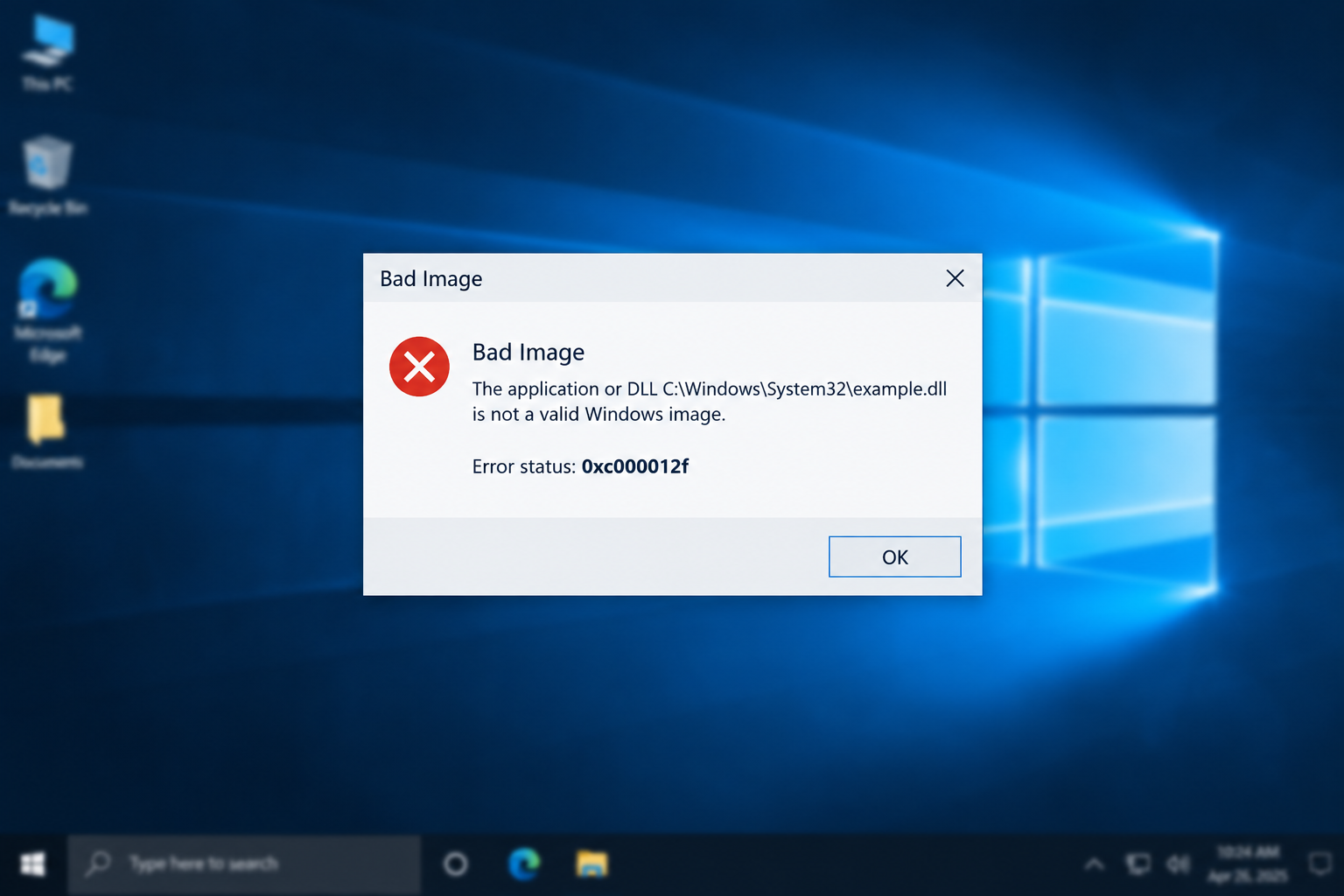
Error 0xc000012f means Windows tried to load a program file or DLL that is damaged or not in a format it can run. The quickest fix in November 2026 is to reinstall or repair the app named in the error. If that doesn’t work, install Microsoft’s current Visual C++ v14 Redistributable, then run DISM and SFC from an administrator Command Prompt. These steps work on Windows 10 22H2 and on Windows 11 24H2 and 25H2.
If you open a program or set up Microsoft Office and get “Bad Image Error Status 0xc000012f”, you can fix it on your own in most cases. The fixes below start with the quickest and safest. The ones that change your system come later.
Why the bad image error 0xc000012f happens
0xC000012F is the Windows status code STATUS_INVALID_IMAGE_NOT_MZ. Windows expects every program file (.exe) and library (.dll) to start with a valid “MZ” header. When a file is cut short, corrupted or replaced, Windows can’t load it and shows the Bad Image box. Common causes:
- The program’s main file, or one of the DLLs it needs, is corrupt.
- The Microsoft Visual C++ runtime files are damaged or mismatched. Apps built with Visual C++ 2015 or later are especially prone to this.
- Windows system files are damaged, often after a failed or interrupted update.
- A recent Windows update doesn’t work well with the program.
- A third-party program that starts with Windows, such as an antivirus or overlay tool, interferes with the app.
Two old explanations, disk fragmentation and “corrupt registry keys”, don’t hold up. Windows defragments hard drives on a schedule and never defragments SSDs, and registry cleaners don’t repair a corrupt DLL. Skip any “PC optimizer” that promises to fix this error with one click.
What the error message looks like
The message names the file that failed to load. Most of the time this tells you exactly which program needs repairing. A typical example:
“C:\Windows\System32\schannel.dll is either not designed to run on Windows or it contains an error. Try installing the program again using the original installation media or contact your system administrator or the software vendor for support. Error status 0xc000012f.”
Look at the path. A file inside the program’s own folder (for example under C:\Program Files) points to the program, so reinstall it (Method 5). A file in C:\Windows\System32 points to Windows system files, so run DISM and SFC (Method 2). Office users often see AppvIsvSubsystems64.dll named in the error. That file belongs to Office, so repairing Office usually fixes it.
Best ways to fix the Windows bad image error
Try the methods below one at a time. After each one, restart your PC and open the program again before you move on.
If you’re still on Windows 10, keep in mind that Microsoft ended support for it on October 14, 2025. Home and Pro PCs on version 22H2 can still get security patches through the consumer Extended Security Updates (ESU) program. In June 2026 Microsoft extended that program to October 12, 2027. Make sure your PC is enrolled and fully patched before you start, because many bad image errors come from half-installed updates.
Method 1: Uninstall the latest Windows update
A faulty or broken Windows update can cause a Bad Image error. If 0xc000012f started right after an update, remove that update.
On Windows 11:
- Open Settings > Windows Update > Update history.
- Scroll down to Related settings and select Uninstall updates.
- Find the update you installed just before the error started (it’s listed by KB number and date) and select Uninstall.
- Restart the PC and check whether the error is gone.
On Windows 10:
- Open Settings > Update & Security > Windows Update > View update history.
- Select Uninstall updates. This opens the Installed Updates list in Control Panel.
- Select the most recent update from before the error started, then select Uninstall.
- Restart the PC and check whether the error is gone.
Removing an update also removes the security fixes it contained. If this fixes the error, report the problem to the app’s vendor, and let Windows reinstall the update once a fixed version of the app is out.
Method 2: Run DISM and the System File Checker (SFC)
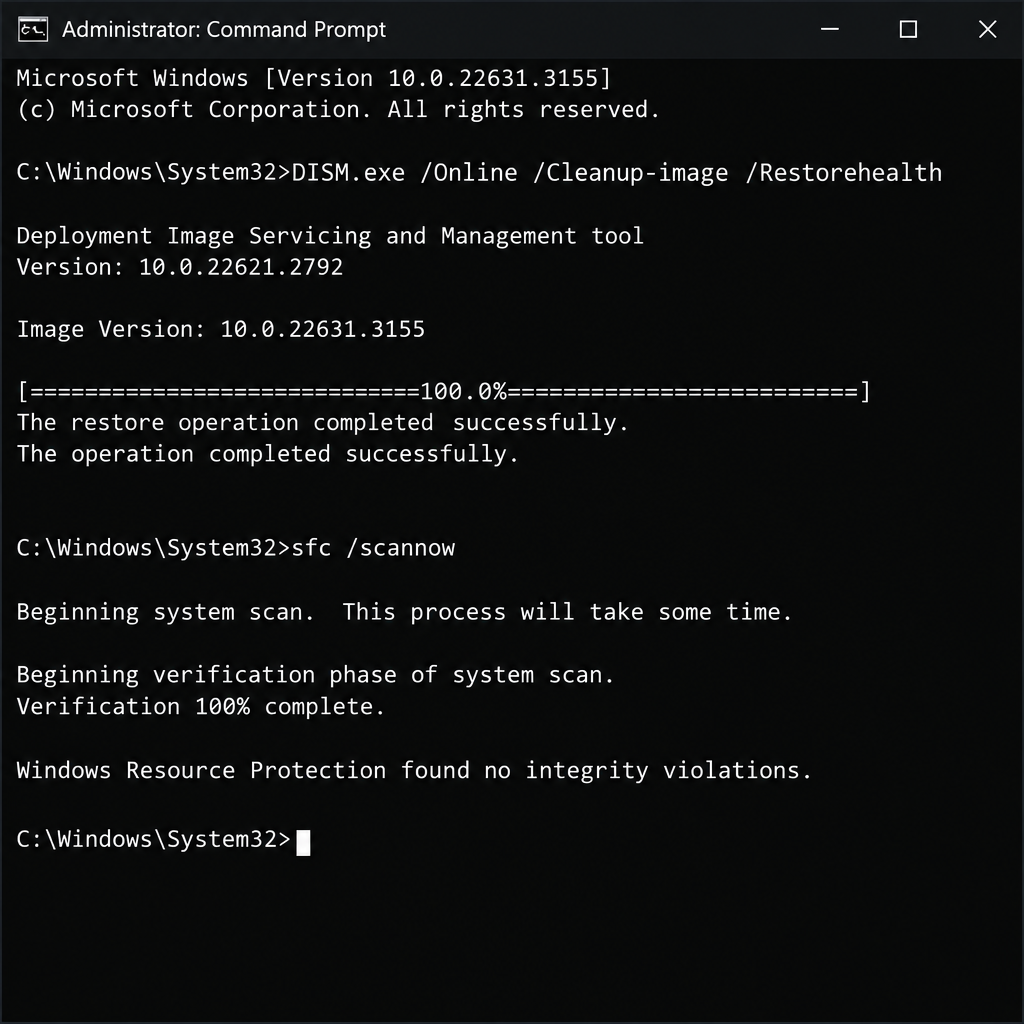
Damaged system files can also cause Bad Image errors. Two built-in tools check them. DISM repairs the Windows component store, which is where SFC gets its clean copies. SFC then replaces corrupted system files. Microsoft’s own instructions run DISM first, then SFC.
- Select Start, type cmd, then right-click Command Prompt and choose Run as administrator.
- Type this command and press Enter:
DISM.exe /Online /Cleanup-image /Restorehealth - Wait for it to finish. It can take a few minutes to start and may sit at one percentage for a while. It needs an internet connection to download clean files.
- Type this command and press Enter:
sfc /scannow - When the scan reaches 100%, restart the PC.
SFC reports one of these results:
| SFC message | What it means | What to do next |
|---|---|---|
| Windows Resource Protection did not find any integrity violations | System files are fine | Move on to Method 3 or Method 5 |
| Windows Resource Protection found corrupt files and successfully repaired them | The problem was fixed | Restart and test the program |
| Windows Resource Protection found corrupt files but was unable to fix some of them | Some files are still damaged | Run DISM again, then SFC again; details are in C:\Windows\Logs\CBS\CBS.log |
If SFC keeps reporting files it can’t fix after two rounds, see “If nothing works” at the end of this page.
Method 3: Perform a System Restore
System Restore takes Windows back to a restore point from before the error started. It removes apps, drivers and updates installed since then, but your personal files stay put. It only works if System Protection was turned on beforehand, and on many Windows 10 and 11 PCs it is off.
To check, search for Create a restore point and open it. On the System Protection tab, the protection setting for your C: drive must say On.
- Press Windows + R.
- Type rstrui.exe and press Enter.
- Select Next, choose a restore point from a date when the program still worked, and select Scan for affected programs to see what will be removed.
- Select Next, then Finish, and let the PC restart.
If no restore points are listed, skip this method. Turn System Protection on now so you have one next time.
Method 4: Perform a clean boot
A clean boot starts Windows with only Microsoft services running. If the error disappears, a third-party program that starts with Windows is to blame. These are Microsoft’s steps:
- Sign in with an administrator account.
- Select Start, type msconfig, and open System Configuration.
- On the Services tab, tick Hide all Microsoft services, then select Disable all and Apply.
- On the Startup tab, select Open Task Manager.
- In Task Manager’s Startup apps list, right-click each enabled item and choose Disable.
- Close Task Manager, select OK in System Configuration, and restart.
- Open the program that gave the Bad Image error.
If it now opens without the error, turn services back on a few at a time until the error comes back. That tells you which program is causing it. When you’re done, go back to msconfig, select Normal startup on the General tab, and turn your startup apps back on in Task Manager. Leave the boot options on the Boot tab alone.
Method 5: Reinstall or repair the program
If none of the steps above worked, uninstall the program and reinstall it with a fresh copy. This fixes most bad image errors that point to a file inside the program’s own folder. Before you start, download the latest installer from the developer’s official website, not a mirror site.
- Press Windows + R.
- Type appwiz.cpl and select OK. On Windows 11 you can also use Settings > Apps > Installed apps.
- Find the program that shows the Bad Image error, select it, and choose Uninstall.
- Wait for it to finish, then restart.
- Run the fresh installer to set the program up again.
For Microsoft Office or Microsoft 365, try a repair before uninstalling. On Windows 11, go to Settings > Apps > Installed apps, select the three dots next to Microsoft 365 or Office, then Modify. On Windows 10, go to Settings > Apps > Apps & features, select Office, then Modify. Try Quick Repair first. If the error comes back, run Online Repair.
Also reinstall the Visual C++ Redistributable
Many games and apps depend on the Microsoft Visual C++ runtime. A damaged copy is one of the most common reasons for 0xc000012f. Microsoft now ships a single rolling “v14” Redistributable that covers apps built with Visual Studio 2017, 2019, 2022 and 2026. Visual Studio 2015 is not included in it, and the separate 2015 package is no longer supported.
- Download the latest Visual C++ v14 Redistributable from Microsoft’s “Latest supported Visual C++ Redistributable downloads” page on Microsoft Learn.
- On a 64-bit PC, install both the x64 and the x86 versions, because many apps are still 32-bit. On an Arm PC, use the ARM64 package.
- If the installer offers Repair, choose it. Otherwise install it normally.
- Restart the PC and test the program again.
If nothing works
If DISM and SFC can’t repair Windows, or the error shows up in several unrelated programs, do a repair install of Windows. This keeps your files and apps. On Windows 11 24H2 and 25H2, go to Settings > System > Recovery and select Reinstall now next to Fix problems using Windows Update. On Windows 10, download Microsoft’s Media Creation Tool, run setup from it, and choose to keep personal files and apps. Back up your files first.
If only one program fails after a clean reinstall, contact its developer. Include the full error text and the file name it shows. Also check Windows Security’s Protection history, because an antivirus can quarantine part of a file and leave a broken copy behind. If you also see random crashes or slow file copies, the drive itself may be failing. Back it up right away and have the PC checked by a repair shop.
FAQ
How do I fix error 0xc000012f?
Start with the file the error names. If it’s inside a program’s folder, reinstall or repair that program and reinstall the Visual C++ v14 Redistributable. If it’s in C:\Windows\System32, run DISM and then sfc /scannow as administrator. Uninstalling a recent update, System Restore and a clean boot cover the cases those fixes miss.
Why do I keep getting bad image errors?
You get a Bad Image error when an important program or system file is missing, damaged or the wrong version. If it keeps coming back after a repair, something is damaging the files again. Common culprits are an interrupted update, an aggressive antivirus or a failing drive. Run the drive check in your PC maker’s diagnostics and check Windows Security’s Protection history.
Is 0xc000012f a virus?
Not usually. The error means a file couldn’t be loaded, and corruption causes that far more often than malware does. It’s still worth running a full Microsoft Defender scan, especially if the error appeared after you installed software from an unfamiliar site.
Is 0xc000012f the same as 0xc000007b?
No, they’re different errors. 0xc000007b usually means a 32-bit and 64-bit mismatch, such as a 64-bit app loading a 32-bit DLL. 0xc000012f means the file isn’t a valid program file at all. Reinstalling the app and the Visual C++ Redistributable fixes both errors surprisingly often.
Do registry cleaners or PC optimizer tools fix bad image errors?
No. A bad image error comes from a damaged file, and registry cleaners don’t replace files. Microsoft doesn’t support registry cleaners, and some of them cause new problems. The built-in DISM and SFC tools, plus a clean reinstall of the app, do the job for free.
Does this fix work on Windows 11?
Yes. Every method here works on Windows 11 24H2 and 25H2. Only a few menu paths differ, and those differences are noted in each step. Windows 11 also has the extra Fix problems using Windows Update option for repairing Windows without losing files.
Sources
- Using System File Checker in Windows (Microsoft Support)
- How to perform a clean boot in Windows (Microsoft Support)
- Uninstall updates in Windows 11 (Microsoft Support)
- Latest supported Visual C++ Redistributable downloads (Microsoft Learn)
- Error 0xc000012f “Bad Image” When Running a Program (Winhelponline)
- Microsoft quietly extends free Windows 10 ESU support to October 2027 (BleepingComputer)












