
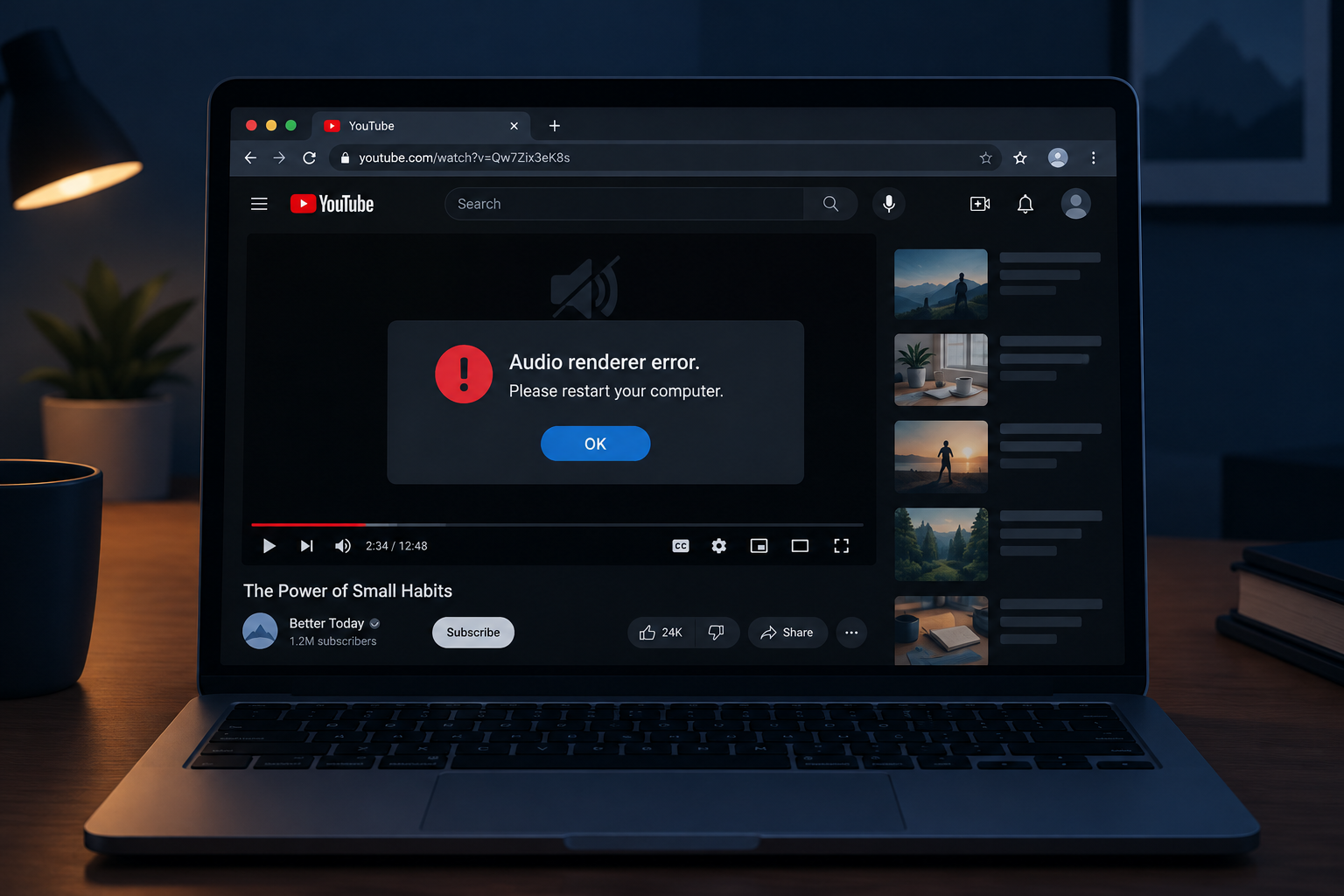
You click a new YouTube upload and get “Audio renderer error. Please restart your computer” instead of the video. Switching browsers doesn’t help, because the same message appears there too.
Why the audio renderer error happens
The error comes from Windows, not from the browser. That’s why it shows up in Chrome, Firefox, Edge and Opera alike, and under every Windows user account on the PC. It became widespread in 2018, around Windows 10 version 1803, and it still turns up on Windows 10 and Windows 11 today. YouTube is where most people see it, but users on the Acer Community forum also report it while playing games.
In most user reports the cause is the audio driver: it is corrupted, out of date or stuck. Other common causes:
- Motherboard bugs. Some motherboard models have recurring audio bugs that trigger the error.
- A Dell BIOS bug. On a number of Dell computers, a bug in one BIOS version causes it.
- Sample rate conflicts. Music software such as Steinberg’s Cubase uses an ASIO driver, a low-latency audio driver. If Cubase and Windows try to use the same audio hardware at different sample rates, they clash and the error appears.
The error is annoying, but it is not a virus or a sign of hacking. Start with these quick, temporary fixes:
- Restart the computer. This is what the message asks for. A restart reloads the audio driver and clears temporary driver and background process problems. For some people the error goes away for good. For others, sound only lasts a few minutes or a few videos before the error comes back.
- Unplug and replug your headphones or speakers. Unplug them from the audio jack or USB port, wait about a minute, then plug them back in. This often lasts longer than a restart, sometimes a whole session, before the error returns.
- Disconnect any second playback device. Several guides link the error to having more than one output connected at once, such as USB headphones plus a monitor with speakers.
If you’re tired of repeating these, work through the fixes below in order. Dell owners may only get a permanent fix from a BIOS update. Cubase users need to match the sample rate and bit depth.
First, check which version of Windows you have. Windows 10 reached end of support on October 14, 2025. In June 2026 Microsoft extended its consumer Extended Security Updates (ESU) program, so enrolled home PCs now get security updates until October 12, 2027. The steps below give the Windows 11 menu path first and the Windows 10 path second.
5 ways to fix the audio renderer error on Windows 11 and Windows 10
The fixes go from quickest and safest to most involved. After each one, restart and play the video again before you move on.
Method 1: Run the audio troubleshooter
Windows has a built-in audio troubleshooter that checks your sound settings, the audio service and the driver, and fixes common problems automatically. Microsoft says to run it first. On Windows 11, Microsoft has retired the old troubleshooters, so the audio troubleshooter now runs in the Get Help app.
On Windows 11:
- Press Windows key + I to open Settings.
- Go to System > Troubleshoot > Other troubleshooters.
- Next to Audio, click Run. The Get Help app opens. If it asks for consent to run diagnostics, select Yes.
- When asked, choose the device that shows the audio renderer error and answer the prompts.
- Apply any fixes it suggests, then restart your computer and check whether the error is gone.
You can also open the Start menu, type Get Help, open the app, type audio troubleshooter in its search bar and press Enter.
On Windows 10:
- Press Windows key + I to open Settings, then click Update & Security.
- Click Troubleshoot in the left pane. You can also open this page by pressing Windows key + R, typing ms-settings:troubleshoot and pressing Enter.
- On the right, click Additional troubleshooters.
- Under Get up and running, click Playing Audio, then click Run the troubleshooter.
- After it checks the drivers and the audio service, the troubleshooter asks you to pick a device. Choose the one that shows the error and click Next.
- The scan can take a few minutes. If it finds a problem, follow the on-screen prompts to fix it.
- Restart your computer and check whether the error is gone.
Method 2: Disable and enable the audio device
Turning the audio device off and on again works like a restart for that one device. It reloads the driver and clears temporary glitches without rebooting the whole PC. One Acer Community user reported that this fixed the error every time it came back. Games that depend on the default audio device can break too. Some stardew valley wont launch issues have been traced to a missing or disabled playback device, so make sure every device is turned back on before you test.
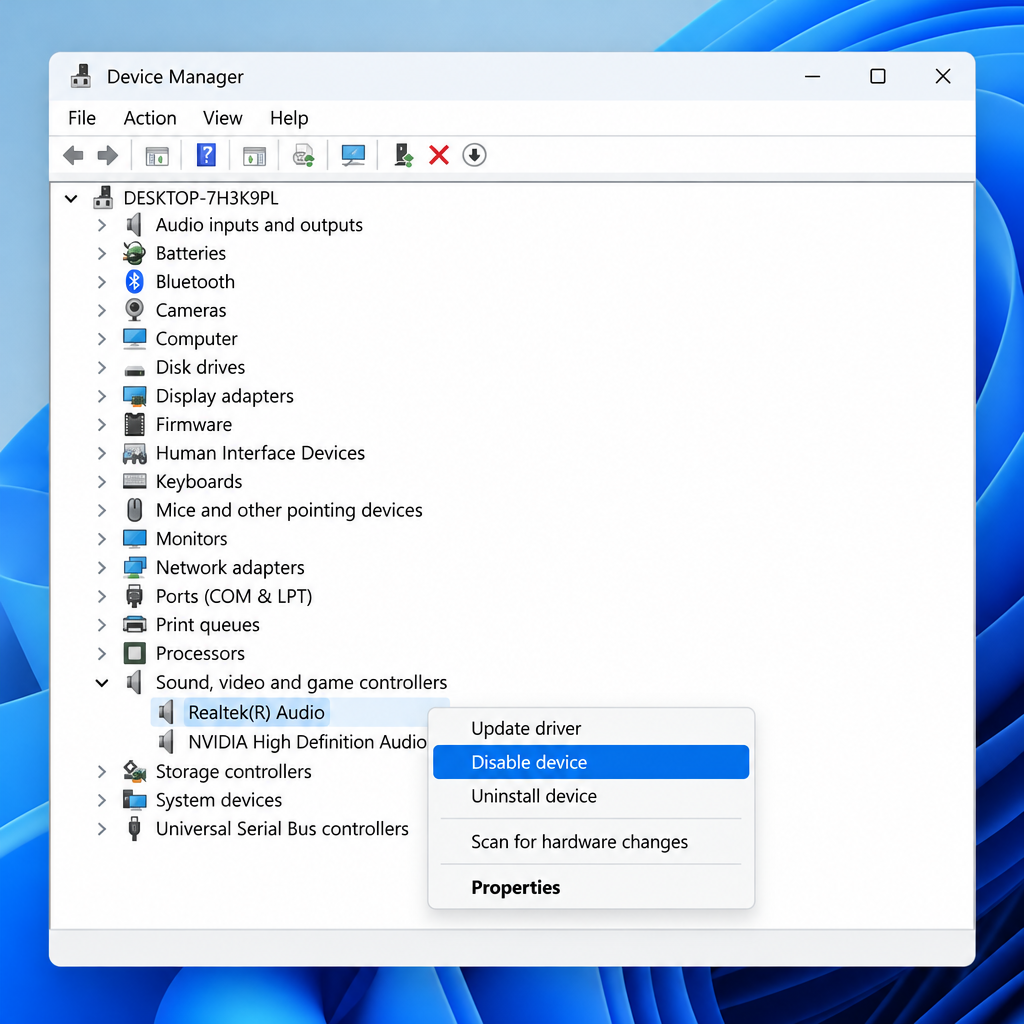
- Right-click the Start button to open the Power User menu, then click Device Manager. You can also press Windows key + R, type devmgmt.msc and press Enter.
- Expand Sound, video and game controllers by double-clicking the label or clicking its arrow. Right-click the first device and choose Disable device. Click Yes to confirm.
- Repeat step 2 for every audio device in the list.
- Wait a minute or two. Then right-click each device again and choose Enable device.
- Restart your PC.
If the error comes back in the middle of a session, restarting the Windows Audio service is a quicker way to get sound back. Press Windows key + R, type services.msc and press Enter. Right-click Windows Audio and choose Restart.
Method 3: Roll back, update or reinstall the audio driver
A corrupt or outdated driver is the most common cause of the audio renderer error, so this is the fix most likely to last. Microsoft recommends keeping the audio driver up to date. If that doesn’t work, uninstall it, and Windows reinstalls it automatically when you restart. If the error started right after a driver update, try a rollback first.
- Open Device Manager and expand Sound, video and game controllers (see steps 1 and 2 of Method 2).
- Double-click your audio device to open its Properties window.
- Go to the Driver tab. Click Roll Back Driver to go back to the previous version, if that option is available. If it isn’t, or the rollback doesn’t help, click Uninstall Device to remove the device and its driver. Confirm any pop-up messages.
- If you uninstalled the driver, restart your computer. Windows reinstalls a working driver automatically.
- To get a newer driver, check Windows Update. On Windows 11, go to Settings > Windows Update > Advanced options > Optional updates > Driver updates. On Windows 10, go to Settings > Update & Security > Windows Update > View optional updates. You can also download the latest audio driver for your model number or service tag from your PC or motherboard maker’s support site (Dell, HP, Lenovo, Acer, ASUS and others), or from your sound card maker’s site.
Only get drivers from Windows Update and official vendor sites. Third-party “driver updater” tools add risk without fixing anything the official routes can’t, and some install the wrong driver. If Device Manager says the operation did not complete successfully, restart the PC and try the step again. If it keeps failing, install the vendor’s driver package directly.
Method 4: Change the audio sample rate and bit depth
This fix works because the error often comes from two programs using the audio device at different sample rates. Setting Windows to one fixed format ends the clash. Users on Microsoft’s forums report that this alone fixed the error. For most people, 24 bit, 48000 Hz (Studio Quality) is a good default because it matches most video and game audio. If that doesn’t help, try 16 bit, 44100 Hz (CD Quality). If the error only appears while a Cubase window is open, use the sample rate your Cubase projects use and match it in Cubase as described below.
On Windows 11:
- Go to Settings > System > Sound and click the output device that shows the error. You can also right-click the speaker icon on the taskbar and choose Sound settings.
- Under Output settings, open the Format drop-down and choose 2 channel, 24 bit, 48000 Hz (Studio Quality), 2 channel, 16 bit, 44100 Hz (CD Quality), or whatever rate your Cubase projects use.
- You can make the same change in the classic dialog. Click More sound settings at the bottom of the Sound page, select the device on the Playback tab, click Properties, open the Advanced tab and pick the Default Format. Click Apply, then OK.
On Windows 10:
- Right-click the speaker icon on the taskbar and choose Sounds. If you don’t see the icon, click the upward-facing Show hidden icons arrow. On newer Windows 10 builds, choose Open Sound settings, then click Sound Control Panel.
- On the Playback tab, select the device that shows the error and click Properties.
- Go to the Advanced tab and choose 24 bit, 48000 Hz, 16 bit, 44100 Hz or your preferred rate as the Default Format. Click Test to check that sound plays.
- Click Apply, then OK.
If the 24-bit options are missing or greyed out, update the audio driver first (Method 3).
Then match the rate in Cubase:
- In Cubase, open Studio > Studio Setup and select your ASIO driver under Audio System. Click Control Panel to open the ASIO driver’s settings.
- Set Sample Rate (Hz) to the same value you chose in Windows, for example 44100.
- Check that your project uses the same rate under Project > Project Setup.
- Restart the PC so the changes take effect.
The same rule applies to other music software that uses an ASIO driver: set it to the same rate as Windows.
Cubase also has an option on the Audio System page called Release Driver when Application is in Background. It hands the audio hardware back to other apps when Cubase isn’t the active window. That can help if your interface’s ASIO driver only supports one app at a time. Steinberg forum users report mixed results with it, so test playback in both Cubase and your browser after you change it.
Method 5: Update the BIOS (Dell users)
On Dell computers, the fixes above may not be enough. Many Dell owners report that a bug in one BIOS version causes the audio renderer error and that only a BIOS update fixes it. Try the safer driver and format fixes first. On other brands, only update the BIOS if the maker’s release notes list an audio fix.
A BIOS update sounds daunting, but Dell offers several official ways to do it in its “Dell BIOS and UEFI Update Download and Installation Guide”:
- SupportAssist. Dell recommends this for most users. Open the Start menu, search for SupportAssist and open the app. It scans your PC for updates, including the BIOS, and installs them.
- Windows Update. Dell BIOS updates can appear as Dell firmware under optional driver updates.
- Standalone utility. Enter your Service Tag on the Drivers & Downloads page on Dell’s support site, download the latest BIOS file for your exact model and run it. Use this if the other methods fail.
On Windows 11 24H2 PCs that had the January 2025 update installed, some BIOS updates through SupportAssist failed or got stuck. Dell says it has released BIOS versions that fix this, so download the latest one for your model from Drivers & Downloads.
SupportAssist and Windows Update both need a working internet connection to find the BIOS file. Fix any network trouble before you start, such as the limited access issue tp link Wi-Fi adapter owners often report.
Before you start the BIOS update:
- Back up your important files. Dell warns that a failed BIOS update can leave the computer unable to start.
- Plug a laptop into AC power and keep it plugged in for the whole update. Don’t run the update on battery alone.
- Unplug external devices such as hard drives, USB drives and printers.
- If BitLocker is turned on, go to Manage BitLocker and choose Suspend protection. Otherwise Windows asks for the BitLocker recovery key at the next restart. Turn protection back on after the new BIOS is installed and the PC starts normally.
- If you have set a BIOS admin password, clear it first. Dell notes that some update methods, including SupportAssist, can’t get past one.
Never turn off the PC while the update runs. If you aren’t comfortable doing this, ask Dell support or a repair shop. HP, Lenovo and ASUS offer BIOS updates through their own support tools. Only install them from the maker’s site.
If nothing works
Try another browser, or update the one you use, and test sound in a different app such as a local video or music file. If sound plays everywhere except one browser, reset or reinstall that browser. If the error or silence appears in every app, the problem is in Windows, the driver or the hardware.
Get professional help if the error continues after a driver reinstall, the latest BIOS from your PC maker and a test with different headphones or speakers. At that point the sound chip or motherboard may be faulty. Contact your PC maker’s support, especially if the computer is still under warranty. On Windows 10, make sure the PC is enrolled in Extended Security Updates so it keeps getting fixes.
FAQ
Is the audio renderer error caused by YouTube or my browser?
No. The error comes from Windows and its audio driver, which is why it follows you from Chrome to Firefox, Edge or Opera. YouTube is just where most people notice it first, because it’s often the first thing that plays sound. Fix the driver or audio device and the error goes away in every browser.
Why does the error come back after I restart?
A restart or replugging your headphones only resets the driver for that session. If the driver is corrupt or outdated, the Dell BIOS bug is present, or two apps keep fighting over different sample rates, the error comes back. Work through Methods 2 to 5 to fix the actual cause.
Is the audio renderer error a virus?
No. It is a Windows audio driver or device conflict, not malware. Be wary of websites that say you need a “repair tool” or driver updater to fix it. The built-in troubleshooter, Device Manager and your PC maker’s drivers are all you need.
Can headphones cause the audio renderer error?
Yes, especially USB and Bluetooth headsets, and setups with more than one playback device connected. Unplugging and replugging the headphones often gets you through a session. Disabling and re-enabling the device in Device Manager, or reinstalling its driver, usually fixes it for longer.
Do these fixes still work on Windows 10?
Yes. Every method here has a Windows 10 menu path, and the Device Manager steps are the same on both versions. Windows 10 support ended on October 14, 2025, so make sure your PC is enrolled in Extended Security Updates, which now cover home users until October 12, 2027.
Is it safe to uninstall my audio driver?
Yes. It’s one of Microsoft’s own recommended fixes. When you restart, Windows reinstalls a working audio driver automatically. You’ll have no sound until the restart finishes, so save your work first.
Sources
- Microsoft Support: Fix sound or audio problems in Windows
- Microsoft Support: Windows troubleshooters (Get Help)
- Microsoft Support: Deprecation of Microsoft Support Diagnostic Tool (MSDT) and MSDT Troubleshooters
- Microsoft: Windows 10 Consumer Extended Security Updates (ESU)
- Dell Support: Dell BIOS and UEFI Update Download and Installation Guide
- Dell Support: BIOS Update Error or Update Gets Stuck After Windows January 2025 Update
- Steinberg Help: Audio System Page (Cubase)
- Acer Community: How do I fix audio renderer error permanently












