Amazon Mechanical Turk closed for good on September 30, 2026, after about 21 years. Former workers should look first at Prolific and CloudResearch Connect for paid studies and at Mindrift, DataAnnotation and Outlier for AI training work. Researchers have mostly moved to Prolific and Connect AI, and AI teams buying training data now use managed vendors or SageMaker Ground Truth with a private workforce.
Key takeaways
- MTurk is gone. The only date still open is January 28, 2027, when transaction history disappears.
- Former Turkers earn the most per hour from paid research studies (minimums of $7.50 to $8 an hour) and from AI training platforms.
- On paper, research panels charge higher fees than MTurk did. Per usable response they cost less, according to a 2023 PLOS ONE study.
- Amazon’s closure FAQ says nothing about transferring accounts or balances, so anyone selling “MTurk accounts” is running a scam.
Fact-checked
We checked these key facts against the sources named, on November 19, 2026:
- Download your history before January 28, 2027 (source: cmu.edu)
- Independent 2026 reviews put basic tasks at roughly $2 to $7 an hour effective (source: shifttrackerapp.com)
- On Prolific corporate that costs about $2.86 per complete, and $2.67 at the academic rate (source: researcher-help.prolific.com)
- Work, payments and account changes all stopped on fixed dates between July 2026 and January 2027 (source: mindrift.ai)
- Prolific charges 42.8% of rewards for corporate customers and 33.3% for academic customers, plus an $8 an hour pay minimum (source: researcher-help.prolific.com)
Is Mechanical Turk still working? No. Here’s exactly what happened
No. Amazon Web Services (AWS) shut down MTurk permanently on September 30, 2026, and mturk.com now shows a closure notice that points to its FAQ. Work, payments and account changes all stopped on fixed dates between July 2026 and January 2027.
The rest of this page splits into three tracks. Former workers should read the account checklist and the worker section. Academic and survey researchers should go to the Prolific and Connect AI section. Businesses and AI teams labelling data should go to the section on self-serve crowds, managed vendors and SageMaker Ground Truth.
The shutdown timeline, date by date
Amazon wound MTurk down in stages, so the deadline that mattered to you depended on whether you posted work or did it.
| Date | What happened | What it means for you |
|---|---|---|
| May 15, 2026 | CloudResearch announced the sunset of its MTurk Toolkit (formerly TurkPrime) | Researchers using the Toolkit had to plan a move |
| July 5, 2026 | Amazon said MTurk would stop taking new customers | Existing customers kept support, but no new features arrived |
| July 30, 2026 | New-customer cutoff | No new requester accounts after this date |
| August 25, 2026 | Amazon announced the full closure | First official confirmation that the whole service would end |
| September 30, 2026 | MTurk closed. Unsubmitted HITs expired. The MTurk workforce option was removed from SageMaker Ground Truth and Amazon Augmented AI (A2I). The CloudResearch Toolkit stopped running studies | No new work could be done or submitted |
| October 30, 2026 | Last day for requesters to approve or reject completed HITs and pay bonuses. Completed HITs with no decision were auto-approved | After this date, payment-detail changes go through MTurk Customer Service |
| January 28, 2027 | Transaction history is no longer available | Download your records before this date |
Why Amazon closed it (what Amazon said vs. what observers think)
Amazon’s statement, reported by CNBC on August 25, 2026, was short: “Following an assessment, we’ve made the decision to close AWS Mechanical Turk, effective September 30, 2026.” Amazon gave no detailed reason.
The likely causes are easy to spot, though. Large language models now handle most of the cheap work that kept MTurk busy: tagging images, rewriting sentences, sorting text. Quality on the platform had also slipped. In 2023, EPFL researchers Veselovsky, Horta Ribeiro and West estimated that 33% to 46% of MTurk workers on one text-summarisation task had used a large language model to do it. That undercut the whole point of paying for human answers.
Demand also changed. AI labs now want vetted experts for evaluation and reinforcement learning from human feedback (RLHF), and that work moved to managed vendors such as Scale AI and Surge AI. The cheap-crowd era was over before MTurk was.
Former MTurk workers: what to do with your account now
You still have a few things to do even though the work has ended. Save your records, keep them for taxes, use official support for payment problems, and ignore anyone who says they can revive or transfer your account.
Close out your MTurk account
- Sign in to MTurk and download your full transaction history.
- Save it with your tax records for 2026.
- Check that your final approved earnings and any bonuses arrived.
- Contact MTurk Customer Service about any payment-detail changes after October 30, 2026.
- Ignore any offer to buy, sell or “transfer” MTurk accounts or balances.
Download your earnings history before January 28, 2027
Your MTurk transaction history stays available until January 28, 2027, and Amazon has not said it will reopen access after that. Download it now, even if you think you won’t need it. It is the only proof of your 2026 MTurk income and of any final payments that were auto-approved on October 30.
Pro tip
Save the download in two places, such as a cloud drive and a USB stick. If a tax question comes up in 2028, the MTurk site won’t be there to check.
Taxes and final payments
Amazon says tax documents will still go out through its normal processes and deadlines. Watch the email address on your MTurk account and your Amazon Payments details. If a requester never approved or rejected your completed work, it was auto-approved on October 30, 2026, so that money should have reached your balance.
Did you ask whether you’ll still get paid what’s left in your balance? The official route is MTurk Customer Service, which handles payment-detail changes after October 30. Use the contact option linked from the closure FAQ on mturk.com, not a phone number from a search ad or social media post.
Scams to ignore
Amazon’s closure FAQ mentions no transfer of accounts or balances. So a website, Telegram channel or Discord seller offering “approved MTurk accounts”, “balance transfers” or a way to keep earning on MTurk is offering something that doesn’t exist. At best you lose the money you pay. At worst you hand over identity documents or login details.
Best Mechanical Turk alternatives for workers
For most former Turkers, paid research studies on Prolific and CloudResearch Connect are the best replacement. If you can pass a skills test, AI training platforms pay much more. Plain microtask sites still exist, but the hourly rates look a lot like late-era MTurk.
The work hasn’t vanished, but it has moved. Requesters went where quality controls and hourly minimums are enforced, and AI companies hired contractors directly. Here is where you can earn now.
Paid research studies: Prolific and Connect
Prolific is the closest thing to “MTurk surveys, but fairer”. Studies on Prolific must pay at least £6.00 an hour ($8.00), and Prolific recommends £9.00 ($12.00). You see the reward and the estimated time before you start, so you know the hourly rate up front. Prolific says it has more than 300,000 active participants, which is its own figure. That means a lot of competition for each study.
CloudResearch Connect is run by the company behind the old MTurk Toolkit, and many former MTurk requesters followed it there. Its participant minimum is $7.50 an hour. That minimum went up from $6 an hour at the end of 2024.
Both platforms can put new sign-ups on a waitlist when demand from participants is high, and a wave of former Turkers arrived at once in late 2026. Neither platform publishes waitlist times. Expect weeks rather than days, and fill in your demographic and screener profile in full, because that decides which studies you’re shown.
Pro tip
Apply to Prolific and CloudResearch Connect on the same day. Both can put you on a waitlist, so applying to both gets you working sooner.
Microtasks closest to HITs: clickworker and Toloka
clickworker, owned by the AI data company LXT, is the nearest thing to the old HIT queue. It offers short writing, tagging, search-relevance and survey tasks, paid per task. It also gives qualified workers access to Microsoft’s Universal Human Relevance System (UHRS) tasks. clickworker publishes no official rate card. Independent 2026 reviews put basic tasks at roughly $2 to $7 an hour effective. Qualified UHRS work is reported at somewhere between $8 and $25 an hour, with large swings from week to week.
Toloka has changed shape. Its worker-side tasks and projects moved to Mindrift in mid-2026. Mindrift’s own welcome page tells “Tolokers” that their account, balance and history moved over automatically, so you log in there with the same details. Mindrift pays accepted tasks twice a month through Payoneer or Tipalti (PayPal). If you search “Toloka” for work now, you’ll end up at Mindrift.
AI training work: DataAnnotation, Outlier, Mindrift and others
This is the best-paid track for former Turkers who write well or have a degree-level specialty. You rate chatbot answers, write prompts and correct model output. It is the “human” part of AI that MTurk used to sell.
- DataAnnotation (the official site is dataannotation.tech) says general projects start at $20 an hour. Coding and STEM work starts at $40, and professional work in law, finance or medicine starts at $50. These are the company’s own figures. Worker reports vary, and some describe far fewer projects than the starting rate suggests. It is widely reported to be the contributor platform for Surge AI.
- Outlier is the contributor platform of Scale AI. Its generalist page advertises “up to” $12.50 to $34.50 an hour, depending on quality, accuracy and time spent. It pays through PayPal and AirTM. Third-party trackers put typical generalist listings near $19.50 an hour, and workers say work can pause between projects.
- Mindrift (Toloka’s platform) now carries the old Toloka tasks as well as expert AI-training projects.
- Mercor hires domain experts, such as lawyers, doctors and engineers, on hourly AI-training contracts for labs. It suits professionals more than casual earners.
- TELUS Digital (formerly TELUS International) and Appen recruit search and ads raters and AI-data contributors. These are usually part-time contract roles with a qualification exam and set weekly hours.
Is DataAnnotation or Outlier worth it, or are they scams? Both are real platforms that pay real money. The usual complaints are unpredictable work, unpaid onboarding tests and accounts dropped from projects without a clear reason. Treat them as variable side income, not a salary. The scam risk is impersonation: fake recruiters on messaging apps who use these brand names and ask for fees or bank details. Real platforms never charge you to join.
Can you make $100 a day? Realistic expectations
On MTurk, almost no one did. The largest log study of the platform, by Hara and colleagues (CHI 2018), followed 2,676 workers across 3.8 million HITs from September 2014 to January 2017. It found a median wage of $2.00 an hour and a mean of $3.13. At $2.00 an hour, $100 takes about 50 hours of work.
Did you know?
According to Hara et al.’s 2018 CHI study, workers earned a median of $2.00 an hour and only 4% earned more than $7.25 an hour, even though requesters paid an average of $11.58 an hour. Unpaid time spent searching for and returning HITs made up the gap.
On today’s alternatives the maths is better, but supply is the limit. At Prolific’s recommended $12 an hour you would need about 8.5 hours of studies a day, and few accounts see that many. Earning $100 a day is realistic only on AI-training projects at $20 to $40 an hour, and only while a project is running.
To check that a requester or platform pays fairly before you start, look at the hourly rate. Prolific and Connect show it on every study. On per-task sites, time your first few tasks yourself. Turkopticon, the worker-run requester review tool, was built for MTurk, so worker forums and subreddits such as r/beermoney are now the main places to compare notes.
Best alternatives for academic researchers and survey teams
Prolific and CloudResearch Connect (sold to researchers as Connect AI) are the two main replacements for MTurk survey research. Both enforce hourly pay minimums, offer prescreening and charge lower academic fees. SurveyMonkey Audience and Qualtrics panels make sense when you need a quoted, managed sample rather than a self-serve participant pool.
Prolific: fees, screeners and setup
Prolific adds a platform fee of 42.8% on top of participant rewards for corporate customers and 33.3% for academic and non-profit customers. In practice, you multiply rewards by about 1.43 or 1.33 to get your total. Participant pay must be at least $8.00 an hour, with $12.00 recommended.
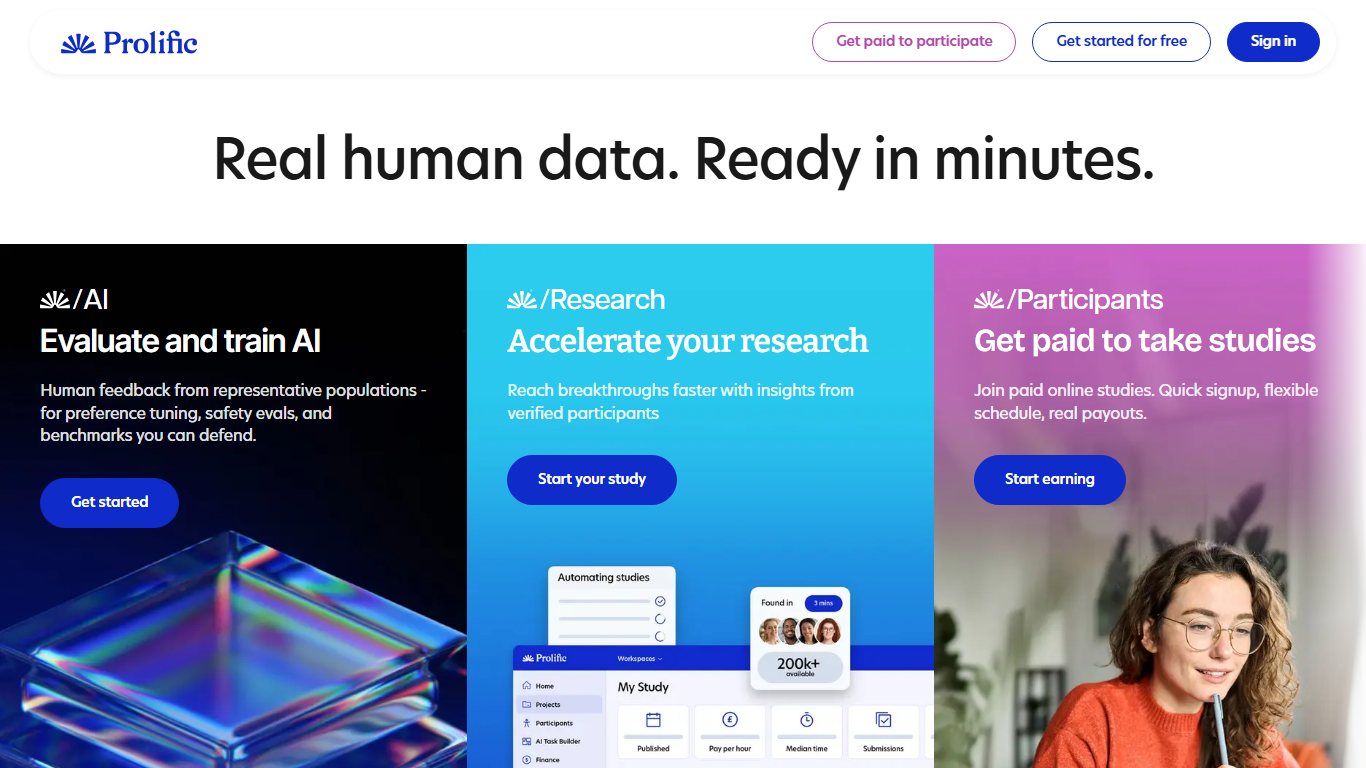
The main reason to choose Prolific is targeting. Prolific says it offers more than 300 free pre-set screeners covering demographics, health, employment and more. You can also invite earlier participants back for follow-up waves, which suits longitudinal studies. Setup works with Qualtrics, Gorilla, jsPsych and other external tools: you paste your study link and Prolific passes participant IDs in URL parameters.
CloudResearch Connect AI: fees, minimums and HIT migration
Connect’s standard service fee has been 40% since January 1, 2025, and academic and non-profit accounts pay 25%. The participant minimum is $7.50 an hour.
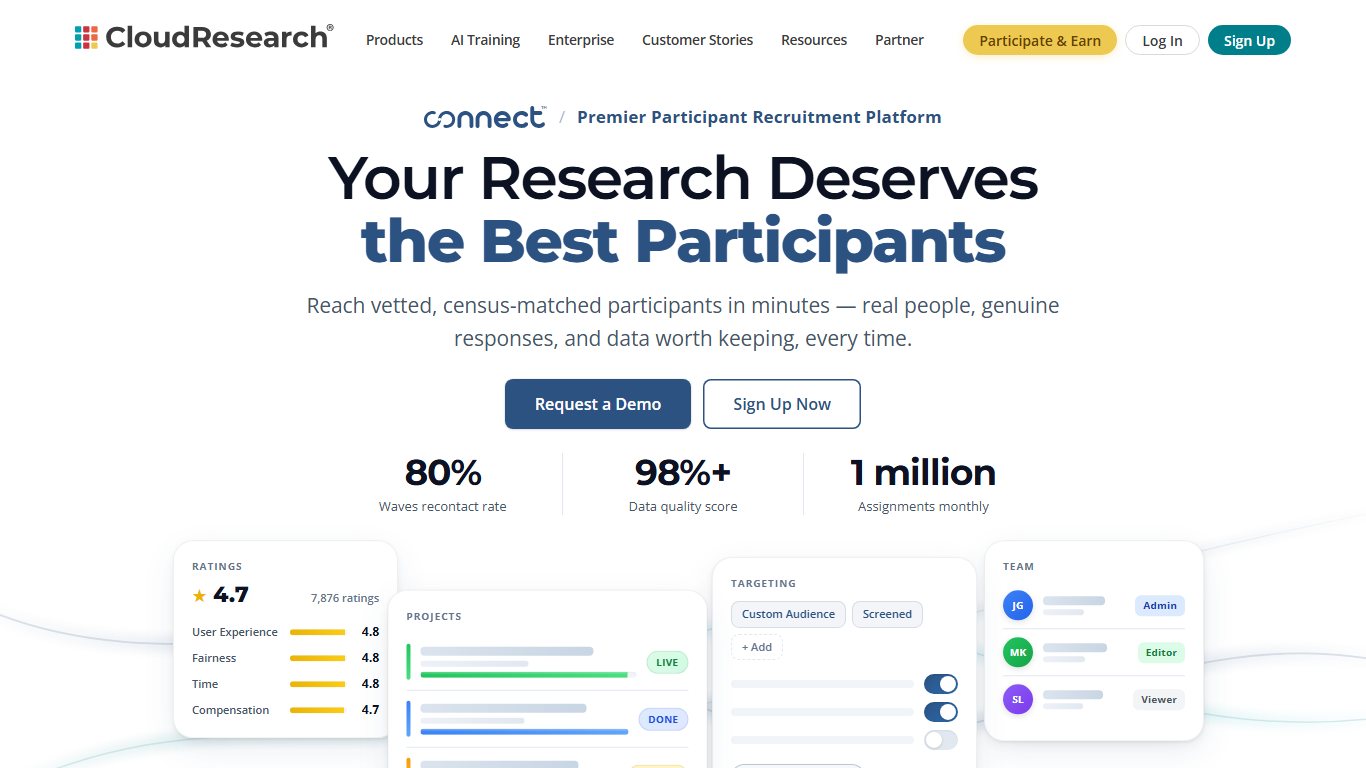
For former MTurk requesters, Connect is the easiest move. CloudResearch ran the MTurk Toolkit until September 30, 2026, so its tools use familiar concepts: worker inclusion and exclusion lists, bonuses and HIT-style tasks. CloudResearch markets Connect AI to MTurk refugees as able to host HIT-style tasks built with MTurk’s Crowd HTML Elements. Run a pilot before you assume a complex template moves over unchanged.
SurveyMonkey Audience and Qualtrics panels
SurveyMonkey Audience and Qualtrics panel services sell sample by the completed response. The price depends on length, targeting and incidence. These services suit market research teams that need nationally balanced or hard-to-reach samples and are happy with a quote instead of a self-serve dashboard. They also cost more per complete for quick academic pilots.
Budget formula
Multiply your participant pay by 1.428 on Prolific corporate (1.333 academic), or by 1.40 on Connect standard (1.25 academic), to get the real total before you request funds.
What the data-quality studies actually found
The best independent comparison is Douglas, Ewell and Brauer’s 2023 study in PLOS ONE. It ran the same survey on MTurk, Prolific, CloudResearch, Qualtrics and an undergraduate pool. MTurk had lower attention-check pass rates and lower test-retest reliability. Once low-quality answers were removed, MTurk was also the most expensive option.
| Measure | MTurk | Prolific | CloudResearch |
|---|---|---|---|
| Cost per high-quality respondent (Douglas et al., 2023) | $4.36 | $1.90 | $2.00 |
| Attention-check pass rate (Douglas et al., 2023) | Lowest of the three | Higher | Higher |
| Test-retest reliability (Douglas et al., 2023) | Lowest of the three | Higher | Higher |
| Platform fee (2026 / at closure) | 20%, or 40% for 10+ assignments | 42.8% corporate, 33.3% academic | 40% standard, 25% academic |
| Minimum participant pay | None (tasks from $0.01) | $8.00/hr | $7.50/hr |
Did you know?
According to Douglas, Ewell and Brauer’s 2023 PLOS ONE study, a high-quality survey response cost more than twice as much on “cheap” MTurk ($4.36) as on Prolific ($1.90), once bad answers were thrown out.
Most of the pages ranking for this topic are written by the platforms themselves. That includes Prolific, CloudResearch, LXT, iMerit and RentAHuman. Read their quality claims with that in mind. A vendor’s “ranked #1” claim is worth less than a peer-reviewed comparison that publishes its method and all the samples it compared.
Best alternatives for businesses and AI teams labelling data
For high-volume, simple labelling, use a self-serve crowd such as Toloka or clickworker. For expert, RLHF or regulated data, use a managed vendor. If your pipeline already runs on AWS, keep SageMaker Ground Truth and swap the MTurk workforce for a private or vendor workforce.
Self-serve crowds
Toloka still runs a requester platform and openly targets MTurk customers (“Your crowdsourcing platform is closing. Keep your global workforce on Toloka”). Its fee is a percentage of task cost, bonuses included, and its budget review screen shows the total before launch. You can use fixed pricing or dynamic pricing based on worker skill. For custom data collection, Toloka asks you to contact its sales team.
clickworker offers both a self-service marketplace and managed projects through its parent company LXT. Pricing is quoted per project.
Managed annotation and RLHF vendors
Managed vendors cost more per label and often less per usable label, because they handle vetting, training, quality review and rework. These are the main options:
- Scale AI: large-scale labelling and RLHF, with its own Outlier workforce. Meta took a 49% stake in June 2025. Some AI labs see that as a neutrality concern, so weigh it if you compete with Meta.
- Surge AI: high-skill RLHF and model-evaluation data, linked to the DataAnnotation workforce.
- Appen: one of the oldest crowd data companies, with search-relevance and multilingual depth.
- Sama: managed annotation with an impact-sourcing model, mainly in East Africa.
- CloudFactory: managed workforce for computer vision and document data.
- iMerit: enterprise annotation for medical, geospatial and autonomous-vehicle data.
- LXT: AI data services, multilingual speech and text, and the clickworker crowd.
None of them publishes a standard price list. You get a quote after a scoping call and usually a paid pilot. Ask each vendor for inter-annotator agreement on your pilot batch, its policy on workers using AI tools, and where the workers are located, which matters if you have data-residency rules.
The case against managed vendors is fair. For simple, high-volume work with a clear “gold” answer, a self-serve crowd with good test questions is cheaper and faster to change. Pay managed rates only when errors are expensive.
Staying on AWS: SageMaker Ground Truth without MTurk
Amazon SageMaker Ground Truth and Amazon A2I still work. Only the MTurk public workforce option was removed, on September 30, 2026. You can switch the workforce type on existing labelling jobs and human-review workflows to a private workforce (your own staff, managed through Amazon Cognito) or to a vendor workforce bought through AWS Marketplace. Your templates, manifests and output format stay the same.
MTurk vs the alternatives: fees and pay at a glance
Self-serve research panels charge 25% to 43% on top of pay and enforce hourly minimums. Managed vendors quote per project. AI-training platforms pay workers the most. The table below uses official figures where they exist and marks third-party estimates.
| Platform | Best for | Workers can join? | Requester fee | Minimum / typical pay | Self-serve or managed | Source checked |
|---|---|---|---|---|---|---|
| MTurk (closed) | Comparison only | No | 20%, 40% for 10+ assignments | From $0.01 per task | Self-serve | Prolific comparison page |
| Prolific | Academic and market research | Yes (may waitlist) | 42.8% corporate, 33.3% academic | $8/hr minimum, $12/hr recommended | Self-serve | Prolific pricing page |
| CloudResearch Connect | Research, HIT-style tasks | Yes (may waitlist) | 40% standard, 25% academic | $7.50/hr minimum | Self-serve | CloudResearch help center |
| clickworker | Microtasks, UHRS | Yes | Quoted per project | About $2-$7/hr basic (third-party) | Both | Independent 2026 reviews |
| Toloka / Mindrift | Crowd labelling; AI training | Yes, via Mindrift | Percentage of task cost | Varies by project | Self-serve requester side | Toloka docs, Mindrift |
| DataAnnotation | AI training work | Yes (skills test) | Not a requester platform | From $20/hr (company figure) | Managed (Surge AI) | DataAnnotation blog |
| Outlier | AI training work | Yes (skills test) | Not a requester platform | Up to $12.50-$34.50/hr generalist | Managed (Scale AI) | Outlier careers page |
| Scale AI, Surge AI, Appen, Sama, CloudFactory, iMerit, LXT | Enterprise and RLHF data | Through their contributor programs | Quote only | Set by vendor | Managed | Vendor sites |
| SageMaker Ground Truth | AWS-native labelling | Private or vendor workforce only | AWS usage pricing | Set by your workforce | Self-serve tooling | AWS |
How to calculate real cost per usable response
Take a 10-minute survey paying $2.00, which works out to $12 an hour. On Prolific corporate that costs about $2.86 per complete, and $2.67 at the academic rate. On Connect it costs $2.80 standard or $2.50 academic. On MTurk, with 10 or more assignments, it would have cost $2.80.
Then divide by the share of responses you keep. If 30% fail your attention and AI-use checks, a $2.80 complete really costs $4.00 per usable answer. That gap is why Douglas et al. found MTurk the most expensive option per high-quality respondent despite its lower fee.
Which alternative fits you
Start from your situation, not the brand. The table below matches each type of former MTurk user to a first choice and a backup.
| If you are… | Start with | Backup option | Why |
|---|---|---|---|
| A former Turker doing surveys | Prolific | CloudResearch Connect | Enforced hourly minimums, rates shown up front |
| A former Turker with strong writing or a specialty | DataAnnotation or Outlier | Mindrift, Mercor | $20/hr and up when projects are available |
| A worker who liked quick HITs | clickworker | Mindrift | Closest task format, lower pay |
| An academic researcher | Prolific or Connect AI | Qualtrics panels | Academic fees of 33.3% and 25%, plus prescreening |
| A market research team | Prolific | SurveyMonkey Audience | Fast self-serve, or quoted balanced samples |
| An AI team doing simple labelling | Toloka | clickworker | Self-serve, priced per task |
| An AI team doing RLHF or expert data | Surge AI or Scale AI | Appen, iMerit, Sama, CloudFactory | Vetted experts and quality review |
| Already running on AWS | SageMaker Ground Truth (private or vendor workforce) | Managed vendor | Keeps your existing pipeline |
How this comparison was produced
Platforms were included if they were open to new sign-ups in November 2026 and could take on a real MTurk use case. Official, published fees and pay floors counted most. Peer-reviewed quality evidence came next, then fit for each of the three reader tracks. Third-party pay estimates are labelled as such, and vendor claims such as participant counts are marked as self-reported.
How to move a study or task off MTurk in an afternoon
Most survey studies move in a few hours: re-host the link, rebuild the screeners, set an hourly reward and add quality checks. HIT templates with custom code take longer and need a pilot run.
Before you start
Export everything you still have from MTurk (HIT templates, qualification lists, worker IDs and results) before January 28, 2027. Removing personal data from worker ID lists may also be required under your IRB protocol.
Migrate a study
- Export your HIT layouts, qualification definitions and past results as CSV or HTML files.
- Pick the platform from the tables above and open an academic account if you qualify.
- Re-host your Qualtrics or other survey link, and pass the platform’s participant ID through URL parameters.
- Replace MTurk completion codes with the platform’s completion redirect URL.
- Rebuild your screeners with built-in prescreeners rather than custom qualification tests.
- Time five to ten pilot runs, then set the reward per hour, not per task.
- Add attention checks and an AI-use check, then run a small pilot batch before full launch.
Translating MTurk terms
The ideas carry over even where the names change.
| MTurk term | Prolific | CloudResearch Connect |
|---|---|---|
| HIT | Study | Project or task |
| Assignment | Place (one participant) | Participant slot |
| Qualification | Prescreener / screener | Inclusion and exclusion criteria |
| Bonus | Bonus payment | Bonus |
| Approve / reject | Approve / reject submission | Approve / reject |
| Worker ID | Prolific ID | Connect participant ID |
Protecting data quality from bots and LLM answers
The 2023 EPFL finding that a third or more of MTurk summarisation workers used an LLM affects every platform, not just the closed one. Use open-ended items that need personal context. Disable pasting into free-text boxes where your survey tool allows it, check how long each response took, and include one item that tells participants not to use AI tools. Exclude with care and pre-register your exclusion rules so reviewers trust them.
Price per hour
Prolific’s minimum reward rate is £6 ($8) an hour, and Connect’s participant minimum is $7.50 an hour. Time your task with a few test runs before you set the reward, or the platform may flag your study as underpaying.
What “Mechanical Turk” means, and why the name fit
The original Mechanical Turk was a chess-playing “machine” that Wolfgang von Kempelen built in 1770 to impress Empress Maria Theresa. It looked like an automaton but hid a human chess master inside. Amazon picked the name in 2005 because its service did the same thing: software called it like a machine, and people did the work out of sight. Jeff Bezos called it “artificial artificial intelligence”.
The name ended up describing the closure too. Once real AI could do the cheap tasks, the hidden humans that remained were experts. Those experts are now hired by name, through the platforms above.
FAQ
Is MTurk still working?
No. MTurk closed permanently on September 30, 2026. Requesters had until October 30, 2026 to approve work and pay bonuses. The only thing still available is your transaction history, until January 28, 2027.
Why is Amazon shutting down MTurk?
Amazon only said the decision followed “an assessment”. The likely reasons are AI automating the cheap tasks MTurk depended on, quality problems including workers using LLMs, and AI-data buyers moving to managed expert vendors.
When did Mechanical Turk close?
It closed on September 30, 2026. The closure was announced on August 25, 2026, after new customers were cut off on July 30, 2026.
What happened to my MTurk balance and earnings history?
Completed HITs with no requester decision were auto-approved on October 30, 2026. For payment-detail changes, contact MTurk Customer Service. Tax documents follow Amazon’s normal process. Download your history before January 28, 2027.
Can you make $100 a day on MTurk?
Almost never. The Hara et al. study found a median wage of $2.00 an hour between 2014 and 2017, so $100 would have taken about 50 hours. On today’s alternatives, $100 a day is realistic only on AI-training projects paying $20 an hour or more.
What does “mechanical Turk” mean?
It refers to von Kempelen’s 1770 chess automaton, which secretly hid a human player. The phrase now means a system that looks automated but runs on hidden human work.
What is the best alternative to MTurk for workers?
Prolific is the best place to start, with Connect as a backup, because both enforce hourly minimums. If you can pass a skills test, DataAnnotation, Outlier and Mindrift pay more per hour but offer less predictable work.
What is the best MTurk alternative for academic research?
Prolific suits you best if prescreening and longitudinal follow-ups matter most. CloudResearch Connect AI suits you if you want the lowest academic fee (25%) and familiar MTurk-style tools.
Is Prolific better than MTurk?
For data quality, yes. Douglas et al. (2023) found Prolific gave higher attention-check pass rates and test-retest reliability, and a cost per high-quality respondent of $1.90 against $4.36 on MTurk.
How much does Prolific cost compared with MTurk?
Prolific charges 42.8% of rewards for corporate customers and 33.3% for academic customers, plus an $8 an hour pay minimum. MTurk charged 20%, or 40% for 10 or more assignments, with no minimum. Prolific costs more per complete and less per usable answer.
If you were a worker, download your MTurk history today and apply to two platforms this week. If you post work, run a 20-person pilot on your chosen platform before you move the whole study.