
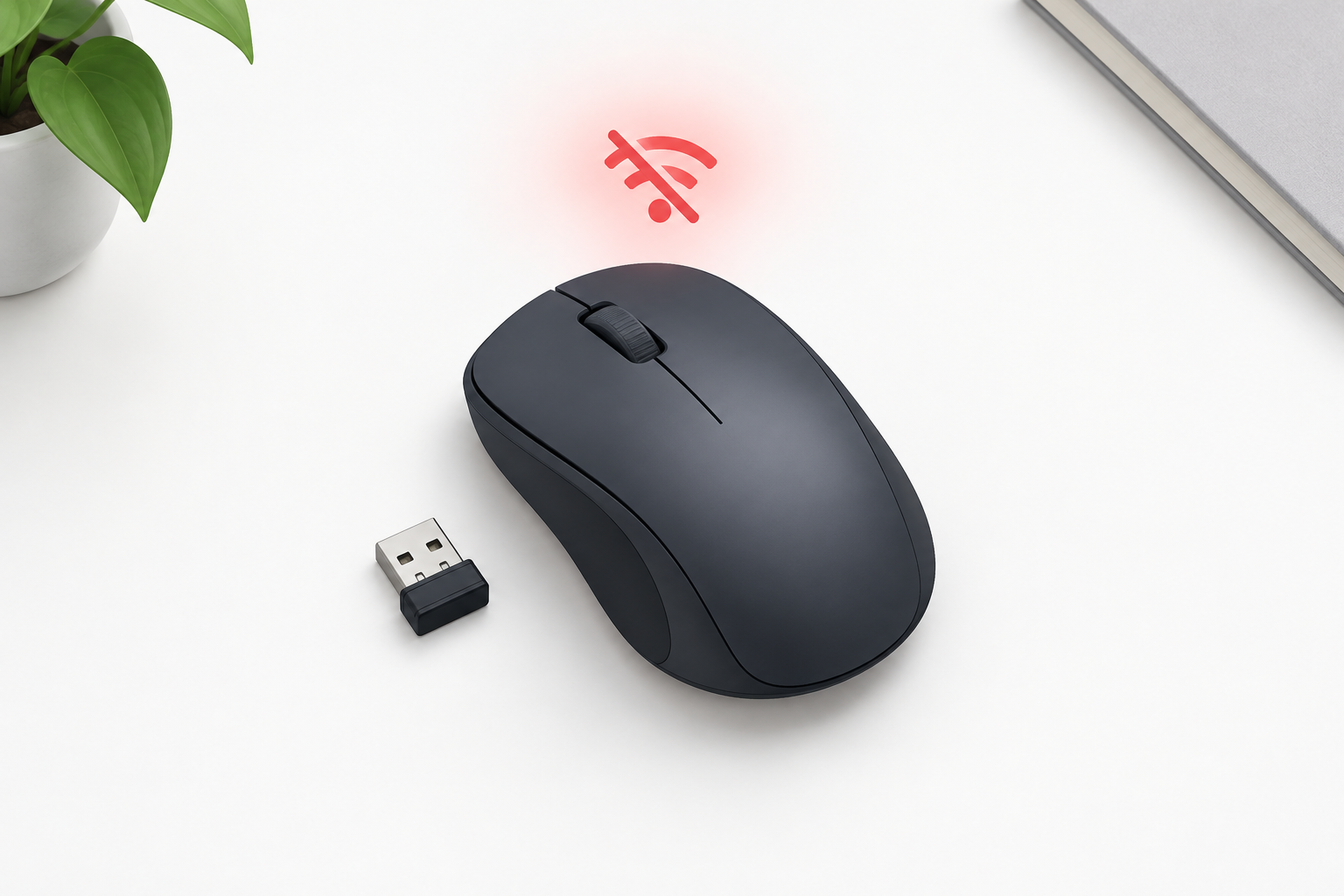
Start with the basics. Fit fresh batteries or charge the mouse, plug the USB receiver into a different port (ideally a USB 2.0 port away from any USB 3.0 devices), and restart the PC. If that fails, check in Device Manager that the mouse is enabled, then reinstall its driver through Device Manager or Windows Update. If the mouse still fails on a second computer, the mouse is faulty, so contact the manufacturer.
A wireless mouse that stops working in the middle of an important task is frustrating, but most cases have a quick fix. The causes are usually simple: a flat battery, a bad USB port, radio interference, a Windows setting or a driver problem. The fixes below run from the quickest and safest to the most involved.
One note on Windows versions. Microsoft ended Windows 7 support on January 14, 2020. Free Windows 10 support ended on October 14, 2025, and the paid consumer Extended Security Updates (ESU) program ran until October 13, 2026. The steps still work on both older systems, but Windows 11 (version 25H2 is the current release) is the only one of the three still getting regular updates.
Signs your wireless mouse needs fixing
A wireless mouse that connects through a USB receiver over radio frequency (RF) usually shows one of these symptoms when something is wrong:
- The cursor freezes on the screen.
- The cursor lags or sometimes ignores your movements and clicks.
- Windows does not detect the wireless mouse at all.
- The cursor jumps around erratically.
- The mouse stops working completely on Windows 11, 10 or 7.
The methods below fix all of these.
Why your wireless mouse stops working
- Hardware damage.
- Flat or weak batteries.
- Connection problems between the mouse and its receiver.
- Outdated or corrupted drivers.
- Interference from other devices and programs.
- Windows glitches, often after an update or a Fast Startup boot.
Interference is easy to overlook. Most wireless mice with a USB receiver use the 2.4 GHz band. Wi-Fi routers share that band, and so do many gadgets that connect over Wi-Fi, from GoPro cameras and gopro alternatives that pair with your phone to virtual reality headsets. Logitech also warns that USB 3.0 ports and devices can disrupt a 2.4 GHz USB 2.0 receiver. The result is delayed cursor movement and missed clicks.
Fix 1: Try these quick checks first
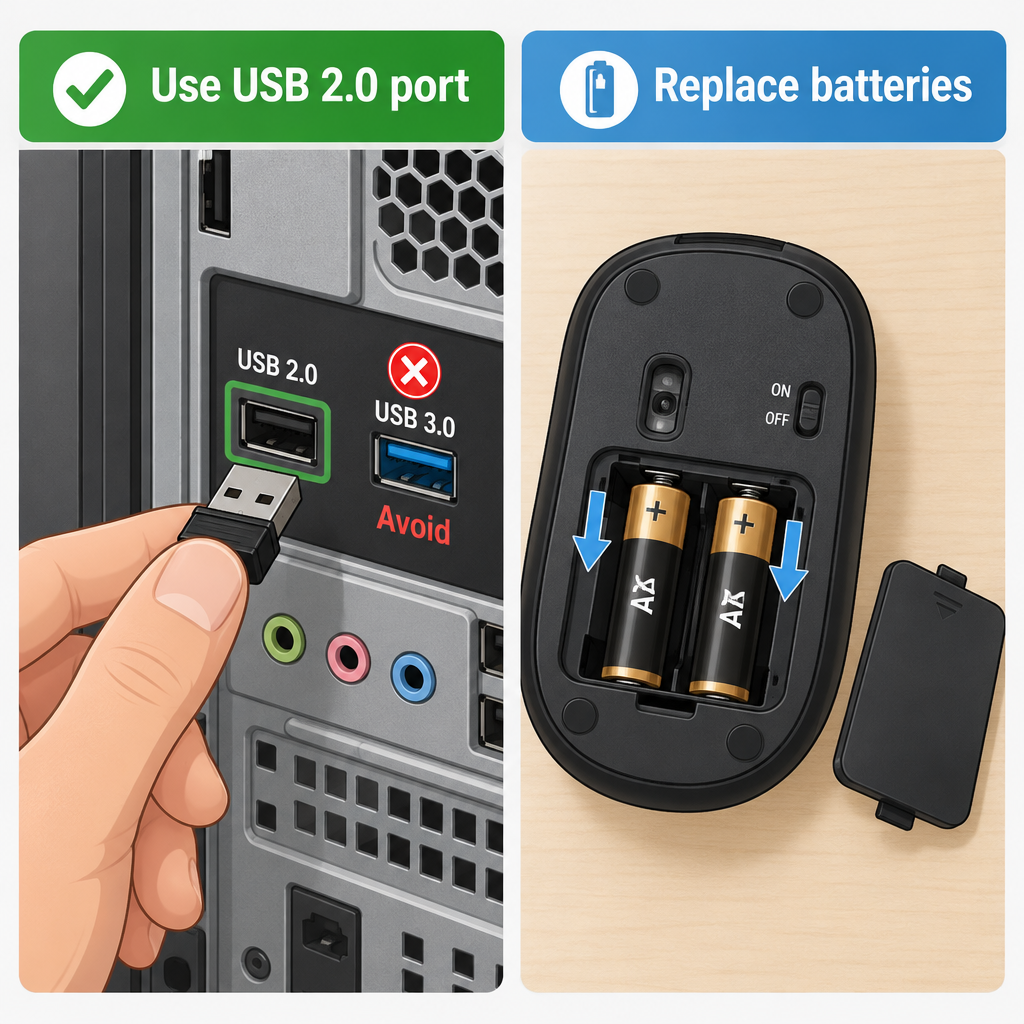
These quick checks clear most temporary problems. Work through them in order before you change any settings.
- Change the receiver port. Plug the receiver into a different USB port. On a desktop, the ports on the back connect straight to the motherboard and tend to be more reliable than front ports or unpowered hubs. Logitech advises using a USB 2.0 port away from USB 3.0 devices. If that is not possible, use a USB extension cable to bring the receiver closer to the mouse.
- Replace the batteries. Make sure the batteries are fresh and inserted the right way round, or fully charge a rechargeable mouse. Also check that the mouse’s power switch is on.
- Replug the receiver. Unplug the USB receiver, wait about 10 seconds, then plug it back in while the PC is running.
- Re-pair a Bluetooth mouse. If your mouse connects by Bluetooth instead of a receiver, remove it and pair it again. On Windows 11, go to Settings > Bluetooth & devices > Devices, select the three dots next to the mouse and choose Remove device. Then put the mouse in pairing mode and select Add device. Mice with their own receiver, such as Logitech models, can also be re-paired with the maker’s app, Logi Options+.
- Check for hardware damage. Look for a cracked case, sticky buttons, a damaged battery compartment, or a dirty or scratched optical sensor on the underside. Clean the sensor gently. If the damage is obvious, you will probably need a new mouse.
- Connect the mouse to a different computer. Try the mouse and receiver on another PC. If the problem continues there too, the mouse or receiver is at fault, so contact the manufacturer’s support team, especially if it is under warranty.
Fix 2: Turn off Fast Startup
Fast Startup can stop drivers from loading fresh at boot, which can leave a USB receiver unrecognised. Turning it off forces a full startup. It is available on Windows 11 and 10. Windows 7 does not have the feature, so skip this fix there. You need to be signed in as an administrator.
Step 1: On Windows 10, open Settings > System > Power & sleep and click Additional power settings. On Windows 11, open Control Panel > Hardware and Sound > Power Options.
Step 2: Click “Choose what the power buttons do” in the left pane.
Step 3: Click “Change settings that are currently unavailable”.
Step 4: Under Shutdown settings, untick “Turn on fast startup (recommended)”.
Step 5: Click Save changes.
Step 6: Restart your computer so every driver loads from scratch.
If the Fast Startup option is missing, hibernation is turned off on that PC, which means Fast Startup is already off.
Fix 3: Enable the wireless mouse in Device Manager
If the mouse has been disabled in Device Manager, Windows will ignore it until you enable it again. Without a working mouse you have to use the keyboard, so follow these steps:
Step 1: Press Windows key + R, type devmgmt.msc and press Enter to open Device Manager.
Step 2: Press Tab once to move into the device list. Your PC’s name will be highlighted at the top.
Step 3: Use the down arrow to reach “Mice and other pointing devices”.
Step 4: Press the right arrow to expand the section.
Step 5: Use the down arrow to select “HID-compliant mouse” (or your mouse’s name). A small down-arrow icon on the device means it is disabled.
Step 6: Press Shift + F10 (or Fn + Shift + F10 on some laptops) to open the right-click menu.
Step 7: Use the down arrow to select Enable device, then press Enter.
Step 8: Test the mouse, then close Device Manager with Alt + F4.
Fix 4: Reinstall the wireless mouse driver
A corrupted mouse driver can stop the mouse working even when the hardware is fine. Reinstalling Windows’ standard driver fixes this on Windows 11, 10 and 7.
Step 1: Open Device Manager. On Windows 11 and 10, press Windows key + X and choose Device Manager. On Windows 7, use the Run box method from Fix 3.
Step 2: Expand “Mice and other pointing devices” and select your mouse.
Step 3: Right-click it (or press Shift + F10) and choose Update driver.
Step 4: Choose “Browse my computer for drivers”.
Step 5: Choose “Let me pick from a list of available drivers on my computer”.
Step 6: Leave “Show compatible hardware” ticked.
Step 7: Select “HID-compliant mouse” from the list and click Next.
Step 8: Wait for Windows to install the driver, then close the window.
Step 9: Restart your PC.
Step 10: Check whether the problem continues.
If it does, go back to Device Manager, right-click the mouse, choose Uninstall device and restart the PC. Windows will reinstall the driver automatically when it detects the receiver. If the trouble started right after a driver update, open the mouse’s Properties, go to the Driver tab and choose Roll Back Driver instead.
Fix 5: Update the mouse driver through Windows Update or the manufacturer
Get drivers from Windows Update or the mouse maker’s own support site. Avoid third-party “driver updater” tools. They are not needed for a mouse, and some come bundled with unwanted software.
Step 1: On Windows 11, open Settings > Windows Update > Advanced options > Optional updates and install any mouse, Bluetooth or USB driver listed there. On Windows 10, go to Settings > Update & Security > Windows Update and click View optional updates.
Step 2: Visit the support page for your mouse model on the manufacturer’s official website (Logitech, Microsoft, Dell, HP and others) and install its current driver or app, such as Logitech’s Logi Options+.
Step 3: Restart the PC and test the mouse.
If nothing works
If the mouse still fails after all five fixes and it also failed on a second computer, the mouse or its receiver is faulty. Contact the manufacturer for a warranty replacement. Most receivers are paired to their own mouse, so a spare receiver from another mouse usually won’t work. If the mouse works fine on other PCs but not on yours, test another USB device in the same ports. If those fail too, the problem may be the PC’s USB controller, and that is a job for the PC maker’s support or a repair shop.
FAQ
Why does my wireless mouse lag or stutter?
Lag is usually caused by weak batteries, distance from the receiver or radio interference. Move the receiver closer with a USB extension cable, keep it away from USB 3.0 devices and Wi-Fi routers, and fit fresh batteries. A reflective glass surface can also confuse the optical sensor, so try a mouse pad.
How do I know if the mouse or the receiver is broken?
Try both on a second computer. If the mouse works there, the problem is your PC’s settings, drivers or ports. If it fails on both computers even with new batteries, the mouse or receiver is faulty, and the manufacturer is the next step.
Can I use a wireless mouse without its USB receiver?
Only if it also supports Bluetooth. Many current mice offer both, and you can pair them in Settings > Bluetooth & devices on Windows 11. A receiver-only mouse needs its original receiver, or a compatible replacement from the same maker, such as a Logitech Unifying or Bolt receiver for supported models.
Will a wireless mouse still work on Windows 10 or Windows 7?
Yes. Windows 10 and Windows 7 still work and still recognise wireless mice, and the fixes above apply to both. Neither gets regular security updates any more, though: Windows 7 support ended in January 2020, and consumer ESU patches for Windows 10 stopped on October 13, 2026. Upgrading to Windows 11 or a newer PC is the safer long-term choice.
Do I need a driver updater program to fix my mouse?
No. Windows includes a standard HID-compliant mouse driver that works with almost every wireless mouse. Any extra software comes from Windows Update or the manufacturer’s official app. Third-party driver updaters add risk and give you nothing those two sources don’t.
Sources
- Logitech Support: Wireless product not working properly when also using a USB 3.0 device
- Lenovo Support: How to turn on or off fast startup in Windows 10 and 11
- Dell Support: Microsoft support for Windows 7 ended on January 14, 2020
- Microsoft Q&A: Wireless mouse not working with Windows 11












