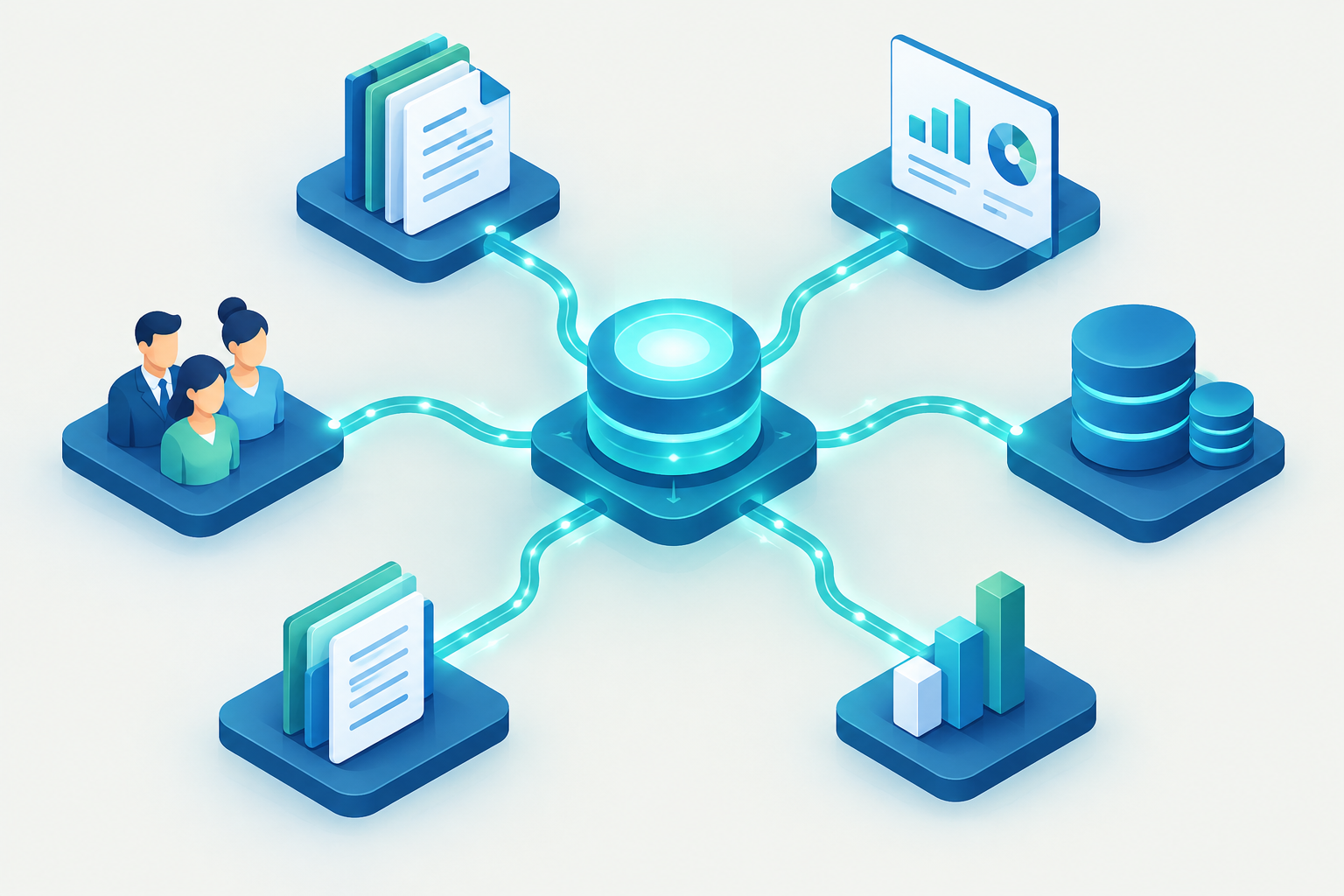
Knowledge management is the work of capturing what an organization knows and making it easy to find and reuse. In practice it follows six steps: collect the right data, organize it, summarize it, analyze it, turn the results into documented knowledge, and use that knowledge to make decisions. ISO 30401 is the international standard for a knowledge management system. Its 2018 edition, amended in 2022 and 2024, was being revised during 2026. Most teams today keep the results in a shared knowledge base. That can be a hosted tool such as Confluence or a self-hosted open-source wiki such as BookStack or MediaWiki.
Knowledge management refers to the systematic handling of everything an organization has learned and recorded. To manage knowledge well, you need to store information somewhere people can find it easily.
Businesses of every size, all over the world, do some form of knowledge management. They gather information through many different methods and tools.
The information they gather is then organized, stored, shared and analyzed using set procedures.
Each piece of information is checked against the data, records, people and skills the organization already has.
Once it has been analyzed properly, the information is saved as the organization’s “knowledge.” It is then put to use, for example when managers make decisions or when new staff members are trained.
People have approached knowledge management from many angles over the years. Early methods mostly meant storing records by hand and analyzing them manually. Since computers arrived, most of this work has moved to software, and much of it is now automated.
That shift has made storing, finding and sharing information far easier. Most established companies now have their own knowledge management framework. Many base it on published models such as ISO 30401 or the frameworks from APQC (the American Productivity & Quality Center).
A framework sets out where knowledge is collected, how it is gathered, which tools are used, how and where the data is stored, and how it is analyzed.
Knowledge Management Process
This process works in any business. The exact tools and methods change from one organization to the next, depending on its size, industry and the systems it already uses.
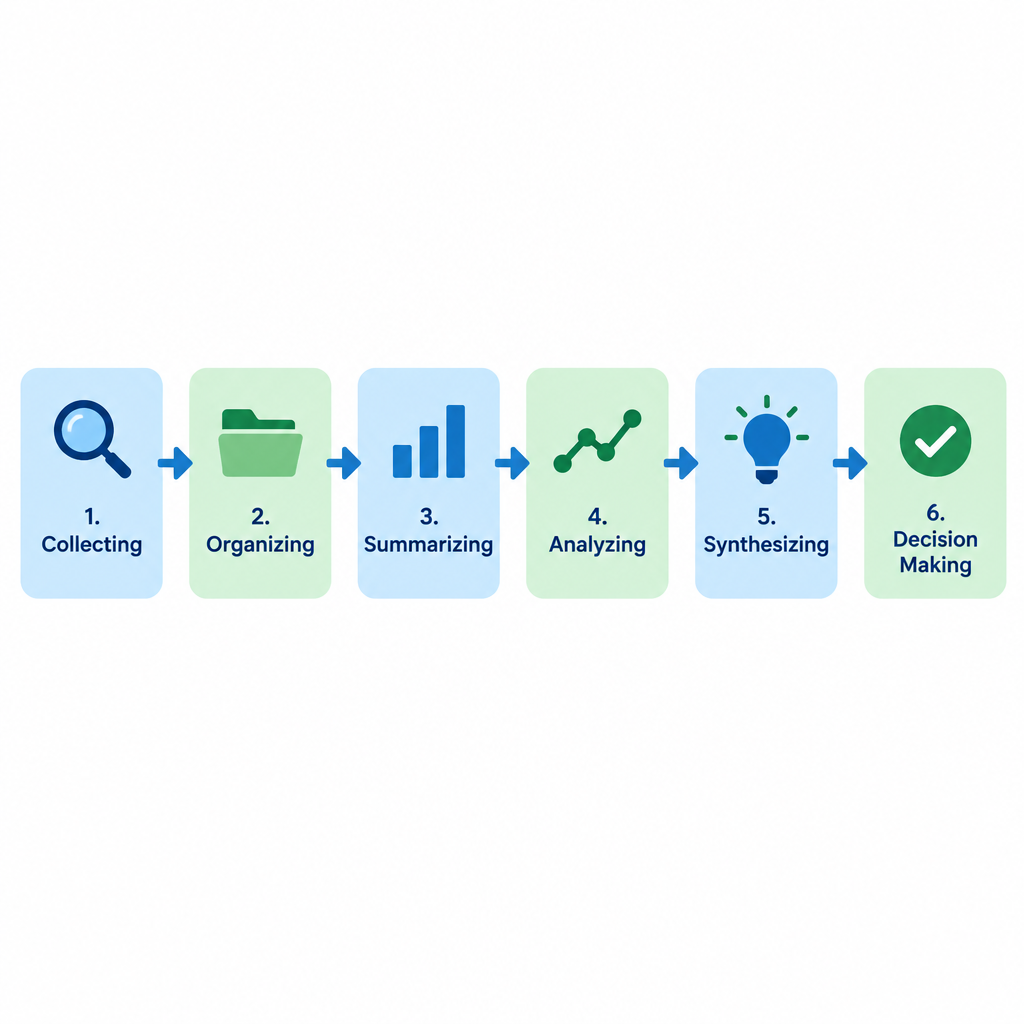
The process has six main steps, and each step uses its own mix of tools and methods. When you carry out the steps in the right order, the raw information you gather becomes knowledge you can act on.
Other models split the work up differently. APQC’s Knowledge Flow Process, for example, uses seven stages: create, identify, collect, review, share, access and use. The core idea is the same in both: knowledge has to be captured, checked and put in front of the people who need it.
The six steps are:
Collecting
Everything starts here, and this is the most important step. If you collect irrelevant or wrong information, the knowledge built from it will be wrong too, and decisions based on it will be flawed.
There are many ways and tools to collect data. The collection procedure should be a formal part of the overall knowledge management process. The people who gather data should write these procedures down and follow them.
The procedure names specific collection points. Some of these can be summaries of routine reports. Monthly sales reports and daily attendance reports, for example, are good sources of data.
This step also sets out how data is pulled from each collection point and where it will be stored. Most organizations now use a database application or a cloud-based knowledge platform to store it.
Organizing
Collected data has to be organized, usually according to a set of rules the organization writes for itself.
For example, all employee information could be kept in one place and all sales information in a single folder. Organizing data this way keeps a database clean and easy to maintain.
If a database holds a lot of data, a technique called normalization can help. As Microsoft’s documentation explains, normalization arranges data into tables and columns so that duplicate data is reduced and the data stays consistent. A database that follows the first three normalization rules is in “third normal form,” which is enough for most applications.
The result is data that is arranged logically, with related records linked so they are easy to retrieve. At the end of this step, raw data has become information.
Summarizing
Here the information is boiled down to its key points. Large sets of information are turned into tables or charts and filed in the right place.
You can summarize with software such as spreadsheets, reporting dashboards and business intelligence tools, or with manual methods such as written briefs.
Analyzing
The information is examined for relationships, duplicates and patterns.
Experience makes a big difference here, so this task is best given to a seasoned professional or a team of them. The findings are normally written up in reports.
Synthesizing
This is the point where information becomes knowledge. The findings from the analysis are combined to produce new ideas, guidelines and other useful outputs.
A pattern found in one area can explain behavior in another. Over time, the company builds up a body of knowledge it can apply in many different situations.
This knowledge is then documented and stored in the organization’s knowledge base for future reference.
Today the knowledge base is usually a web-based application that staff can reach from anywhere with an internet connection.
You can use free, open-source knowledge base software or pay for a commercial product. BookStack (MIT license) and MediaWiki (GPL license) are popular open-source choices you host yourself. BookStack organizes content into books, chapters and pages, and MediaWiki suits large, heavily cross-linked wikis. Atlassian Confluence is a common hosted option. Its Free plan covers up to 10 users with 2 GB of storage, and paid plans charge per user.
Decision Making
In the final step, the knowledge is used to make decisions. When you estimate a new project or task, for instance, you can draw on what was learned from estimating similar projects in the past.
That makes estimates faster and more accurate. Good knowledge management helps an organization create value and, over time, save money by not repeating old mistakes or re-solving problems it has already solved.
FAQ
What are the main steps of the knowledge management process?
The six steps are collecting, organizing, summarizing, analyzing, synthesizing and decision making. Each step builds on the one before it, so mistakes made early, especially during collection, carry through to the end. APQC’s Knowledge Flow Process covers the same ground in seven stages: create, identify, collect, review, share, access and use.
What is the difference between information and knowledge?
Information is data that has been organized so it makes sense, such as a sorted table of monthly sales. Knowledge comes from analyzing and combining that information into something you can act on. An example is knowing which conditions usually lead to a sales dip and what to do about it.
Is there a standard for knowledge management?
Yes. ISO 30401 sets out requirements for a knowledge management system. The 2018 edition was amended in 2022 and in 2024, and a revised edition was being drafted during 2026. Organizations can use it as a guide, or get audited against it.
What software is used for a knowledge base?
Common choices include hosted platforms such as Atlassian Confluence, whose Free plan covers up to 10 users, and self-hosted open-source tools such as BookStack and MediaWiki. Small teams often start on a free tier or open-source wiki and move to a paid plan once they need more users, storage or admin controls.
Why does data normalization matter in knowledge management?
Normalization cuts down on duplicate data in a database. When the same fact is stored in several places, one copy can get updated while the others don’t, and people end up working from conflicting versions. A normalized database keeps one reliable version of each fact.
Who should analyze the information?
Experienced professionals, or a team of them, should do the analysis. Spotting meaningful patterns and ignoring noise takes judgment that comes from knowing the business. Their findings should be written up in reports so the next step, synthesis, has something solid to work from.
Sources
- ISO 30401 Knowledge management systems (ISO committee page)
- ISO 30401:2018/Amd 2:2024 Climate action changes (DIN Media)
- APQC’s Knowledge Flow Process Framework
- APQC Knowledge Management Strategic Framework
- Description of the database normalization basics (Microsoft Learn)
- Confluence pricing (Atlassian)
- Learn about the features of Confluence Cloud plans (Atlassian Support)