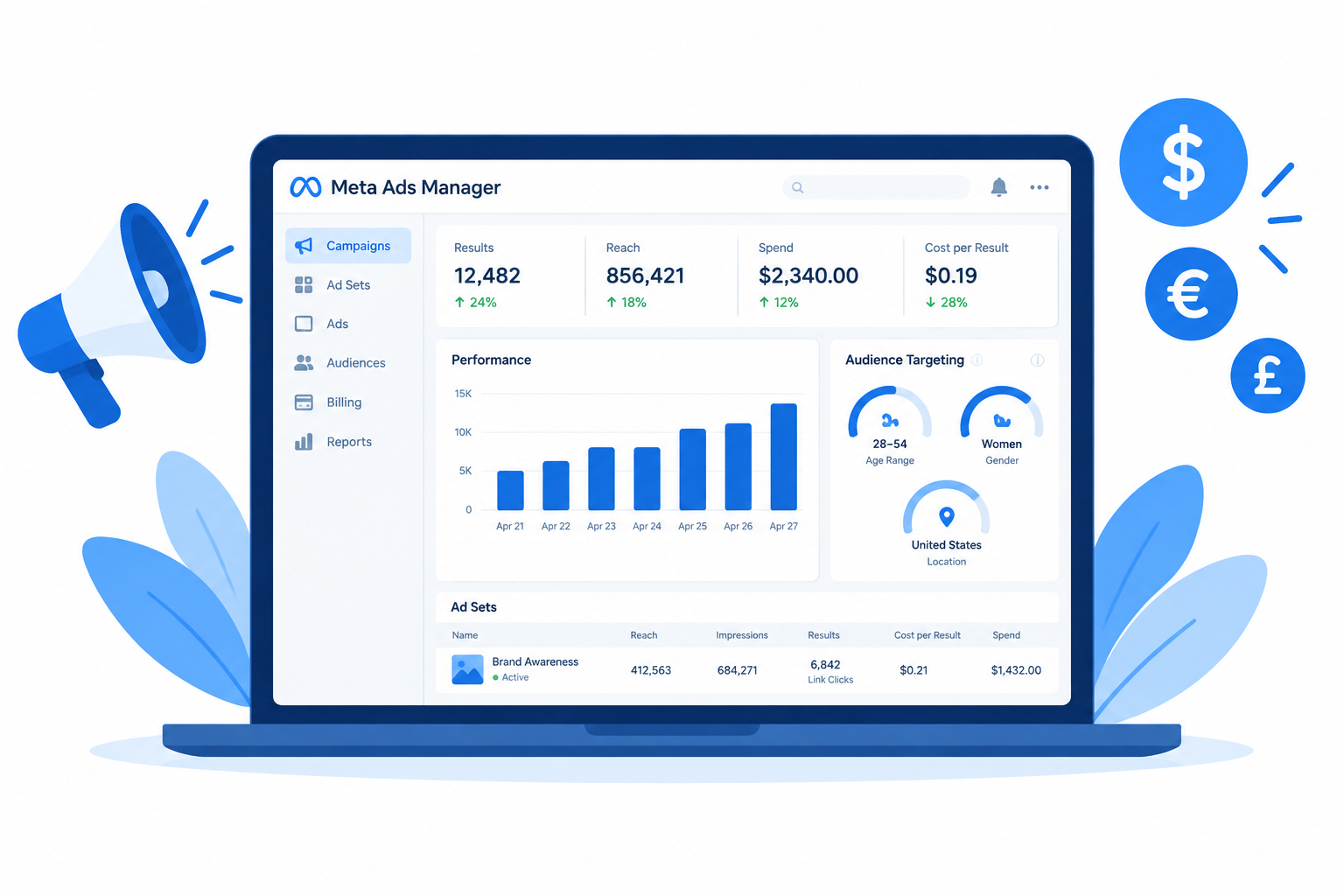
An effective Facebook ad strategy in November 2026 starts with knowing your customer and matching each ad to where that person is in the buying journey. Next, set up the Meta Pixel (ideally with the Conversions API) so you can measure results. Then pick one of the six campaign objectives in Meta Ads Manager (Awareness, Traffic, Engagement, Leads, App promotion or Sales) for each stage of your funnel. Start with a small budget, measure, and put more money into what converts.
Spending a marketing budget well is hard, because there are so many advertising options. Picking the one that fits your business, reaches your audience and gives you the best return on investment takes some thought.
Facebook has changed a lot over the years, but it is still a strong place to advertise a business. Ads can be cheap, and you can target your “ideal” customers closely. Meta no longer reports Facebook’s daily users on their own. It now counts people across Facebook, Instagram, WhatsApp and Messenger together: 3.64 billion daily active people on average in September 2026, according to its third-quarter 2026 results. That is a very large pool to find your audience in.
Why you need a plan before you spend
Treat Facebook like any other marketing channel and start with a clear plan. If you skip that step, you might as well be throwing flyers off a bridge and hoping for the best.
The Facebook advertising landscape today
New advertisers often see Facebook as a confusing frontier. It isn’t really. Millions of businesses already advertise there. Meta said more than 8 million advertisers used at least one of its generative AI ad creative tools in the first quarter of 2026 alone, and the total number of advertisers is larger still.
A fair question is whether the platform is too crowded to bother with. There are so many advertisers because it works. Facebook is a reliable way to reach the people you want and get them to act, which ideally means buying your product. Meta’s Family of Apps ad revenue reached $63.1 billion in the third quarter of 2026, up 26% from a year earlier.
Not every one of those advertisers succeeds, though. Many never work out who their ideal customer is or how to target the people they want to sell to.
So the real question isn’t whether to advertise on Facebook. It’s how to advertise well enough that the return is worth your time and money.
What to learn before you set up your Facebook ad
Planning ahead makes a campaign far more successful, even if you are keen to start right away.
First, work out who your customer is:
- Who are they?
- What does their family situation look like?
- How much do they earn?
- Where do they live? (Both the place, and whether they own or rent.)
- Where do they work?
- How do they spend their free time?
Once you know who they are, go one step further and understand how they think.
What keeps them up at night? What is their emotional state, and what needs are they trying to meet? How do they see themselves? Their view of themselves usually matters more than your view of them, even when yours is more realistic.
Map the typical customer journey
Next, walk through the steps a typical customer takes as they:
- Realise they have a problem
- Work out what the problem is
- Discover possible solutions
- Hear about you as an option
- Decide to buy your product
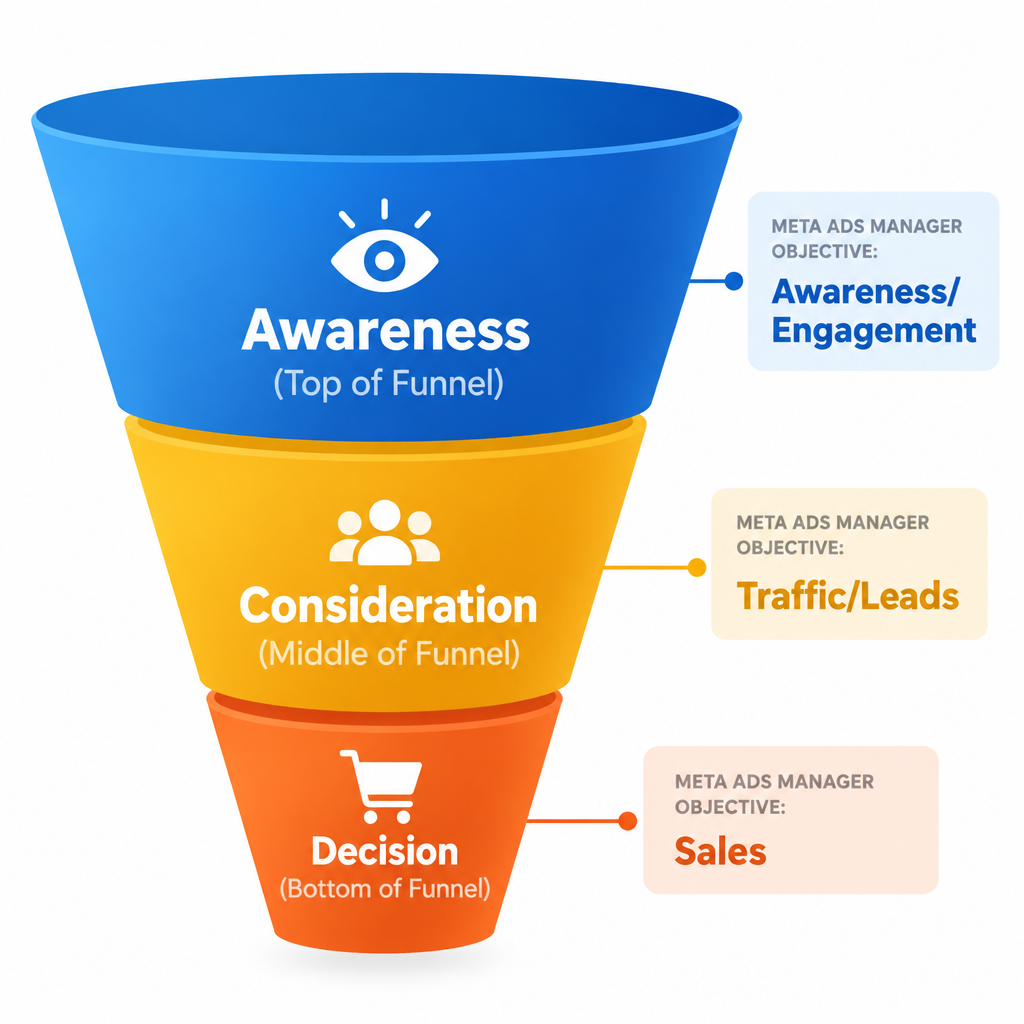
The three stages of the buying journey
Every customer’s journey is a little different, but most fall into three stages:
- Awareness stage (top of the funnel)
- Consideration stage (middle of the funnel)
- Decision stage (bottom of the funnel)
This matters to you as an advertiser because your content, offers, wording and call to action should change with the stage your prospect is in.
Finally, split your audience into segments based on where they are in that journey. That lets you make the right offer to the right people at the right time.
Examples of audience segments
- New prospects come into your funnel as warm leads because they are interested in your product.
- Lukewarm leads visited your site but didn’t engage. Retargeting can remind them that you are still there with a solution to their problem.
- Engaged blog readers like your blog and keep coming back. They are more likely to share your content on Facebook or buy from you.
- Landing page visitors arrived at a specific landing page, so they are probably interested in that product. Sales closing best practices apply to this group, because they are already close to a decision.
- Shopping cart abandoners came very close to buying, but something stopped them. A gentle nudge may be all they need to finish the purchase.
- Repeat customers love your brand. They have bought before and keep coming back. They can become brand advocates who praise and recommend your product to friends.
As you learn more about your own audience, you may find other segments that need different messages.
Now think about how your Facebook strategy changes depending on who you are advertising to and where they are in their journey (and your funnel):
- To attract prospects, run ads about your brand, or content that helps them understand their problem and positions you as an expert.
- To convert prospects, use contests and giveaways, free trials and lead ads.
- To close prospects, use lead nurturing campaigns, discount offers, sales campaigns and limited-time deals that encourage them to buy.
- Once prospects become customers, delight them with premium offers, referral programs, upsell campaigns and useful information about what they bought.
Meta Ads Manager now asks you to pick one of six campaign objectives when you create a campaign. The objective is locked once the campaign is created, and changing it means building a new campaign and going through the learning phase again. So it pays to match the objective to the funnel stage from the start.
| Funnel stage | Your goal | Meta Ads Manager objective | Example ad |
|---|---|---|---|
| Awareness (top) | Get noticed, build trust | Awareness or Engagement | Short how-to video about the problem you solve |
| Consideration (middle) | Bring people to your site or collect leads | Traffic or Leads | Free guide offered through an Instant Form |
| Decision (bottom) | Turn interest into purchases | Sales | Retargeted discount for cart abandoners |
| After the sale | Repeat purchases and referrals | Sales or Engagement | Upsell offer to past buyers |
| Apps only | Installs and in-app actions | App promotion | Install ad for your mobile app |
Install the Meta Pixel to track conversions
There is one more step before you get into strategy: the Meta Pixel, formerly called the Facebook pixel. If you want to track conversions (and you do), you need it. The pixel is a short piece of tracking code that you copy from Meta and add to your website. It records what visitors do once they land on your site, so you can refine your ads based on real behaviour.
Meta now also offers the Conversions API, which sends the same events from your server or e-commerce platform instead of from the visitor’s browser. That fills gaps the pixel misses when browsers or ad blockers block it. Meta can deduplicate events sent from both sources using a shared event ID, so running both together is the usual recommendation. Both are managed in Meta Events Manager, where the Test events tab lets you check that events are arriving before you spend money. To set up the Conversions API, you need admin or developer access to the Meta business portfolio.
Not very technical but still running your own website? Facebook has detailed guidelines to help you install a Facebook pixel on your website. Many website builders and shop platforms also have a built-in Meta integration that only needs your pixel or dataset ID.
Facebook ad strategies
With the groundwork done, you can look at the strategies you can use in your advertising.
Depending on which audience segments you target, not all of these will fit. Keep your audience research in mind as you go through them.
Combine Facebook ads with content marketing
Many businesses make the mistake of showing warm leads ads built to turn them straight into paying customers. A warm lead is not ready to buy from you yet. Instead of putting them off with hard sales offers, give them helpful content that answers their questions and solves their pain points. Keep it short, interesting and useful. Be patient, and over time you will turn these warm leads into customers.
How do you do this?
Work through the strategies below, starting with content and moving down the funnel.
1. Create content and boost it
- Share your content on Facebook.
- Ask your team members (and perhaps a few friends) to like and share the post.
- Boost the post so it reaches a wider audience. The Boost button sits under the post on your Page. For more control over audience and placements, build the campaign in Meta Ads Manager instead, using the Awareness or Engagement objective.
2. Use giveaways and contests
Facebook contests don’t always have to be about sales. You can offer a high-value prize to build brand awareness, which pays off over time by bringing new leads into your conversion funnel. Before you commit to a contest or giveaway, read Meta’s Pages, Groups and Events policies so you don’t break its promotion rules. Promotions can run on Pages, Groups, Events or within apps on Facebook, but not on personal timelines. “Share on your timeline to enter” or “tag friends on your timeline for extra entries” is not allowed. You are also responsible for following local laws, including publishing official rules and eligibility terms.
3. Use lead ads to build your contact list
A large Facebook following is great, but Facebook effectively “owns” those contacts. If Meta changes its algorithm, or your Page is restricted, you lose access to those people.
Create a lead magnet, such as a free ebook or course, then run a campaign with the Leads objective and an Instant Form. That helps you build your own marketing list. People submit their email address inside Facebook or Instagram, often pre-filled from their profile, so there are no extra steps where you might lose them. In return they get their free gift. You can then add their email to your marketing list and include them in your email campaigns from then on.
Instant Forms come in two main types. “More volume” keeps the form short. “Higher intent” adds a review screen so people confirm their details, which usually means fewer but better leads. If a sales team follows up on these leads, Higher intent is usually the better choice. Get the leads out of Meta and into a proper CRM quickly. Dangers of using spreadsheets for sales, such as lost follow-ups, duplicate records and nobody owning the lead, grow fast once a lead campaign starts working.
4. Add video ads
Video ads are worth testing in two situations. One is when you’ve been running ads for a while and aren’t getting the conversions you hoped for. The other is when you’re new to Facebook ads and want to try a few formats to see what works for you.
People engage with video, and short vertical video now gets shown across Facebook and Instagram Reels placements as well as the feed. Keep the first few seconds strong and add captions, because many people watch with the sound off. Benefits of branding show up clearly here: a recognisable logo, colours and voice in the first seconds help people remember who the ad came from, even if they scroll on.
5. Run Facebook and Google ads together
Many marketers treat these platforms as either-or, but Facebook and Google ads can work very well together.
Again, your plan should depend on your campaign goals and the audience segment you want to reach. Someone searching for a specific product, such as a new computer, is probably ready to buy and is just comparing options. Building Google ads around the right keywords may work better for that person than Facebook ads aimed at raising brand awareness. Facebook is stronger at creating demand among people who aren’t searching yet. Google is stronger at catching demand that already exists.
6. Make use of Facebook mobile ads
First, check that your website or landing page works well on mobile. People should have a good experience on any device. If your site isn’t built for that, you aren’t ready for mobile ads. Most Facebook advertising is seen on phones: as far back as 2018, Statista estimated that mobile accounted for 92% of Facebook’s ad revenue. Sending people from a mobile ad to a slow or broken page is money thrown out the window.
A quick check: open your landing page on your own phone using mobile data, not Wi-Fi. Note how long it takes to load and whether the form or Buy button is easy to tap. Fix those problems before you put money into mobile ads.
Over to you
The most important part of a Facebook ad strategy is understanding your audience. Clever tactics and new features won’t help if you don’t know who you are selling to and how close they are to buying.
Take the time to get to know your ideal customer: who they are, what they do and what they want. Once you know where potential customers are in their buying journey, you can guide them toward buying your product. A good next step is to choose one segment, one objective and one offer from the table above, run it for a couple of weeks on a small budget, and let your pixel data decide what you do next.
FAQ
How much should you spend on Facebook ads to start?
Start small enough that you can afford to learn. Many small businesses begin with a modest daily budget per ad set and run it for at least a week or two before judging it. Meta’s delivery system needs some data to get past the learning phase, so very short, tiny tests tend to give unclear results.
What is the difference between boosting a post and running an ad in Ads Manager?
Boosting is the quick option. You promote an existing post from your Page with a few audience and budget settings. Meta Ads Manager gives you the full set of campaign objectives, placements, audiences and testing tools. Use boosting for simple awareness, and Ads Manager when you want leads or sales you can measure.
Do you still need the Meta Pixel if you use the Conversions API?
Yes. Meta’s guidance is to run both together. The pixel captures browser events, and the Conversions API sends events from your server, which covers gaps caused by blocked cookies or ad blockers. Use the same event ID in both so Meta counts each conversion only once.
Which campaign objective should you choose?
Choose the objective that matches the action you actually want. Awareness or Engagement suits people who have never heard of you. Traffic or Leads suits people who are considering their options, and Sales suits people ready to buy. App promotion is only for app installs and in-app actions.
Are Facebook ads still worth it for small businesses in 2026?
For most consumer-facing small businesses, yes. Meta’s apps reach 3.64 billion people a day, and you can target by location, interests and your own customer lists. Ads lose money when targeting is vague, the landing page is slow on mobile or the offer doesn’t match the audience’s stage. Fix those before you blame the platform.
Can you run a giveaway that asks people to share the post?
Not on personal timelines. Meta’s Pages, Groups and Events policies say promotions can’t require people to share on their own or a friend’s timeline to enter. Asking people to comment on or like your Page post is a common, allowed way to enter.
Sources
- Meta Reports Third Quarter 2026 Results
- Meta Pages, Groups and Events Policies