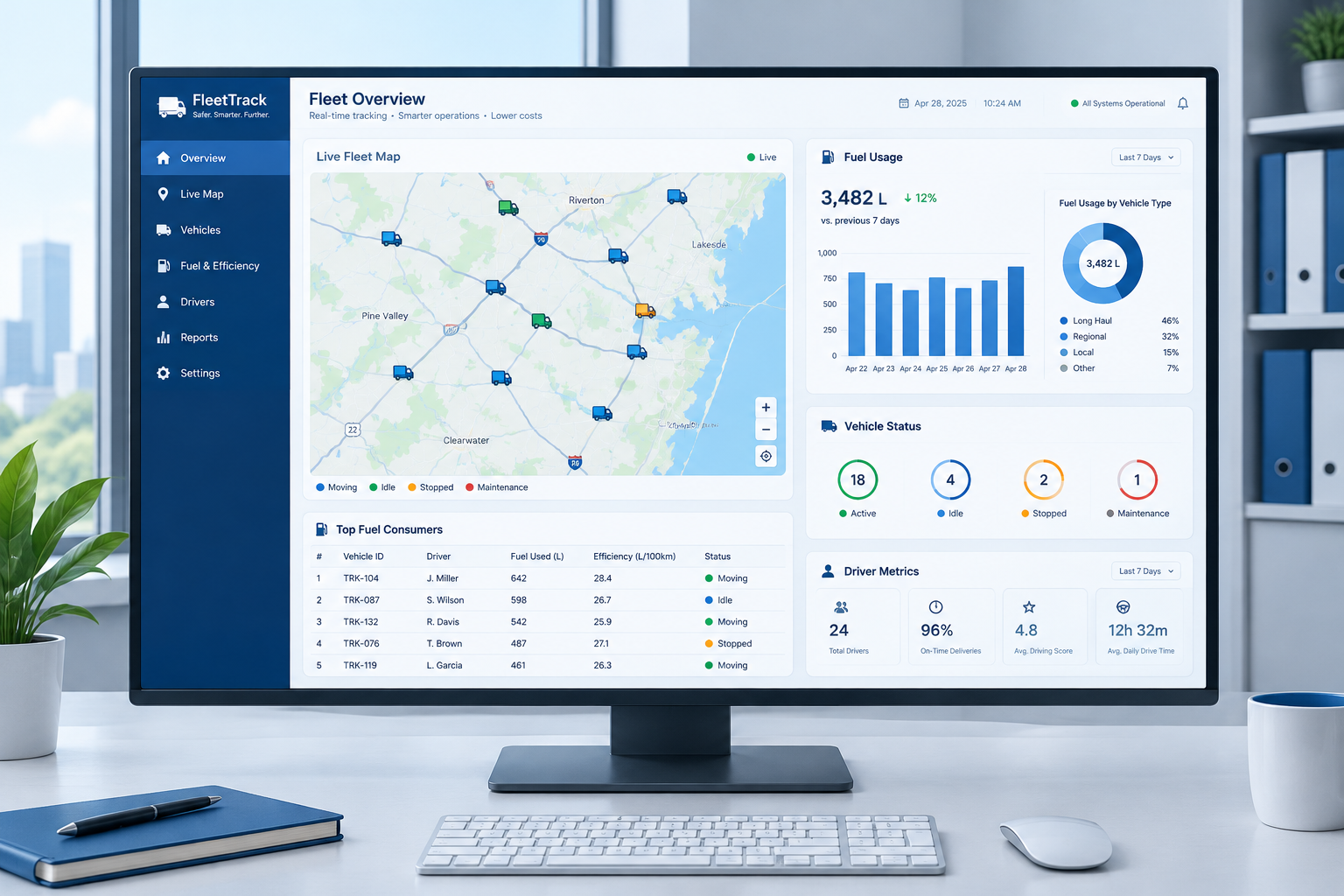
A fleet management system puts vehicle tracking, fuel data, maintenance schedules, driver safety and billing on one dashboard, so you can run a more productive, safer and cheaper fleet from one screen. In Verizon Connect’s 2026 Fleet Technology Trends Report, 80% of fleet professionals said they use GPS tracking, up 11 points from the year before. Fleets using it reported an average 12% drop in fuel costs and a 19% drop in accident costs. If you run more than a handful of vehicles, connect GPS tracking to your maintenance and billing systems first, then add dash cams once the basics work.
| Benefit | What the system tracks | Reported result | Source |
|---|---|---|---|
| Lower fuel costs | Idle time, miles per gallon, routes, driving habits | 12% average drop in fuel costs among GPS users | Verizon Connect 2026 report |
| Fewer accident costs | Harsh braking, speeding, dash cam events | 19% average drop in accident costs among GPS users | Verizon Connect 2026 report |
| Safer drivers | AI video telematics alerts and coaching | 74% of AI video users reported better driver safety | Verizon Connect 2026 report |
| Protection against false claims | Road-facing and driver-facing video | 64% said video improved their protection | Verizon Connect 2026 report |
| Less idling waste | Engine idle hours per vehicle | A heavy-duty truck burns about 0.8 gallon per hour at idle | US DOE, Alternative Fuels Data Center |
| Total operating savings | Fuel, accidents, labor, maintenance | 11% to 19% average decreases | Verizon Connect 2026 report |
What a good fleet management system gives you
A good fleet management system gives you a live, accurate picture of your fleet. At any moment you can see where each vehicle is, how it is being used and when it is due for service.
Most fleets already use these tools. Verizon Connect’s sixth annual Fleet Technology Trends Report surveyed fleet professionals across government, commercial and enterprise sectors between June and July 2025. It found that 80% use GPS tracking, and 46% now use video telematics, 10 points more than in 2023. The people answering already use the technology and reported the results themselves, so treat the figures as typical gains, not guarantees. The direction is still clear. Once GPS tracking is connected to good fleet software, daily operations get simpler and waste becomes visible.
The twelve benefits below run from the quickest savings (fuel, routes, theft) to the longer-term ones (vehicle life, back-office data, EV readiness).
1. Lower fuel costs from idle and route data

Fuel is one of the biggest running costs for any fleet. GPS users in Verizon Connect’s 2026 survey cut it by an average of 12%. Most of that saving comes from three numbers the system reports for every vehicle: idle time, miles per gallon and miles driven.
Start by comparing how much fuel each vehicle uses with how much it should use. A van that returns noticeably worse mileage than its twins on similar routes usually points to idling, aggressive driving, underinflated tyres or a mechanical fault.
Idling is the easiest place to start. The US Department of Energy’s Alternative Fuels Data Center estimates that idling cars and trucks in the US waste roughly 6 billion gallons of fuel a year, and Argonne National Laboratory puts a heavy-duty truck’s idle burn at about 0.8 gallon per hour. A 2026 Geotab fleet idling study found the typical heavy-duty truck burns about 1.8 gallons of idle fuel per day, more than three times as much as a light-duty vehicle.
Here is a simple worked example. One truck that idles an extra hour each working day for 250 days wastes about 200 gallons a year. At an illustrative $4 per gallon, that is around $800 per truck before you count extra engine wear. The idle report shows which vehicles idle most, so you know where to focus.
Driving style matters too. If a driver tends to accelerate hard and then brake hard, small coaching changes add up to real fuel savings over a year.
Across the whole fleet, you get a steady stream of fuel data you can use to plan routes, assign the most efficient vehicle to the longest jobs and track whether changes actually worked.
2. Route optimization with live traffic re-routing
Route optimization works out the most efficient order of stops before the day starts. Live traffic data then reroutes drivers when a crash or road closure would cost them time. Fewer miles means less fuel, less wear and more jobs per shift.
Here is how it works. The dispatcher enters the day’s jobs with addresses, time windows and expected job lengths. The system sequences the stops around those constraints and around vehicle capacity, and on many platforms it also accounts for the driver’s remaining hours of service. During the day, traffic feeds update arrival times and can push a new route to the driver app.
Take a plumbing company with eight calls booked in the order customers phoned. Sorting those stops by geography instead removes the backtracking across town, often without touching a single appointment window.
There are limits. Optimization is only as good as the job durations you enter, and it adds little to fixed routes such as school buses or the same daily delivery loop. Drivers also need to trust the app. If they routinely ignore suggested routes, review why before blaming the software.
3. Fuel theft and fraud prevention
A fleet management system catches most fuel card misuse by checking each card transaction against where the vehicle actually was at that moment. If the card was swiped at a station 20 miles from the truck’s GPS position, the platform flags it.
Most platforms integrate with major fuel card networks such as WEX, so purchases flow straight into the system. Common automatic flags include:
- A purchase location that does not match the vehicle’s GPS location.
- More gallons bought than the vehicle’s tank can hold.
- Fill-ups on weekends or at night when the vehicle was parked.
- A sudden drop in miles per gallon that suggests fuel is going somewhere other than the engine.
Treat a flag as a question, not proof. GPS gaps, shared cards and data-entry errors explain plenty of mismatches, so check the trip history and talk to the driver before acting.
The same tracking helps against vehicle and equipment theft. Geofences and after-hours movement alerts tell you the moment a van leaves the yard when it should not. If a vehicle is stolen, give its live location to the police rather than trying to recover it yourself.
4. Fewer accidents through driver coaching and dash cams

GPS tracking users in Verizon Connect’s 2026 survey reported an average 19% drop in accident costs. Driver scoring and dash cams do much of that work by showing you risky habits before they turn into crashes.
Video telematics, meaning dash cams connected to the fleet platform, record the road and, in many systems, the driver. They work differently from screen recording software on a computer: the camera saves short clips around events such as harsh braking, a collision or signs of phone use, and the platform flags them for review. AI-enabled systems can warn the driver in the cab as it happens.
This helps you spot risky habits early, coach drivers before an accident happens and defend your drivers against false claims. Among fleets using AI-powered video telematics in the 2026 Verizon Connect survey, 74% reported better driver safety. In the same report, 64% said video improved their protection against false claims.
Insurance is a side benefit worth asking about. Truck News, reporting on the same survey, said GPS tracking users saw insurance premiums fall by an average of 11%. Insurers price risk differently, so ask your broker or carrier whether they give credit for telematics, safety scores or dash cam footage before you count on a discount.
Before you install driver-facing cameras, tell your drivers clearly what is recorded and why. That builds trust and helps you meet local privacy and employment rules.
5. Preventive maintenance and less downtime

A fleet management system turns mileage and engine-hour readings into service alerts, so vehicles go into the shop on schedule instead of on a tow truck. In Truck News’ summary of the 2026 Verizon Connect report, maintenance costs fell an average of 15% after fleets started using the technology.
Using GPS and odometer data, you can set alerts that fire when a vehicle reaches a mileage or engine-hour milestone. Use whatever interval the manufacturer recommends, for example an oil change every 10,000 miles.
After that, booking the service and getting the vehicle back on the road is simple. Drivers can also photograph damage, receipts or inspection sheets in the driver app, which works much like photo scanning software and files the image against the right vehicle.
In a connected system, the maintenance alert shows up before the truck arrives at the shop, so parts and bay time are ready in advance. Defects that drivers report on their daily inspection go into the same queue.
This lowers the chance of expensive surprise breakdowns. You get a simple process that always shows what needs doing next, and the vehicle spends less time off the road.
6. Longer vehicle life and smarter replacement timing
Engine fault-code alerts catch problems while they are still cheap to fix, and utilization data shows the point where a vehicle costs more to keep than to replace. Together they stretch the useful life of each vehicle and stop you selling good ones too early.
The telematics device plugs into the vehicle’s diagnostic port. On cars and vans that is the OBD-II port; heavy trucks use the SAE J1939 network. It reads diagnostic trouble codes (DTCs), the same codes behind a check-engine light, and sends them to the dashboard with the vehicle name and location. A misfire or overheating code reaches the fleet manager the same day instead of whenever the driver mentions it.
For replacement decisions, track cost per mile for each vehicle: fuel, repairs and days out of service. When that figure keeps climbing on an older unit while a newer one sits half used, the data supports swapping roles or selling the older vehicle before its resale value drops further.
One trade-off: fault alerts can get noisy. Set priorities so that serious codes notify someone at once and minor ones roll into the weekly report.
7. Easier ELD and hours-of-service compliance
Most US commercial drivers who keep records of duty status have needed an FMCSA-registered ELD since December 16, 2019, and many fleet platforms include one. Built-in ELDs put hours-of-service logs in the same system as tracking and maintenance, so dispatchers can see who has driving time left before they assign a load.
The Federal Motor Carrier Safety Administration (FMCSA) phased the rule in. Older automatic onboard recording devices (AOBRDs) were allowed only until December 16, 2019. Some drivers are exempt, including those driving vehicles manufactured before model year 2000, drivers who use the short-haul timecard exception and drivers who keep records of duty status for no more than 8 days in any 30-day period.
A fleet platform helps beyond the logbook itself. Driver vehicle inspection reports can be completed in the same app, violations show up as alerts before a roadside inspection does, and logs are ready to transfer to an officer.
If you buy a device for this purpose, check that it is on FMCSA’s registered ELD list. That list also shows revoked devices, so read the entry carefully before you order.
8. Right-sized fleet and better vehicle utilization
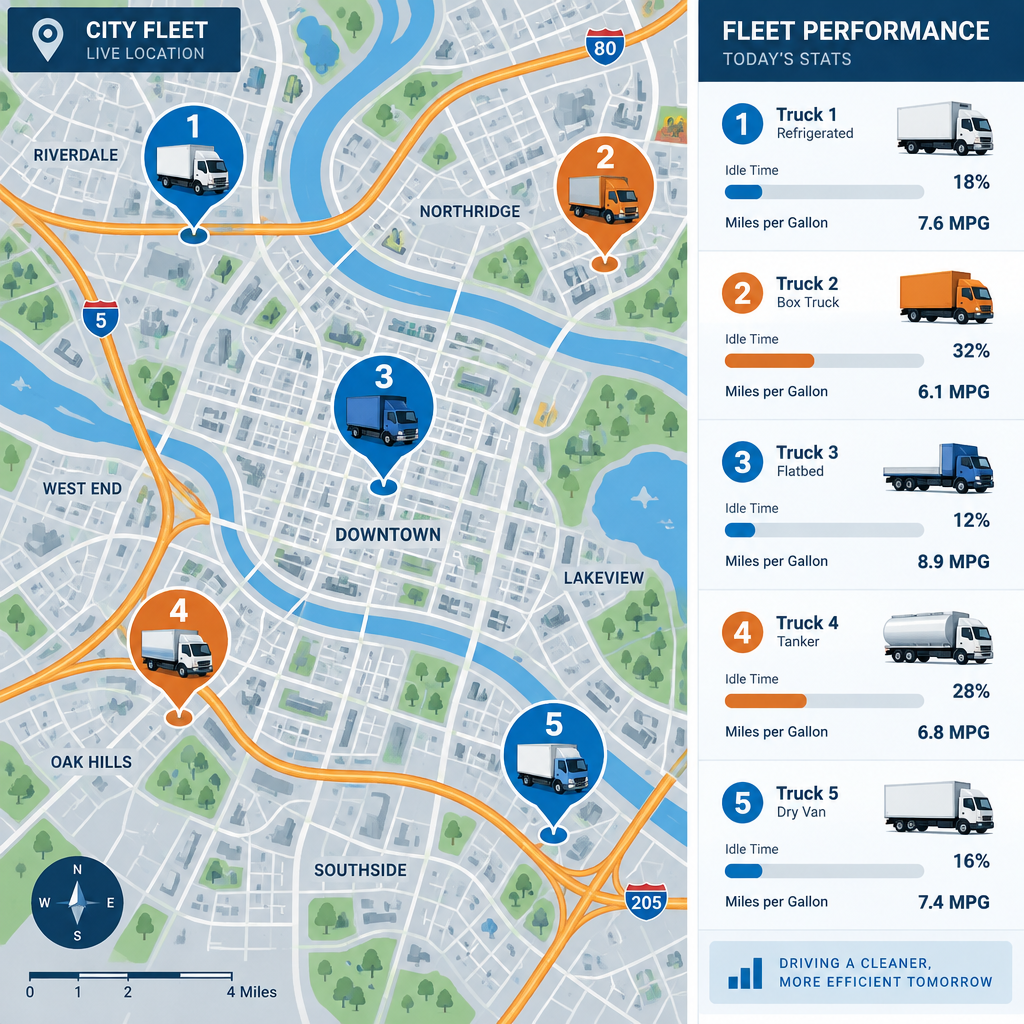
Utilization reports show how much each vehicle is actually used, which tells you whether to keep the same number of vehicles, add some or cut back. You plan ahead from real data instead of reacting to problems.
GPS units and telematics devices report location, idle time, harsh braking, rapid acceleration, ignition on and off times and engine run time. That data shows how your drivers behave and how each trip is going.
It also exposes vehicles that cost money without earning it. For example, if three vans sit unused most weeks, selling one of them saves insurance, registration and servicing costs straight away.
The reverse case matters just as much. If every vehicle runs flat out and jobs slip, the same reports make the case for adding a vehicle or a shift.
Combined with maintenance data, utilization figures help you rotate high-mileage vehicles onto lighter routes, spread wear across the fleet and use the whole fleet better.
9. Better customer service with accurate ETAs

Live GPS lets you give customers accurate arrival times and send the nearest driver to an urgent job. Most fleet platforms can also text customers a tracking link or ETA update, which cuts “where is my technician?” calls. It works for vehicles the way Amazon PPC Tools & Software works for online sellers: it turns scattered data into clear decisions.
Customer details, billing records and driver information sit in one place, and they are easy to find while the customer is still on the phone.
With vehicle locations on the map, you can plan who needs to be where, and when, and reshuffle the schedule when a job overruns. GPS records also settle disputes: if a customer says nobody arrived, the trip history shows when the vehicle was on site and for how long.
10. Time savings from automated logs and billing

A fleet management system automates routine paperwork such as mileage logs, timesheets and invoices. Truck News’ coverage of the 2026 Verizon Connect report said GPS tracking users reported an average 12% decrease in labor costs.
When software handles this work, there are fewer human errors and billing moves faster. Arrival and departure times from GPS can fill in timesheets and job records automatically, and jobs that used to fill a whole day can take a few hours.
The GPS side keeps track of where your vehicles are and how they are used, so you no longer need to phone drivers for updates. Drivers spend less time on paperwork, and office staff spend less time chasing it. That frees up time for work that actually needs a person.
11. Connected back-office data across departments

A fleet management system connects fleet data to accounting, payroll and dispatch, so information passes between departments without anyone typing it in twice. Decisions then rest on one set of reliable numbers instead of each team’s own spreadsheet.
Good fleet management software links fleet tasks such as maintenance and accounts to the rest of your business. Most major platforms offer ready-made integrations or an open API, so trip data can feed invoicing, hours can feed payroll and repair costs can feed the general ledger.
A simple example: a technician finishes a job, the GPS records the time on site, and the invoice goes out that afternoon with the right labor hours attached. Without the connection, someone copies those hours from a paper sheet days later.
Overall efficiency goes up, costly gaps between teams and processes close, and your profit improves. Before you sign, check which of your existing tools the platform integrates with natively, because a custom integration adds cost and upkeep.
12. Sustainability and EV readiness
A fleet management system cuts emissions the same way it cuts fuel bills, by reducing idling and wasted miles. It also gives you the data to plan and run electric vehicles. Every gallon not burned is carbon not emitted, so the idle figures from the Department of Energy’s Alternative Fuels Data Center apply here too.
For EVs, many platforms show state of charge, remaining range and charging sessions next to the rest of the fleet. That helps dispatchers keep routes within range and spot vehicles that did not charge overnight.
The bigger value comes before you buy. Months of trip data show which gas or diesel vehicles drive short, predictable daily distances and return to base each night. Those are the strongest candidates for replacement with an EV.
For ESG and sustainability reporting, fuel used per vehicle and miles driven can be exported and converted into emissions figures, which saves gathering receipts by hand. EV support varies by vendor and by vehicle make, so confirm that the platform works with the models you plan to buy.
Total cost savings and trade-offs
Fleets that use the technology reported average savings of 11% to 19% across fuel, accidents, labor and maintenance in Verizon Connect’s 2026 survey. Every vehicle also carries a monthly fee, and the savings only appear if someone reads the reports and acts on them.
A connected system lets you manage and maintain the fleet before problems happen. Your main departments work as one team and share key information instead of working as separate units. The result is better fleet control, clearer communication, lower fuel bills and fewer surprise repairs.
The counter-argument deserves a fair hearing. Most platforms charge a monthly fee per vehicle, plus hardware and sometimes installation, and pricing is usually quoted rather than published. Contracts often run for several years. Drivers may push back on tracking and cameras if the rollout feels like surveillance.
For a very small fleet of two or three vehicles, a basic GPS tracker with alerts may be enough to start with. Move to a full fleet management system when scheduling, maintenance or compliance starts eating hours every week.
Fleet management challenges these benefits solve
The biggest pressures on US fleets right now are unpredictable fuel prices, hiring and keeping drivers, compliance paperwork and the move to electric vehicles. Each one maps to specific benefits above.
| Challenge | Why it hurts | Benefits that help |
|---|---|---|
| Fuel price swings | Fuel is one of the largest running costs, and budgets break when prices jump | 1. Fuel costs, 2. Route optimization, 3. Fuel theft prevention |
| Driver shortages and turnover | Every unfilled seat means missed jobs, and new drivers carry higher risk | 4. Driver coaching, 10. Less paperwork, 9. Smoother dispatch |
| Compliance workload | ELD logs, inspections and fuel tax reports take hours and carry fines | 7. ELD and HOS compliance, 5. Preventive maintenance |
| Rising repair costs and downtime | A breakdown costs the repair plus the lost day of work | 5. Preventive maintenance, 6. Longer vehicle life |
| EV transition | Buying the wrong EV for a route wastes capital | 12. EV readiness, 8. Utilization data |
Trucking groups such as the American Trucking Associations have reported driver shortages for years. Fleets cannot fix the labor market, but they can make the job less frustrating. Fair coaching based on video instead of complaints, less paperwork and fewer phone calls from dispatch all help keep good drivers.
Benefits by fleet type
The same system pays off in different places depending on what your vehicles do all day. These five common fleet types show where the value usually lands first.
Last-mile delivery and logistics
Delivery fleets gain most from route density and accurate ETAs (benefits 2 and 9). Packing more stops into each route and sending customers live tracking links cuts both miles and failed deliveries.
Field service and HVAC
Plumbing, electrical and HVAC companies use live maps to send the nearest technician to emergency calls (benefit 9). GPS arrival and departure times feed job billing and payroll directly (benefits 10 and 11).
Construction
Construction fleets track heavy equipment by engine hours rather than miles, which drives maintenance schedules (benefit 5). Geofences around job sites and yards flag equipment that moves after hours, a common theft pattern (benefit 3).
Long-haul trucking
Long-haul carriers rely on the built-in ELD for hours-of-service compliance (benefit 7). The International Fuel Tax Agreement (IFTA) requires quarterly reports of miles and fuel by state or province. Telematics records distance by jurisdiction and fuel card data supplies purchases, so many platforms can generate the IFTA report even when the carrier still files it separately.
Government and municipal fleets
City and county fleets often own vehicles that sit unused for long stretches. Utilization reports support selling or pooling them (benefit 8), and cost-per-mile data backs up replacement budgets presented to councils (benefit 6).
FAQ
What is a fleet management system?
A fleet management system is a platform that tracks and manages company vehicles from one dashboard. It usually combines GPS tracking, fuel and idle reports, maintenance scheduling and driver behavior scoring, and often adds ELD compliance and dash cam video. Office staff use fleet management software in a web browser, and drivers usually use a phone or tablet app.
What are the 5 pillars of fleet management?
A commonly cited model groups fleet management into five pillars: vehicle acquisition and lifecycle, maintenance, fuel management, driver safety and compliance. It is a widely used way to organise the job, not an official standard, and some versions add telematics or cost control as separate pillars. A fleet management system supports all five from one place.
What are the top fleet management systems to compare?
The major US vendors to compare are listed here in alphabetical order, not as a ranking:
- Fleetio: maintenance-focused fleet software that pulls GPS and engine data from other telematics providers.
- Geotab: telematics company known for its GO devices and an open platform with a large marketplace of add-ons.
- Motive: formerly KeepTruckin, a platform built around ELD compliance, AI dash cams and fleet cards.
- Samsara: connected operations platform combining GPS tracking, AI dash cams, ELD and equipment monitoring.
- Verizon Connect Reveal: Verizon’s GPS tracking and fleet management platform, with video telematics and dispatch tools.
Most quote pricing per vehicle per month, so ask several for quotes based on your fleet size and contract length.
How much can a fleet management system save?
In Verizon Connect’s 2026 Fleet Technology Trends Report, fleets using GPS tracking reported an average 12% drop in fuel costs and a 19% drop in accident costs. Overall savings across fuel, accidents, labor and maintenance averaged about 11% to 19%. Your results depend on fleet size, how much your vehicles idle and whether managers act on the data.
Is fleet management software worth it for a small business?
Usually yes, once you have more than a few vehicles that spend all day on the road. Cutting idle time and unneeded mileage often covers the per-vehicle monthly fee. With only one or two vehicles, start with a simple GPS tracker and add full software when scheduling and maintenance get harder to manage.
Is fleet software required to comply with the ELD rule?
You need a registered electronic logging device if you are a motor carrier or driver who must keep records of duty status under FMCSA rules. Many fleet platforms include one, but a standalone ELD also meets the rule. Whichever you choose, check that it appears on FMCSA’s registered ELD list.
Does a fleet management system lower insurance premiums?
It can. Truck News’ coverage of Verizon Connect’s 2026 survey reported an average 11% drop in insurance premiums among GPS tracking users. Policies differ by insurer, so ask your broker whether they give credit for telematics data, safety scores or dash cam footage.
What does a fleet manager do?
A fleet manager buys, maintains and eventually replaces the company’s vehicles, and keeps drivers safe and compliant. Day to day that means scheduling service, controlling fuel spending, reviewing safety events, keeping ELD and inspection records in order and reporting costs to management. A fleet management system pulls the data for all of those tasks into one place.
Can fleet software track drivers outside working hours?
Most platforms let you set privacy or off-duty modes so that tracking stops or hides location data outside shifts. Workplace monitoring rules vary by state and country. Write a clear tracking policy, share it with drivers and check local rules before you track personal use of company vehicles.
Sources
- 2026 Verizon Connect Fleet Technology Trends Report (Verizon News)
- Fleet management trends: 3 goals fleet managers have for 2026 (Verizon Connect)
- AI, telematics adoption increases as fleets prioritize savings, efficiency, safety (Truck News)
- Verizon’s Fleet Technology Trends Report Highlights the Key Priorities for 2026 (Telecom Review Americas)
- Idle Reduction Benefits (US Department of Energy, Alternative Fuels Data Center)
- Idle Fuel Consumption for Selected Gasoline and Diesel Vehicles (US Department of Energy)
- Fleet idling study (Geotab)
- Who must comply with the ELD rule (FMCSA)
- ELD fact sheet (FMCSA)
- IFTA fuel tax reporting software (Motive)
- Best fleet management software comparison (Tech.co)