Fleet management software is a cloud platform that collects data from your vehicles, usually through a telematics device plugged into each one. It puts location, fuel use, maintenance, driver behavior and compliance records on one dashboard. As of November 2026, the best-known platforms in the US include Samsara, Motive, Geotab and Verizon Connect. For trucking fleets, the most important check is whether the system’s electronic logging device (ELD) is on the FMCSA’s registered list. The biggest day-to-day savings come from less idling, preventive maintenance and safer driving.
Fleet management software lets you move away from manual, paper-based admin. Fleet managers use it to track expenses, plan maintenance and run day-to-day vehicle operations from one place.
Used well, it makes your fleet more efficient and gives you an edge over competitors. There are many products on the market, so you need to pick the one that fits the size of your fleet, the type of vehicles you run and the rules you have to follow.
Going digital gives you more accurate information and fewer mistakes. Routine work such as logging hours, scheduling services and building reports can be automated, which cuts out a lot of human error.
Below you can learn what a fleet management system does and the eight main benefits it brings.
What is a fleet management system
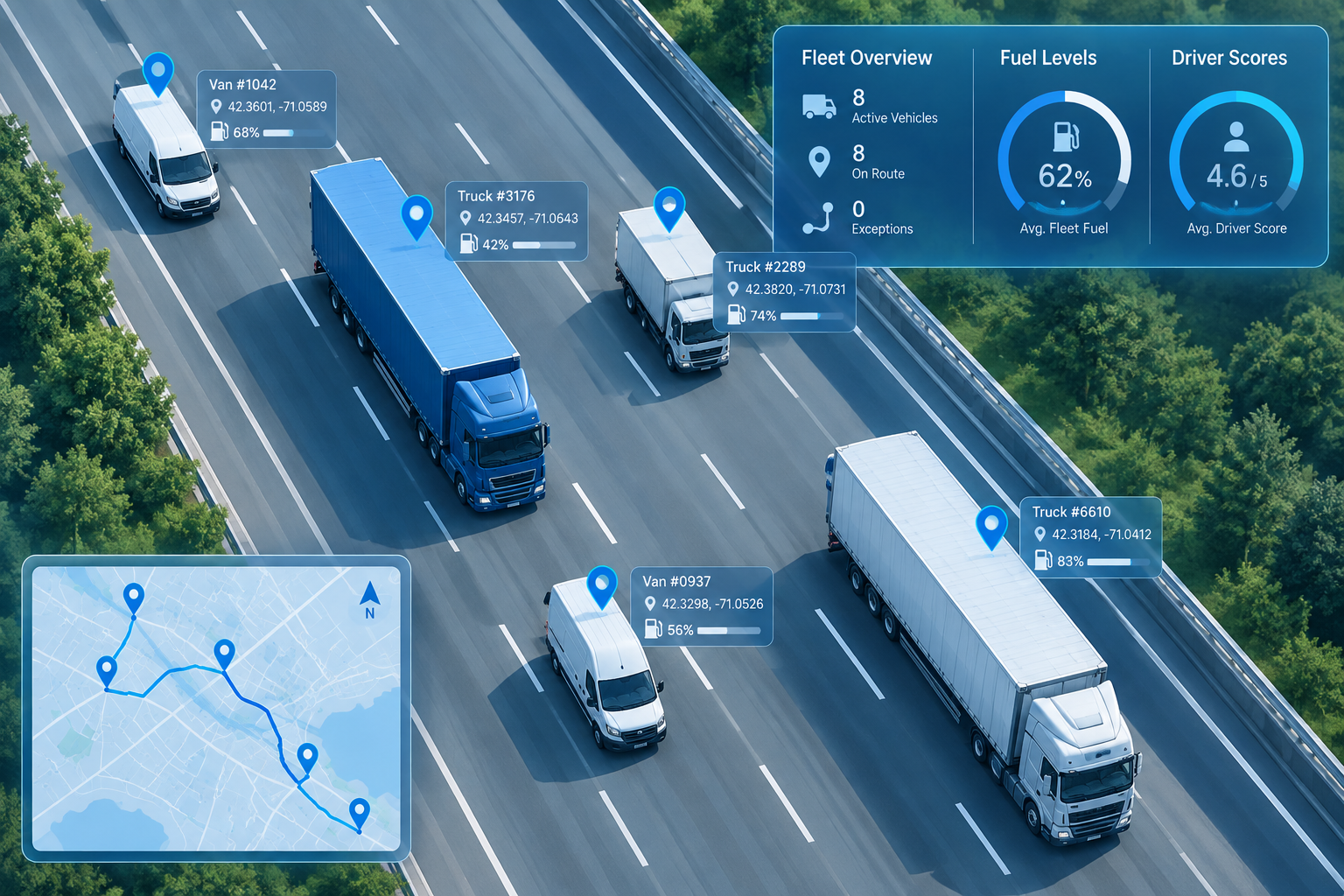
A fleet management system is software that receives telematics data from every vehicle in your fleet and turns it into information you can act on. A small device connects to each vehicle’s diagnostic port or wiring. It sends GPS position, engine data and driving events to a cloud dashboard that you open in a web browser or a phone app.
The software helps you monitor, manage, analyze and improve how your vehicles are used. Your data is available whenever you need it, so decisions about maintenance, inspections and monitoring rest on real figures instead of guesswork.
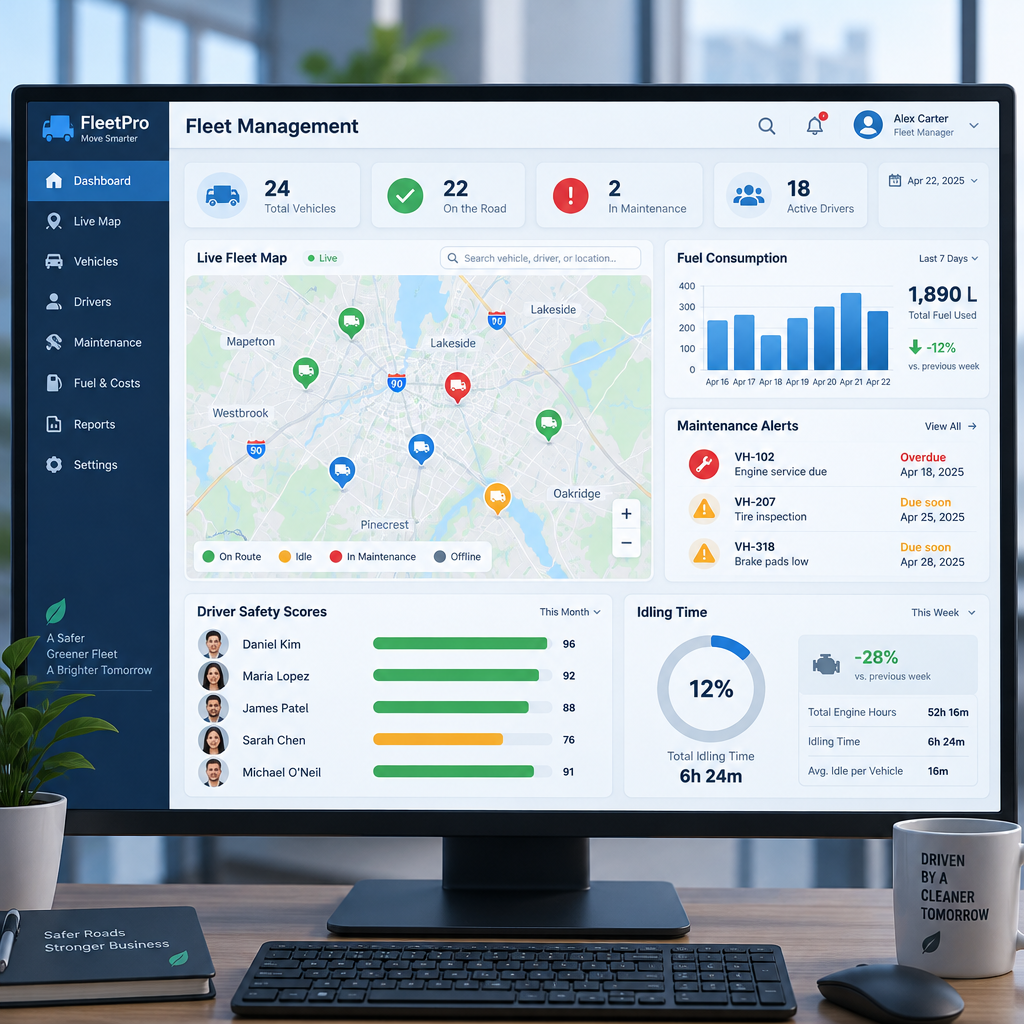
Before you choose a vehicle management platform, work out which features your company actually needs. A delivery business with ten vans needs different things from a long-haul carrier that must follow federal hours of service rules. Fleet management software typically helps you manage and organize:
- Fuel and other operating expenses
- Vehicles, assets and drivers
- Vehicle maintenance and repairs
- The location of assets and vehicles
- Hours of service violations
- Hours of service records, through a built-in ELD for trucks and buses that need one
- Driver behavior and safety scores
Most platforms also go beyond plain reporting. They flag problems and suggest actions, such as a service reminder or a coaching session for a driver, which you can accept or dismiss.
Fleet management software and the ELD rule
If you run commercial trucks or buses in the US, your fleet software probably doubles as your hours of service logbook. The FMCSA’s ELD rule, published in December 2015, requires most drivers who must keep records of duty status to use an electronic logging device. Since April 1, 2018, drivers without a compliant device can be placed out of service.
An ELD connects to the vehicle’s engine and records driving time automatically. A phone or tablet can count as an ELD, but only if it meets the rule’s technical requirements, including a connection to the engine. The device must also be on FMCSA’s list of registered devices.
That list changes. Throughout 2026, FMCSA has been removing devices that fail to meet requirements, in batches such as 12 devices on May 20, 2026 and 5 devices on August 6, 2026. When a device is revoked, carriers generally get 60 days to switch to a compliant one. After that, drivers using it can be treated as having no record of duty status. Before you sign a contract, check the vendor’s ELD on FMCSA’s registered list. Check the revoked list again from time to time after you sign.
Why a company needs a fleet management system
A fleet management system saves time and money because it replaces scattered spreadsheets, paper logs and phone calls with one source of truth. It also shows you problems you could not see before.
For example, it can spot drivers who leave engines idling for long periods or do it often. Idling adds up fast. According to the US Department of Energy’s Alternative Fuels Data Center (AFDC), an idling heavy-duty truck burns about 0.8 gallon of fuel per hour. At $4.00 a gallon, a single 10-hour rest stop with the engine running costs about $32. The AFDC estimates that idling trucks use more than one billion gallons of fuel a year in the US.
The software also handles the large amount of data a fleet produces every day. If you run a large fleet, you need a tool that keeps up with it. You can track and improve things like:
- Driving routes (followed by GPS)
- Current orders
- Fuel consumption
- Orders delivered and not delivered
- Future delivery status (tracked through an integrated CRM or dispatch system)
- The technical condition of each vehicle
With a good system, all of your fleet operations sit in one place. You make better decisions because the information you need is always in front of you.
How to compare fleet management platforms
The right platform depends on your fleet type, the regulations you face and how much you want to pay. The table below sums up how the major vendors are usually described in 2026 buyer comparisons. Treat it as a starting point for your own demos, not a final ranking.
| Platform | Usually described as | Typical buyer |
|---|---|---|
| Samsara | All-in-one platform with telematics, dash cams and maintenance | Mixed fleets that want one system for everything |
| Motive | Compliance-focused, strong ELD and safety tools | Trucking companies with hours of service needs |
| Geotab | Open data platform sold through resellers | Larger fleets that want to connect their own tools |
| Verizon Connect | GPS tracking and fleet management from a large carrier | Service and field businesses |
On pricing, published 2026 comparisons commonly put base subscription plans at roughly $25 to $35 per vehicle per month. Hardware, dash cams and contract length add to that. Geotab prices vary more because resellers set them. Ask every vendor for a written quote that covers the hardware, installation, contract term and cancellation terms.
Top 8 benefits of a fleet management system
These are the most important benefits a fleet management system brings. The first two are usually where you see results fastest.
1. Automated reports on all fleet operations
Fleet platforms come with built-in dashboards that show your most important data in real time and turn it into scheduled reports. Automated reports save staff time and remove the copying errors that come with manual reporting.
Data can also be moved into or out of accounting software with little effort. Many platforms connect directly to common accounting and payroll tools. You can customize the dashboards, so each company sees the measures that matter to it.
The result is better profitability and return on investment, a leaner fleet and better customer service.
2. Fuel consumption control
Controlling fuel use is one of the quickest ways to run a more efficient company. A good fleet management system lets you track fuel use and get alerts when a vehicle idles for too long.
It can also warn you when a truck is about to go over its daily mileage limit. These problems often come from aggressive driving, poor route planning or last-minute changes to orders.
With the right system, you can set custom alerts and dashboards that catch these situations early. Then you can fix the cause, whether that is driver coaching or better route planning.
3. Real-time fleet data collection and analysis
Fleet software keeps you up to date on every truck in your fleet, with live location and status on one automated dashboard. That cuts down on check-in calls and makes dispatching faster.
Commercial vehicles produce a lot of telematics data, and much of it is only useful once it has been analyzed. When you can see patterns, such as one route that is always late or one vehicle that uses more fuel than the others, you can fix problems before they cost you customers.
4. Wear control and preventive maintenance
Fleet software reads engine data and fault codes automatically. It then turns them into maintenance alerts and service schedules. Many current platforms also use machine learning to predict when a part is likely to fail.
Predictive and preventive maintenance tells you when a part needs replacing before it breaks. That keeps vehicles out of unplanned downtime and avoids the larger repair bills that follow a breakdown on the road. Many systems also handle digital driver vehicle inspection reports (DVIRs), so defects that drivers find during pre-trip checks go straight to your maintenance team.
5. Fleet safety
Keeping drivers and vehicles safe protects your people, your assets and your service. A fleet management system monitors driver behavior and records events such as harsh braking, hard acceleration, speeding and sharp cornering.
Many platforms pair this with dash cameras that detect risky behavior, such as phone use or following too closely. Managers can review the clips and coach drivers before a near miss turns into a crash that delays deliveries or damages vehicles.
6. Fleet fraud prevention
Driver fraud costs money and can damage your relationships with customers. Fuel card fraud is one of the most common types, for example buying fuel for a personal car on the company card.
Fleet software helps here because it can compare each fuel card transaction with the vehicle’s GPS location, tank size and fuel level. If a card is used where the vehicle was not, or for more fuel than the tank holds, the system flags the anomaly for review.
7. Meeting delivery deadlines
Route planning tools in fleet software help you plan routes that get orders delivered on time while keeping mileage and costs down. When plans change, dispatchers can see every vehicle’s location and reroute the closest one instead of guessing.
Shorter, better-planned routes also burn less fuel. That lowers your costs and your fleet’s emissions at the same time.
8. Fewer traffic accidents
Safety alerts, driver coaching and camera footage together help reduce traffic accidents. Fewer collisions mean fewer injuries, fewer insurance and legal claims, and less money spent on repairs and lost vehicle time.
Video footage also matters after a crash. When the other party was at fault, clear footage can protect your driver and your company from false claims.
FAQ
How much does fleet management software cost?
Most platforms charge a monthly subscription per vehicle. In 2026 comparisons, base plans from major vendors are commonly quoted at about $25 to $35 per vehicle per month. Dash cams, advanced safety features, hardware and installation usually cost extra, and many vendors want multi-year contracts. Always get a written quote before you commit.
Is fleet management software the same as GPS tracking?
No. GPS tracking is one part of it. A full fleet management system adds fuel tracking, maintenance scheduling, driver safety scoring, ELD compliance, reporting and connections to accounting tools. A basic GPS tracker only shows where your vehicles are.
Do I need an ELD for my fleet?
If your drivers have to keep records of duty status under FMCSA rules, you generally need an ELD that is on FMCSA’s registered list. There are exceptions, for example for some short-haul operations and older vehicles. Check FMCSA’s ELD rule pages or 49 CFR Part 395 for your situation. Many fleet platforms include an ELD, so one system covers both tracking and compliance.
What happens if my ELD is revoked by FMCSA?
FMCSA notifies affected carriers and usually gives them 60 days to replace the device with a registered one. If you are still using the revoked device after the deadline, your drivers can be treated as having no record of duty status and may be placed out of service. Check FMCSA’s revoked devices list whenever your vendor announces changes.
Is fleet management software worth it for a small business?
It often is, even for a handful of vehicles, because savings on fuel, maintenance and insurance can cover the subscription. The value is lower if your vehicles rarely leave a fixed site or drive very few miles. Ask vendors for a trial or a short pilot on a few vehicles, and measure fuel use and idle time before and after.
Can fleet software track my drivers when they are off duty?
Most platforms let you set privacy modes or limit tracking to working hours, but the settings vary by vendor. Tell drivers what is tracked and why, and check your state’s employee monitoring laws, especially if drivers take vehicles home. Clear policies help drivers accept the system.
Fleet management software pays off fastest when you start with one problem, such as idle time or late deliveries, and measure it before and after you roll the system out. Shortlist two or three vendors, check that the ELD is on FMCSA’s registered list if you need one, and run a pilot on a few vehicles before you sign a long contract.
Sources
- FMCSA: What are the key requirements of the Electronic Logging Device (ELD) rule
- FMCSA: ELD FAQ, electronic logging devices and hours of service
- FMCSA: Revoked ELDs notice, May 20, 2026
- FMCSA: ELDs removed, August 6, 2026
- US Department of Energy AFDC: Idle reduction benefits and considerations
- US Department of Energy AFDC: Heavy-duty vehicle idling fact sheet