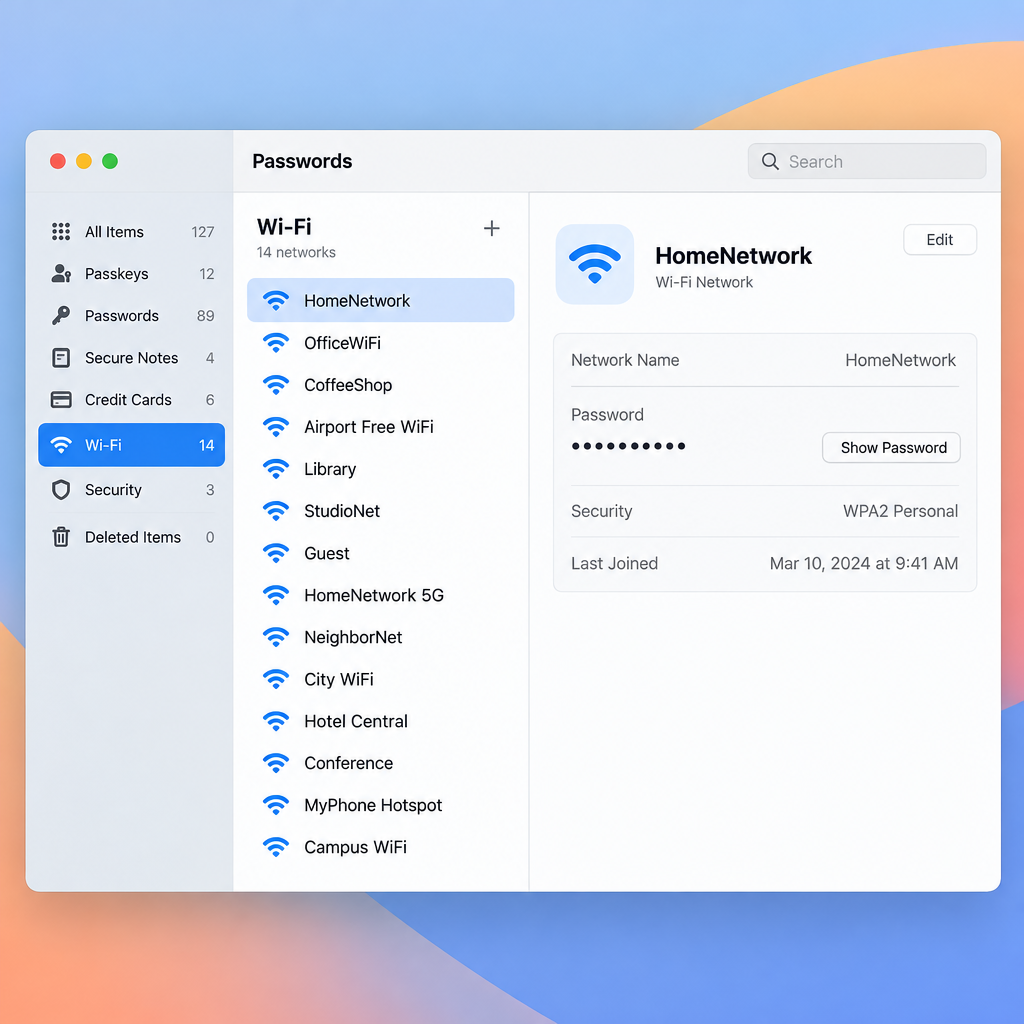
On a Mac running macOS Sequoia 15 or later, including macOS Tahoe 26 and macOS Golden Gate 27, the quickest way to see a saved Wi-Fi password is the Passwords app. Open it, click Wi-Fi in the sidebar, choose the network, and unlock with Touch ID or your Mac password. On macOS Ventura 13 and later, you can also copy the password from System Settings. Keychain Access and Terminal still work too, and they are the only built-in options on older versions of macOS.
This happens in a lot of homes. Your phone, PC or Mac joined the Wi-Fi once, saved the password, and nobody wrote it down. Now a guest or a new device needs it. You could look it up in your router’s settings, but your Mac already has it stored and will show it to you after you confirm you are an administrator.
Ways to see a saved Wi-Fi password on a Mac
macOS has four built-in ways to show saved Wi-Fi passwords. Which one you use depends on your macOS version and how comfortable you are with the tools.
| Method | Works on | Needs the exact network name | Best for |
|---|---|---|---|
| Passwords app | macOS Sequoia 15 and later | No | Most people |
| System Settings, Copy Password | macOS Ventura 13 and later | No | Copying a password fast |
| Keychain Access | All recent versions | No | Older Macs, or seeing everything stored |
| Terminal | All recent versions | Yes | Users who prefer typing commands |
Every method only works for networks saved in your Mac’s list of known networks. Every method also asks you to prove you are an administrator with Touch ID or an admin user name and password.
View saved Wi-Fi passwords in the Passwords app
Starting with macOS Sequoia, Apple keeps your saved passwords, passkeys, verification codes and Wi-Fi passwords in one Passwords app. Apple’s own guide recommends this route.
- Press Command + Space to open Spotlight, type Passwords, and press Return.
- Unlock the app with Touch ID or your Mac login password.
- Click Wi-Fi in the sidebar. If you are connected to a network right now, its name appears at the top.
- Click the network you want. The password is hidden until you reveal it, and you can copy it from there.
- To share the network with a phone, use the option to show a network QR code. The other device scans the code and joins without anyone typing the password.
Copy a Wi-Fi password from System Settings
On macOS Ventura 13 and later, System Settings can copy the password of any known network so you can paste it somewhere else.
- Choose Apple menu > System Settings.
- On macOS Ventura, Sonoma and Sequoia, click Network, then Wi-Fi, then scroll down and click Advanced to open the list of known networks. On macOS Tahoe and later, click Wi-Fi in the sidebar and find the network under Known Networks.
- Click the More button (three dots) next to the network name and choose Copy Password.
- Confirm with Touch ID or an admin password, then paste the password into Notes or a message.
Some networks, such as public or work networks that use a sign-in page, do not offer Copy Password.
View saved Wi-Fi passwords in Keychain Access
Keychain Access is the password manager built into macOS. It stores Wi-Fi passwords, website logins, certificates and keys on your Mac. When iCloud Keychain is turned on, saved passwords sync across your Apple devices. Since macOS Sequoia, Apple has moved everyday password tasks to the Passwords app, but Keychain Access is still included, including in macOS Golden Gate.
You can also store secure notes, certificates and other sensitive information in Keychain Access. Since macOS Sequoia, it can still show existing secure notes but can no longer create new ones. Follow these steps to find a Wi-Fi password:
- Open Spotlight with Command + Space, or click the magnifying glass in the menu bar.
- Type Keychain Access and press Return. On macOS Monterey and earlier, you can also find it in Applications > Utilities. On macOS Sequoia and later, Apple moved the app to a hidden system folder (/System/Library/CoreServices/Applications), so Spotlight is the easiest way to open it.
- Under System Keychains in the left sidebar, click System.
- Click the Passwords tab at the top of the window.
- The list shows the Wi-Fi networks saved on your Mac.
- Double-click the network name to open its details window.
- Select the Show Password checkbox at the bottom.
- Because this is system information, macOS asks for an administrator user name and password. Enter them and click OK (or Allow).
- If you are not sure of your user name, click the Apple menu in the top-left corner. The Log Out item shows your account’s full name. You can also look it up in System Settings > Users & Groups.
- The password now appears in the Show Password field.
You can edit the saved password in this window and click Save Changes. If iCloud Keychain is turned on, the change can sync to your other Apple devices too. It does not change the password on the router. To change the real Wi-Fi password, you have to use the router’s own settings or app. If someone else runs the network, such as an office IT team, you cannot change it from your Mac.
Find a Wi-Fi password with Terminal
Terminal is a built-in app that lets you control your Mac by typing commands. It is a direct route if you do not want to click through the steps above. The catch is that you need the exact name of the Wi-Fi network, including capital letters and spaces.
- Open Terminal with Spotlight (Command + Space, then type Terminal), or go to Applications > Utilities > Terminal.
- Type the following command:
security find-generic-password -wa "WIFI NAME"
Replace WIFI NAME with the exact name of your network, and keep the quotation marks if the name has spaces.
3. Press Return. A window asks for an administrator user name and password.
4. Enter them and click Allow. Terminal prints the Wi-Fi password on the next line.
If Terminal says it cannot find the item, check the spelling of the network name. You can copy the exact name from the Wi-Fi menu or from the Known Networks list in System Settings.
Which method to use
As the steps above show, getting a saved Wi-Fi password on a Mac is easy. On macOS Sequoia or later, use the Passwords app. It is the quickest and lists every saved network. On macOS Ventura or Sonoma, Copy Password in System Settings is fastest. If you need to see a password rather than paste it, use Keychain Access. Terminal suits people who already know the network name and like the command line.
Avoid losing Wi-Fi passwords again
A password manager means you never have to dig for the password again. It saves every Wi-Fi network’s login details, and you can get them back with one Touch ID or password check.
If all your devices are Apple devices, the Passwords app with iCloud Keychain is the simplest choice. Apple introduced it in macOS Sequoia, iOS 18 and iPadOS 18, and it can store and sync Wi-Fi passwords across your Mac, iPhone and iPad. Apple also makes iCloud Passwords for Windows. If you use Android too, a cross-platform manager such as 1Password, Dashlane, Enpass or LastPass works on Mac, Windows, iPhone and Android. Each needs its own app or browser extension.
FAQ
Can a Mac show a Wi-Fi password without an admin password?
No. Every built-in method asks for Touch ID or an administrator user name and password before it shows a Wi-Fi password. A standard user account cannot see these passwords without an admin’s credentials. If you do not know any admin login for the Mac, ask the owner or the person who set it up.
Why is a Wi-Fi network missing from the Passwords app or Keychain Access?
Your Mac only shows passwords for networks saved in its list of known networks, whether you joined them or added them manually. If you joined only on your iPhone, the password appears on the Mac only when iCloud Keychain is on and both devices use the same Apple Account. Networks that use a sign-in page or a work login with a user name may not store a regular password at all.
Where is Keychain Access on macOS Sequoia and later?
Apple removed it from the Utilities folder in macOS Sequoia. The app now sits in /System/Library/CoreServices/Applications. The easiest way to open it is to press Command + Space, type Keychain Access, and press Return.
Can a Mac share a Wi-Fi password with an iPhone?
Yes. When your Mac is connected and unlocked, and the iPhone is nearby and tries to join the same network, the Mac can offer to share the password. Both devices need Wi-Fi and Bluetooth turned on, and the other person usually needs to be in your contacts. The Passwords app can also show a QR code for the network, which any phone can scan.
What if the password the Mac shows no longer works?
The Mac shows the password it saved, not the router’s current one. If someone changed the Wi-Fi password, the old copy on your Mac will fail. Find the new password in the router’s admin page or app, or on the label of a router that still uses its factory password. Contact your internet provider if you cannot sign in to the router.
Sources
- Apple Support: Find a Wi-Fi password in the Passwords app on Mac
- Apple Support: If you need help with your Wi-Fi password
- Apple Support: Wi-Fi settings on Mac
- Apple Support: Keychain Access User Guide for Mac
- Apple Developer Forums: Does the Keychain Access app still exist in macOS Sequoia