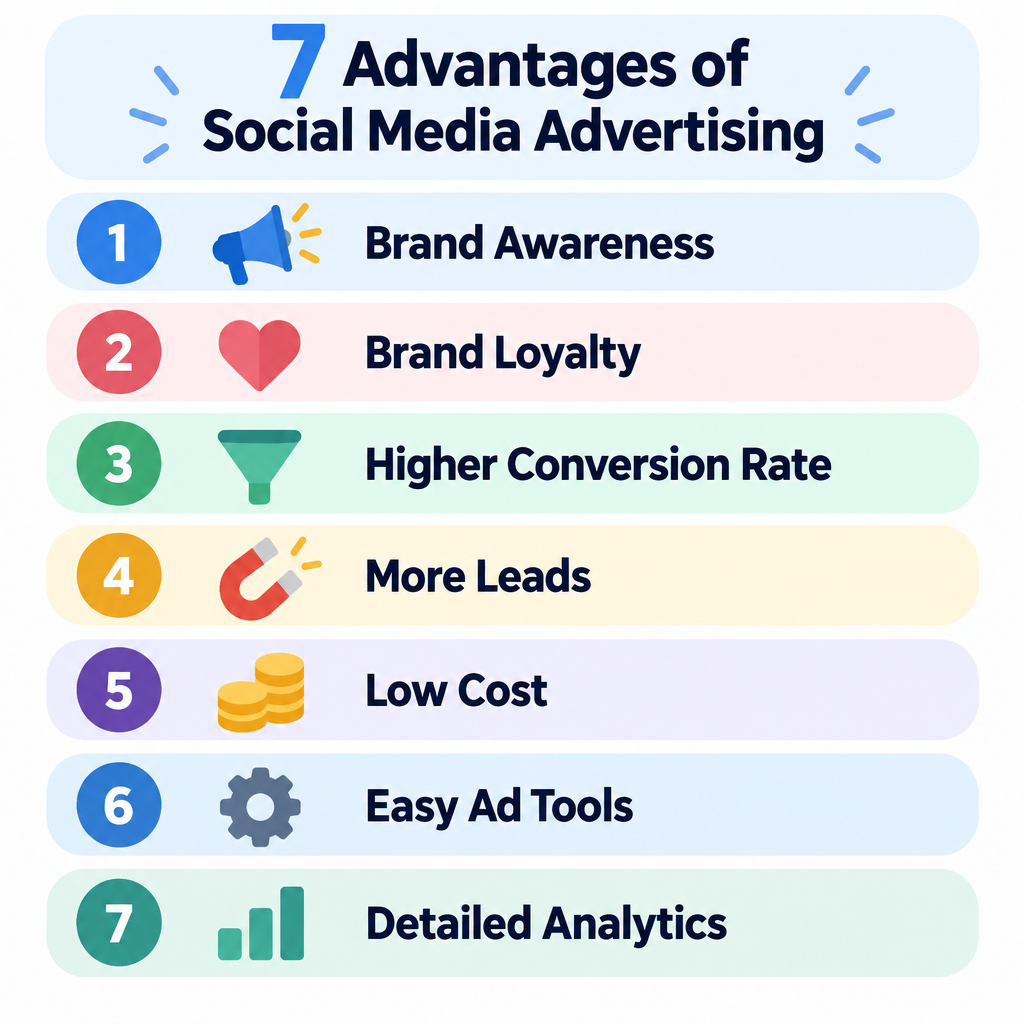
Social media advertising puts your business in front of about 5.81 billion social media user identities, according to DataReportal’s October 2026 figures. You also pay only for the results you choose, such as clicks, views or leads. Its seven main advantages are brand awareness, brand loyalty, higher conversion rates, more leads, low cost, easy ad tools and detailed analytics. The main downsides are the skill it takes to run campaigns well and the competition for attention, so for most businesses a small, well-targeted test on one platform is the best first step.
Social media has become one of the main places people spend their time online. If you want to reach your target market, your company needs to be active and visible there.
DataReportal, which publishes its research with Kepios, counted 5.81 billion social media user identities at the start of October 2026. That is about 70% of the world’s population. Its Digital 2026 Mid-Year Update put internet users at 6.12 billion in April 2026. These figures count accounts rather than unique people, because one person can hold several profiles. For comparison, the Digital 2020 report counted 4.14 billion social media users out of 4.66 billion internet users.
Millions of people use X (formerly Twitter), Facebook, Instagram, TikTok, LinkedIn and YouTube every day, so social media advertising is not a tactic you can afford to ignore.
Spending in the UK shows how fast it has grown. In 2019, according to IAB UK, £3.59 billion went on social media ads in the UK, up 25% on the year before. By 2025 the Advertising Association and WARC put UK social media ad spend at £11.5 billion. That was up 21% on 2024 and made up 24.7% of the £46.7 billion UK advertising market, behind only search. One detail matters if you compare figures: AA/WARC counts YouTube as social media, not TV.
Social media advertising is only one of the ways you can use social media to reach your business goals. How businesses use social media for marketing also covers organic posts, customer service and community building. Paid ads are the fastest way to reach people who don’t follow you yet.
The 7 advantages of social media advertising for business
Below are the seven main benefits and how to use each one for your company.
Success comes from building the right advertising plan for your audience. Reaching millennials on X calls for a different plan than reaching teenagers on TikTok. To build that plan, you need to understand what social media ads do well and how to use each strength.
If social ads are not part of your marketing plan yet, you are probably missing chances to reach more customers, increase conversions and keep existing customers happy.
1. Increased brand awareness
Advertising your company, products or services on social media raises brand recognition straight away.
Before anyone clicks or buys, social ads are already showing your brand to large numbers of people. That might be an ad before a YouTube video or a post marked “Sponsored” in someone’s Instagram feed.
Greater awareness keeps your company in customers’ minds, even if only in the background. That exposure can bring new leads and more conversions for well-known brands and newcomers alike.
If you run an awareness campaign, pick the ad format that suits the goal. A study by Magna found that 65% of people skip online video ads as soon as possible.
If YouTube is part of your plan, non-skippable in-stream ads make sure viewers see the whole message. Google Ads Help says these run for 7 to 15 seconds on most devices, with a 30-second version for connected TVs. Ads of 6 seconds or less run as bumper ads.
2. Improved brand loyalty
Talking with customers on social media helps you build a loyal customer base. Social ads do more than promote products. They give you a way to engage with your audience and build lasting relationships.
Social ads are also a good way to show social proof, which builds loyalty and turns one-time visitors into repeat customers. For example, you can use them to share case studies or customer testimonials that show how happy people are with what you sell.
Remarketing ads build loyalty too. They keep your products in front of past customers and website visitors.
3. Higher conversion rate
Social ads can raise your conversion rate. In the Digital 2020 report, 27% of people surveyed said they found new brands and products through social media ads.
You can raise conversions in several ways. Tools such as Meta Ads Manager (for Facebook and Instagram) and LinkedIn Campaign Manager let you target specific audiences. That way your ads reach the people most likely to want what you offer.
Retargeting campaigns help in other ways. They nurture warm leads and bring them back to your business.
Remarketing is especially useful for online shops. If you run an e-commerce store, you can use Facebook and Instagram retargeting ads to bring back visitors who left items in their cart and get them to finish the purchase.
An earlier Facebook study found that a series of image ads did better than other ad types at bringing customers to the advertiser’s site. If your goal is more sales on your website, consider a funnel built from a sequence of image ads.
On Snapchat, branded lenses and filters encourage people to share your content with their own friends. Sponsored AR Lenses and Sponsored AR Filters have run for years. In April 2025 Snap added Sponsored AI Lenses, which place users in branded AI-generated scenes. These formats create shareable content that raises awareness and draws in new customers.
The best social media tip is to actually be social. If your content is interesting and relevant, people remember your brand, reshare it and recommend you to friends and followers. Shareable paid content brings more traffic to your website and more conversions.
If you want more website traffic and more conversions, social ads are a good place to start.
4. More leads for your business
Social ads raise your company’s visibility, and lead generation campaigns turn that visibility into real contacts.
For consumer-facing businesses, Meta’s Leads objective in Meta Ads Manager is a strong choice. It can collect details through Instant Forms inside Facebook and Instagram, or start conversations in Messenger, Instagram and WhatsApp. Common uses include sign-ups for an online event, building your email list before a product launch and gathering customer details for future campaigns.
For B2B companies, LinkedIn advertising is a powerful source of leads. It suits a SaaS company looking for new customers and an e-commerce brand looking for distributors.
LinkedIn Message Ads, called Sponsored InMail until LinkedIn renamed them in 2019, deliver your message straight to a member’s LinkedIn inbox. You can attach a LinkedIn Lead Gen Form to collect leads without the person leaving LinkedIn, and Campaign Manager reports open rates and click-through rates.
5. Low-cost advertising
Cost is often the biggest worry, but social ads can be very affordable.
Most social campaigns use pay-per-click (PPC) or pay-per-view (PPV) pricing. You pay only when someone clicks your ad or watches your video ad, so your budget goes on people who actually take action.
WordStream’s 2025 Facebook ads benchmarks found an average cost per click of $0.70 for traffic campaigns across all industries, down from $0.77 in its previous report. Earlier WordStream benchmarks put the average at $1.68. Costs vary a lot by industry. Legal and finance clicks cost much more than retail. Even so, low average prices make social ads a sensible way to support your marketing without overspending.
6. Easy-to-use ad tools
Social ads don’t need to be intimidating. The big platforms all offer self-serve ad tools built for non-specialists.
You can run campaigns in Meta Ads Manager for Facebook and Instagram ads or in Campaign Manager for LinkedIn ads, and set them up to deliver the results you want.
These tools walk you through every step, from picking an objective to entering your audience and budget. Meta Ads Manager offers six objectives: Awareness, Traffic, Engagement, Leads, App Promotion and Sales. Choose carefully, because changing the objective later means building a new campaign.
Once your ads are live, you can track how they perform and use that data to improve them.
Some platforms also let you build custom reports and automated rules, such as pausing an ad when its cost per result goes too high. If you manage several platforms at once, social media marketing software can schedule posts and bring reports from different networks into one place. That saves real time for marketers who handle many jobs.
7. In-depth analytics
The final advantage is the amount of data you get. Every campaign shows clear numbers on reach, clicks, cost and conversions.
You can see almost straight away how campaigns are performing now and how they did in the past. That lets you adjust live campaigns, run A/B tests and plan future campaigns around what worked.
The data helps beyond advertising too. For example, the reactions and comments on your ads show what your audience likes, and you can use that when you write organic content for your website.
Linking your ad platforms with Google Analytics 4 shows what happens after the click. It gives you a clearer picture of which marketing activities actually suit your business.
Disadvantages of social media advertising
Social ads have real drawbacks, like any marketing method, and you should plan for them.
First, they are harder than they look, and junior team members may find them overwhelming. Good campaigns need targeting, creative, copywriting and analysis skills, so put someone qualified in charge or hire a specialist agency. Social media marketing strategy is where that skill gap shows most, because a weak plan wastes budget however good the ads look.
Second, social ads are open to everyone, so you compete with many other businesses for the same attention. Treat that as a reason to stand out with bold, creative ads rather than a reason to stay away.
Third, tracking is less precise than it used to be. Privacy changes such as Apple’s App Tracking Transparency, introduced in iOS 14.5 in 2021, limit how much some platforms can measure. Platforms also change formats and rules often, so campaigns need regular attention.
Weighing the benefits against the drawbacks
For most businesses, the advantages outweigh the drawbacks. Social ads offer a flexible, affordable way to reach large audiences, and you can target them as narrowly as your budget needs.
The best next step is a small test. Pick the one platform where your customers spend the most time and set a modest daily budget. Choose a single objective, such as leads or sales, run it for a few weeks, then let the analytics decide whether to scale up, change course or try another network.
FAQ
Is social media advertising worth it for a small business?
Yes, in most cases, because you can start with a small daily budget and pay only for clicks, views or leads. Precise targeting means even a modest budget reaches relevant people. Start with one platform and one clear goal so you can tell what is working.
How much does social media advertising cost?
It depends on the platform, your industry and your goal. WordStream’s 2025 benchmarks found an average Facebook cost per click of $0.70 for traffic campaigns across all industries, and some sectors pay several times that. You set your own budget in tools like Meta Ads Manager and LinkedIn Campaign Manager.
Which social media platform is best for advertising?
The best platform is the one your customers use. Facebook and Instagram suit most consumer businesses, LinkedIn suits B2B lead generation, and TikTok and Snapchat reach younger audiences. YouTube works well for video awareness campaigns.
What is the difference between social media advertising and social media marketing?
Social media marketing covers everything you do on social platforms, including free organic posts, replies and community management. Social media advertising is the paid part, where you pay the platform to show your content to a chosen audience. Most businesses get the best results by combining both.
Do you need an agency to run social media ads?
No. The self-serve ad tools are built for business owners and guide you step by step. An agency or freelancer becomes worth it when you spend a large budget, run several platforms at once or don’t have the time to test and improve campaigns every week.
Sources
- DataReportal: Global social media statistics
- DataReportal: Digital 2026 Mid-Year Global Update Report
- Advertising Association: AA/WARC records £46.7bn media investment in 2025
- WordStream: Facebook Ads Benchmarks 2025
- Google Ads Help: Non-skippable in-stream ads
- LinkedIn: Sponsored InMail is now Message Ad
- LinkedIn Marketing Solutions: Message Ads