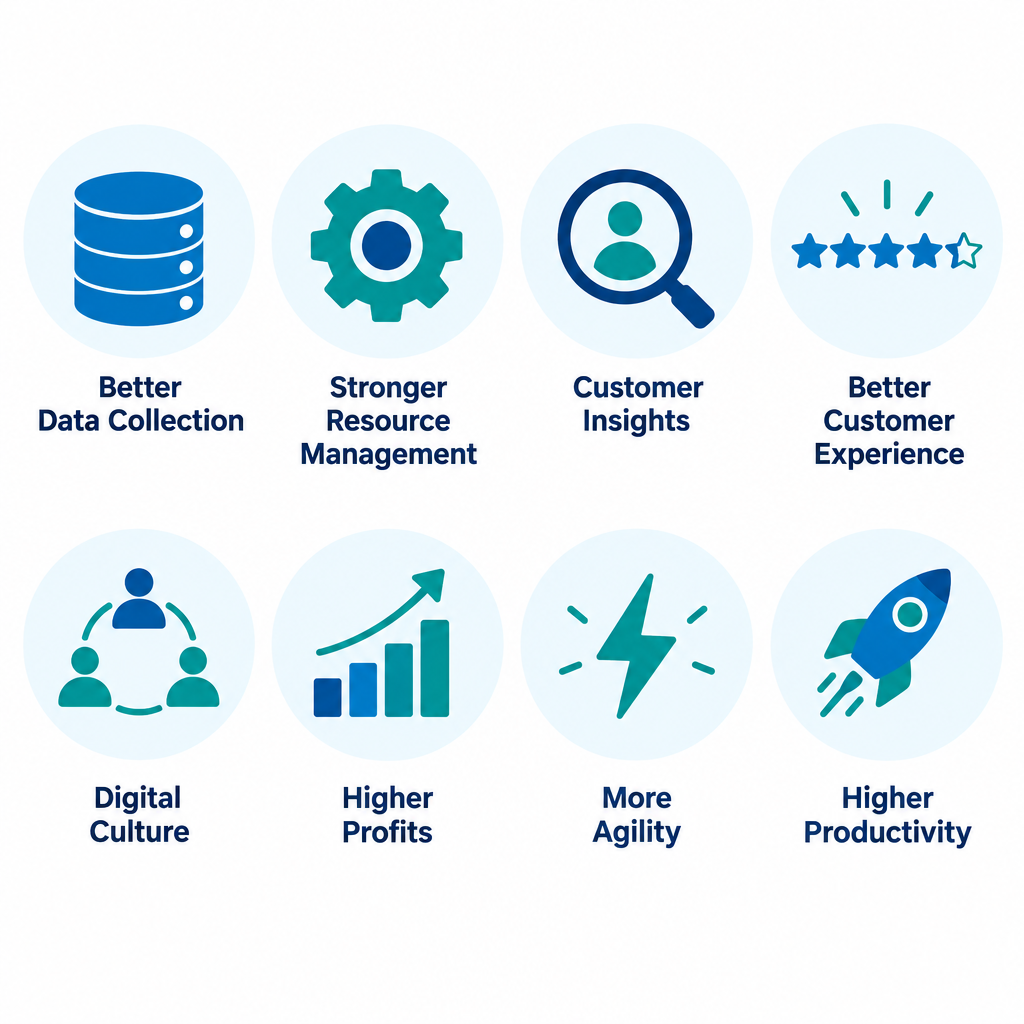
Digital transformation pays off in eight main ways: better data, tighter control of resources, sharper customer insight, a better customer experience, a stronger digital culture, higher profits, more agility and higher productivity. As of November 2026, the biggest gains still come from connecting the systems a business already has, not from buying more software. The average organization now runs 957 applications, and only 27% of them are connected. Start by linking and securing your data, then automate the work around it.
Digital transformation means building digital technology into every part of a business. It changes how the company runs at a basic level. Businesses in every sector feel the benefits: by modernising outdated processes, they can streamline workflows, strengthen security and raise profits.
Most businesses already work in the cloud. According to Flexera’s 2026 State of the Cloud Report, 73% of organizations run hybrid environments that mix public and private cloud. Much of the move to the cloud, though, is simply a digital copy of services that already existed. Real digital transformation goes further. It builds a technology framework that turns those services and data into useful insight, and that can reshape how the whole organization works.
So don’t just move data to the cloud. Use the change to re-examine your existing systems and processes. Make sure they work together and are flexible enough to deliver reliable business insight, so your company is ready for what comes next.
Why Digital Transformation Matters
Digital transformation changes how an organization operates. It touches systems, processes, workflows and culture. It reaches every level of the business, and it brings data from different departments together so teams can work better with each other.
With workflow automation and advanced processing such as artificial intelligence (AI) and machine learning (ML), businesses can connect the steps of the customer journey in ways that weren’t possible before. Generative AI and AI agents have sped this up. Flexera’s 2026 report found that generative AI use among public cloud services rose 8 points to 58%. MuleSoft’s 2026 Connectivity Benchmark Report adds a catch: organizations that have fully adopted AI agents manage even more applications, an average of 1,057. That makes connecting systems more important, not less.
The 8 Biggest Benefits of Digital Transformation
Here are the eight biggest benefits, explained one by one.
Cost is a major reason many businesses take this on. Moving data to a public, private or hybrid cloud lowers operating costs. It also cuts hardware and software spending, which frees team members to work on other projects. Savings are not automatic, though. Flexera’s 2026 report estimates that 29% of cloud spend is wasted, the first rise after five years of decline, so plan cost tracking from day one.
1. Better Data Collection
Most organisations collect huge amounts of customer data. The real value comes from preparing that data for analysis that moves the company forward. Digital transformation creates a system for gathering the right data and integrating it fully for higher-level business intelligence.
It gives different departments a way to turn raw data into insight across many touchpoints. The result is one unified view of operations, production, finances and business opportunities.
Think carefully about how customer data is gathered, stored, processed and shared along the way. When you redesign your IT stack, protect the sensitive data moving in and out of your customer relationship management (CRM) software and other platforms with SaaS data encryption.
As you map the customer journey, look at how you can give customers more control over their own data. Data privacy can be a competitive advantage. Customers pay more attention to how their data is collected and used, and they worry about it. Put strict privacy policies in place and let customers change their choices at any time. That shows them you value their data.
2. Stronger Resource Management
Digital transformation turns scattered information and resources into one set of business tools. Instead of separate software and databases, it consolidates company resources and reduces overlap between vendors. That matters because the sprawl is large. MuleSoft’s 2026 Connectivity Benchmark Report, based on a survey of 1,050 IT leaders, found the average organization manages 957 applications, up from 897 in the 2025 edition. Only 27% of them are connected. Integrating applications, databases and software creates a central store of business insight.
No single department or function owns digital transformation. It covers every part of a company and can bring new processes and efficiency across teams. Every department uses sensitive data, from sales and marketing to finance and the C-suite. Wherever that data moves, it has to be optimised and secured, and teams need simple tools to get their work done.
3. Data-Driven Customer Insights
Data unlocks customer insights. The better you understand your customers, the more you can build a business strategy around what they need. These insights can speed up growth by combining structured data, such as customer account details, with unstructured data, such as social media metrics. Benefits of ecommerce websites, such as round-the-clock sales and detailed purchase history, show this clearly: every order adds to what you know about your buyers.
Data helps you deliver content that is more relevant, more personal and more flexible. The Benefits of content marketing grow when you plan articles, emails and videos around what your customer data actually shows.
4. A Better Customer Experience
Think about how your digital transformation can raise team productivity and also give customers smoother, more intuitive experiences. That covers everything from user interfaces and digital products to email and how often you contact potential customers.
Customers expect a lot from digital interactions. They are used to wide choice, fair prices and fast delivery. Customer experience (CX) is now a main battleground for brands. In a 2018 Gartner survey, 81% of CX leaders said their companies would compete mostly or entirely on customer experience.
Showing customers that you respect their privacy is one way to stand out. Give people control over how their data is collected and used, and let them decide what happens to it.
5. A Stronger Digital Culture and Better Collaboration
Digital transformation builds a digital culture by giving team members the right tools for their work.
These tools make collaboration easier and move the whole organization’s transformation forward. This shift in culture is essential if a company wants to stay competitive over the long run. It also pushes team members to build new digital skills, which is how the company actually gets the benefits. Benefits of online education are a practical part of this: short online courses let staff learn new tools without long breaks from work.
6. Higher Profits
Businesses that go through digital transformation tend to become more productive and more profitable. A 2017 study by the SAP Center for Business Insight and Oxford Economics, which surveyed 3,100 executives, found:
- 80% of digital transformation leaders reported higher profits, compared with 53% of other companies.
- 85% said their market share had grown, compared with 41% of laggards.
- Leaders expected 23% more revenue growth than their competitors.
Keep in mind that this was a vendor-sponsored survey. It shows that leaders did better, not that transformation alone caused the gains.
7. More Agility
Digital transformation makes businesses more agile. By borrowing from software development, companies can get products to market faster and adopt Continuous Improvement (CI) methods. That creates a quicker environment for new ideas and change, and it opens the door to further progress.
8. Higher Productivity
The right tech tools combined with efficient workflows raise productivity. Automating repetitive tasks and connecting data across the whole company lets team members spend their time on more valuable work.
How Virtru Supports Digital Transformation
Digital transformation is changing how businesses operate. Better data collection and better customer experiences bring cost savings and higher profits, and the shift keeps growing. IDC once forecast that digital transformation would take 53% of all information and communication technology (ICT) investment by 2023. Its newer Worldwide Digital Transformation Spending Guide, from May 2024, projects spending of almost $4 trillion by 2027, with digital transformation making up about two-thirds of all ICT spending that year.
One of the main challenges is merging different systems into one workflow. Data security is a serious concern for companies, so data management and security rules have to be planned together.
Stricter regulations and heavy penalties for data loss have turned data protection from an IT chore into a core business task. Build a plan for protecting sensitive data into your digital transformation. Virtru is one vendor that focuses on keeping data protected at each step as it moves through new tools. Its pitch covers three points:
- Take control of your data right away and strengthen the security you already have.
- Protect data simply from the moment it is created.
- Collaborate with confidence while keeping full visibility and control.
People can keep working the way they’re used to while Virtru adds a layer of security. Virtru’s data protection works directly with tools many businesses already use, including Google Workspace (such as Gmail and Drive), Microsoft 365 (such as Outlook), Salesforce and Zendesk. Some of these integrations come only with higher plans or as add-ons, so check with Virtru which ones your plan includes.
FAQ
What is digital transformation in simple terms?
It means using digital technology in every part of a business to change how it works, not just copying old paper or on-premises processes into the cloud. Done well, it connects data, automates routine work and gives teams better information for decisions. It affects tools, processes and company culture.
What is the biggest benefit of digital transformation?
For most businesses, it is better use of data. Once systems are connected, every other benefit gets easier, from customer insight to productivity and profit. With only 27% of applications connected in the average organization, according to MuleSoft’s 2026 report, integration is usually the quickest win.
Does moving to the cloud save money?
Often, but not by default. Cloud services cut hardware costs, yet Flexera’s 2026 State of the Cloud Report estimates that 29% of cloud spend is wasted. Track usage from the start and switch off resources you don’t need.
How does AI fit into digital transformation?
AI and machine learning help businesses analyse data and automate tasks such as customer support, forecasting and document handling. They work best on clean, connected data, so integration and security still come first. Adding AI agents without that groundwork tends to increase app sprawl.
How long does digital transformation take?
There is no fixed timeline, because it is an ongoing change rather than a single project. Most companies start with one high-value area, such as customer data or a key workflow, and expand from there. Small, measurable steps make it easier to show results and keep staff on board.
Is digital transformation only for large companies?
No. Small businesses benefit from the same steps: moving to cloud apps, connecting their tools and automating repetitive tasks. They usually have fewer systems to connect, which can make the change faster and cheaper than it is for large enterprises.
Sources
- MuleSoft: 2026 Connectivity Benchmark Report insights
- Salesforce: MuleSoft 2025 Connectivity Report announcement
- Flexera: 2026 State of the Cloud Report
- IDC: Worldwide spending on digital transformation forecast to reach almost $4 trillion by 2027
- Gartner: Customer experience pyramid press release (2018)
- Virtru: SaaS application encryption